
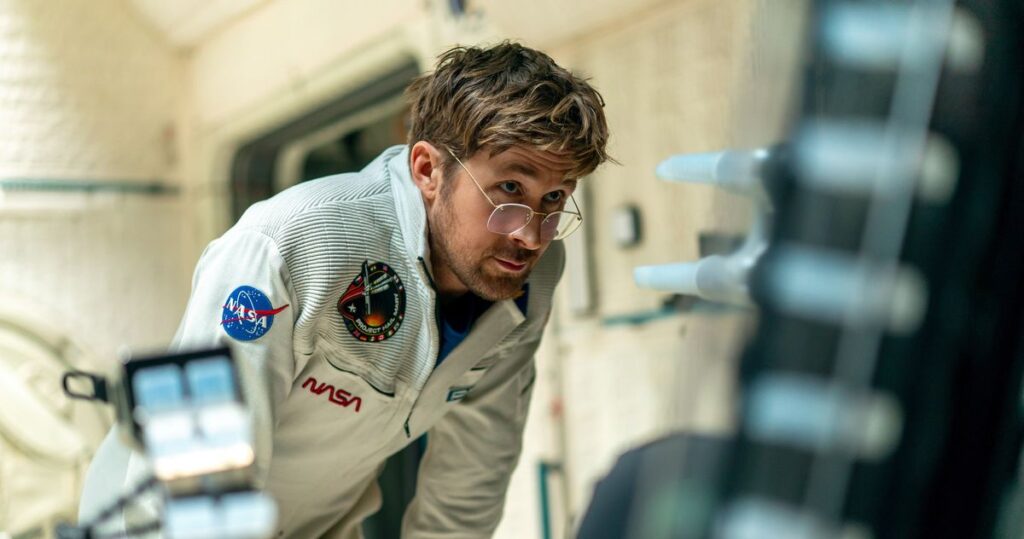
Photo: Jonathan Olley/Amazon MGM Studios/Everett Collection
This weekend, Project Hail Mary escaped multiple gravitational forces at the box office to blast off as the year’s biggest opening. Though non-sequel movies have a harder time putting butts in seats than franchises, and despite distributor Amazon MGM’s fairly crummy box-office track record, the PG-13 Ryan Gosling crowdpleaser sold $80.5 million worth of tickets, eclipsing prerelease financial estimates that predicted an opening tally of between $50 million and $65 million. That number comes in well above 2025’s previous record holder, Scream 7 ($64.1 million), as well as Amazon MGM’s opening-weekend high water mark with Creed III ($58.7 million) to approach the atom-splitting success of post-COVID’s top non-franchise earner — Christopher Nolan’s Oppenheimer, which took in $82.4 million in its first three days in 2023.
A cinematic love child of Interstellar, E.T., and 2015’s The Martian (which is also based on a best-selling novel by Andy Weir), Project Hail Mary stars Gosling as a high-school science teacher who finds himself involuntarily blasted into deepest space where he teams up with a nonverbal rock creature to combat a mysterious virus blotting out the sun. Overseas, the intergalactic epic pulled in an additional $60.4 million from 82 foreign markets for a cumulative gross of $140.9 million. Now, thanks to a raft of glowing reviews, sky-high audience exit-polling scores, and commensurate word-of-mouth buzz, Project Hail Mary is well on its way to recouping its $200 production budget (which does not include another $150 million or so in prints and advertising costs). It’s toppled F1: The Movie for the biggest opening for any film released by a streamer in North America. And even more auspicious for PHM’s longer-term playability: It doesn’t face significant competition among wide-release titles until Universal’s The Super Mario Galaxy Movie hits cineplexes on April Fool’s Day.
“Amazon did an incredible job marketing it,” says Shawn Robbins, Fandango’s director of movie analytics and founder of Box Office Theory. “This is by far their biggest launch. They are better known as a streamer. But this is the best example of the power they can wield as a theatrical distributor.”
PHM’s success comes at a make-or-break moment for Jeff Bezos’s Hollywood money pit, which has spent both extravagantly and quixotically over its 16 years of existence in a bid to become a major purveyor of theatrical hits. Less than four years removed from Amazon’s $8.5 billion acquisition of MGM, and one year and one month since finally assuming full creative control over that studio’s crown jewel IP — the James Bond franchise — Amazon MGM is rolling out a jam-packed 2026 roster. Chief among this year’s 14 titles that Amazon execs like to call “big, bold, cinematic, global films”: Masters of the Universe (based on Mattel’s looksmaxxer-coded He-Man toys; scheduled for release on June 5), Jack Ryan: Ghost War (with John Krasinski making the jump from the Amazon Prime Video series to a stand-alone film as Tom Clancy’s most famous CIA operative; May 20), and Madden (the ever-riseable auteur David O. Russell directs Nicolas Cage in a biopic about stentorian football coach-cum-commentator John Madden; November 26).
But outside Project Hail Mary, Amazon’s 2026 has gotten off to a creaky start. In January, its Chris Pratt–Rebecca Ferguson sci-fi detective caper, Mercy, debuted to a certified-rotten score on the Tomatometer and slunk from theaters after earning just $54.5 million against a reported $60 million production budget. Amazon followed that up one week later with a 1,500-screen rollout of the First Lady doc Melania: Twenty Days to History. It ended up taking in a relatively robust (for the moribund theatrical-documentary genre) $16 million but failed to claw back the $75 million in distribution and marketing fees Amazon shelled out for the “outright bribe” vanity hagiography. And last month’s Chris Hemsworth–starring heist-thriller Crime 101 sold a mere $65 million worth of tickets (versus a $90 million budget) to rank as the year’s first major flop.
So what did Amazon do right with Project Hail Mary? “From day one they treated this as a very important tentpole on their slate,” Robbins says. “They started by showcasing it at Cinemacon last year. The trailer released online last summer, so they got a massive head start on getting word out about the film. On top of the preexisting fan base for Andy Weir’s novel, the snowball kept rolling into this incredible momentum of buzz. And I’m sure advertising across their Prime and streaming channels didn’t hurt either.”
Even more surprising: Despite outsize blockbusters in the genre like certain Star Wars installments, Star Trek reboots and Christopher Nolan flights of inter-dimensional fancy like Interstellar or Inception, sci-fi films are not consistent moneymakers. “This is a sensational opening for a science-fiction adventure,” analyst David A. Gross notes in his FranchiseRE movie-industry newsletter. “Novelist Andy Weir wrote the story as a standalone, but the weekend figure is more than double the average for a series launch — that’s how strong this is. Critics reviews and audience scores are outstanding (an A CinemaScore). This is Amazon MGM’s first big hit.”
Sign up for the Vulture Daily
An entertainment newsletter for the pop-culture obsessed.
Vox Media, LLC Terms and Privacy Notice