
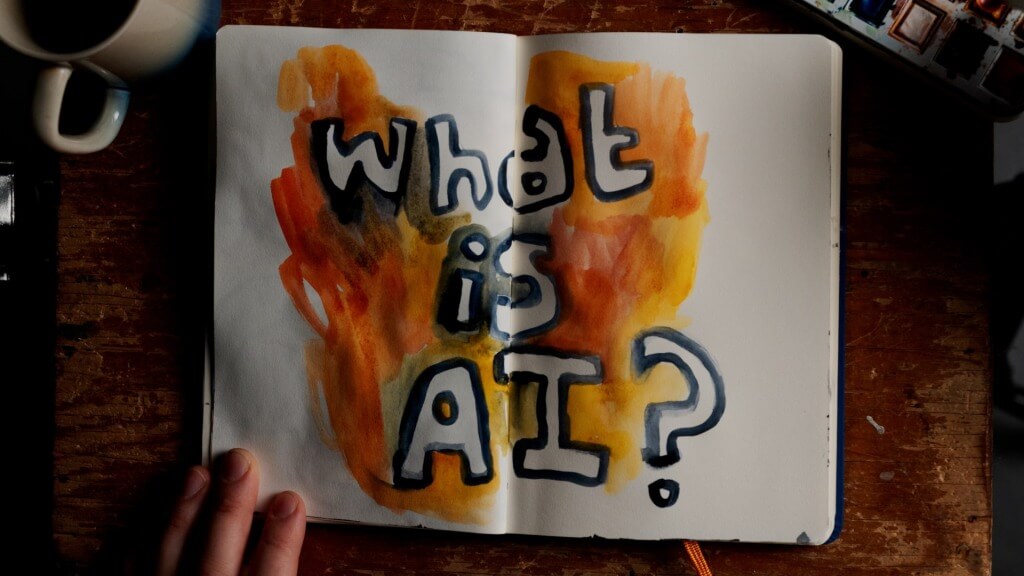
Where many documentaries seeking to wrestle with the ever-evolving place that artificial intelligence has in our society narrow their scope to focus on a particular use of AI that will have some impact on a ubiquitous part of human life—like death, or love, or trying to interview Sam Altman—The AI Doc: How I Became An Apocaloptimist, in keeping with its title, goes so broad as to be meaningless. Co-directed by Daniel Roher (Navalny), whose self-described “hopelessly naïve” anxieties around AI and his looming fatherhood fuel the film’s inquiries, and Charlie Tyrell, The AI Doc is a dull, multi-chapter series of talking heads and twee animations, a film where professional interview subjects argue over the flavor of Kool-Aid they’ve ingested. Is AI a world-ender? Or a world-saver? The only certainty here is that it’s one of those two.
Resigned doomerism or breathless accelerationism—there is no in-between or third option in The AI Doc, an especially ironic position as signs of weakness (like OpenAI’s shuttering of Sora) abound. Despite the film’s initial protestations and weak finale, it is a true believer in the monolithic power of that technological catchall currently appended to each new business plan and start-up: AI. Though it includes a brief foray into machine learning and pattern recognition, this light technical explanation is moved on from quickly, so as not to distract from the larger-than-life forces the film believes are in play. Roher admits that he conceives of AI as a “magical computer box,” and the rotating cast of experts he brings in do little to dissuade him from this Oz-like understanding.
This is partially because The AI Doc, in its desire to be a large-scale moral grappling with its ill-defined buzzword and the inevitable life-changing impact it believes it will have on our future, draws no difference between, say, generative AI and directed machine learning—no difference between a faked video of Martin Luther King Jr. declaring that he doesn’t actually have a dream, and computational models predicting the structure of proteins. There is just “AI,” with intertwined consequences both good and bad. Presenting it as a monolith, whose power is unavoidable and looming and impossible to understand, undermines any attempts at being an AI 101 film for, let’s just say it, old people looking to learn about AI at the movie theater. By the end of the film, The AI Doc comes across as someone who consumed too many conflicting TED Talks and decided to make one of his own to assuage the cognitive dissonance.
The chapters of The AI Doc focus on four main viewpoints:
• We are well on our way to an artificial superintelligence that will exterminate humanity—yikes!
• We are well on our way to an artificial superintelligence that will solve all our problems—hooray!
• I am a tech CEO doing a very good job, if I do say so myself, as my company hurtles recklessly towards some indefinite endgame (which, fingers crossed, is an artificial superintelligence).
• We should probably try to put some regulations in place before an artificial superintelligence is upon us.
These perspectives are siloed off, presented in order, bolstered by Fox News clips and scare quotes, mimicking the malleable opinions of the filmmaker listening to these ideas. Opposed to other recent, credulous AI documentaries with little access to the actual players in the industry, The AI Doc at least boasts the presence of a few leading figures. OpenAI’s Sam Altman and Anthropic’s Dario and Daniela Amodei pop their heads in to drop some instantly ironic commentary about their desires for safety and caution—at least Roher gets some reassurance from them about the future of his own child, who probably won’t be bombed by Anthropic’s Claude like the few hundred Iranian schoolgirls murdered less than a month before this film’s wide release. And don’t forget about Altman, whose cute bonding over also being an expectant father is undermined by the audience’s knowledge that OpenAI has recently agreed to work with the government to surveil its citizens. This industry is so volatile that in the week between The AI Doc‘s SXSW screening and its wide release in theaters, OpenAI lost a billion-dollar deal with Disney.
This immediate and garish outdatedness, inherent to any fast-evolving and unregulated industry, is accompanied by something unique to this film and others focused on AI: a stunted curiosity satisfied with its own ignorance, happier to heap more of the hype (either positive or negative) endemic to an industry than to ask probing questions. Because The AI Doc is more about sensibilities—pessimism versus optimism—than facts, it engages more with the conversation around its subject than its subject matter itself. This always comes across as a particularly condescending attempt at being a stand-in for the film’s assumed audience of yokels who fear and respect the strange new things springing from the almighty computer.
The result is a documentary that believes in moderation but not complexity, simplicity but not understanding. In dividing artificial intelligence not by its practical uses, but by larger, almost mythic designations of good AI and evil AI, the film’s approach is one of awe-induced fear. Its conclusions naturally follow; when faced with incomprehensible omnipotence, what can one do? Like a Lovecraftian protagonist left gibbering in the wake of a non-Euclidian encounter, Roher (and most of the people he speaks to) dribble ineffectual platitudes as meaningless as the term “apocaloptimist.” It’s about what you’d expect to get when you ask people about the future but refrain from addressing the present, the vague words of a fortune teller who’s been at it so long they’ve started to believe their own predictions.