
Gingham dresses, linen aprons; toddlers smiling toothily out from their perch on a perfectly cocked hip. And the mothers holding these babies? They’re beautiful, obviously. They speak in a whisper. Their skin tone is varied in the exact range and spectrum of honey.
Tradwife. It’s a frilly word, the kind that holds a gun to your head and demands you say it in sing-song. The media coverage of the phenomenon has been as breathless and decidedly feminised as the term itself. I have yet to find an article on the topic that was not written by a woman, which feels ironic, given that the term – as well as the vision therein – was originally coined and circulated by men, born out of the dank, murky caves of online “incel” forums, where anonymous usernames set forth the deeply unoriginal vision of a wife who would do everything the real women in their lives refused to do: manage the house, give birth to children, have sex on command, and most importantly, ask nothing in return.
Most people don’t know about these grubby origins, though. Instead, they associate tradwife with the day-bright social media presence of influencers like Hannah Neeleman and Nara Smith, two women who have managed to balloon their pre-existing wealth into eight-figure empires by broadcasting home births and making cereal and bubblegum from scratch while dressed in couture.
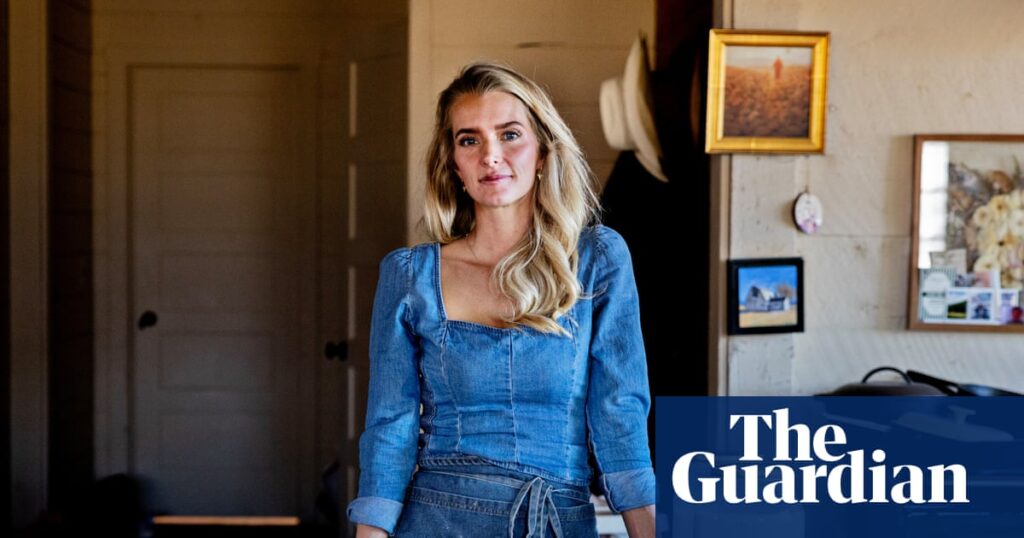
In the two years since tradwives burst on to the scene, I’ve had countless conversations about them – first as a member of the media, speaking with experts; then as a debut author, speaking to members of the publishing and film industries about the world I have created in my novel Yesteryear, which is being made into a film by Anne Hathaway, about a tradwife who wakes up in the past. In those conversations, one question has been posed to me more than any others: How long will this cultural trend last?
I understand the sentiment. Only a decade ago, you couldn’t open an app or turn on a television channel without witnessing some form of vehement resistance to regressive gender and racial politics. There’s no greater symbol of this time than The Handmaid’s Tale, Margaret Atwood’s 1985 dystopian novel that prophesied a world where women became slaves to procreation. Following the election that handed Donald Trump his first term, the book surged in popularity, and would eventually sell 3m copies over the next two years.
double quotation markIf the handmaid was imagined to serve as a warning, and adopted by the resistance, the tradwife was designed as a blueprint by the oppressor
Unsurprisingly, a television adaptation followed, and it became common for women to dress in the handmaid’s garb for protests, wearing a blood-red cloak and a white headdress.
From a certain angle, the tradwife and the handmaid might appear to operate like a pair of chronological iPhone models. Within the tradwife, you see all the essential coding of the handmaid, but with a significant software upgrade: she’s programmed not just to submit, but to consent to her own submission. Where this metaphor falls short is when you consider the source of creation: if the handmaid was imagined to serve as a warning, and adopted by the resistance, the tradwife was designed as a blueprint by the oppressor. And perhaps because of this distinction, the mainstream liberal movement has been unable to subvert the image of the tradwife.
In 2026, there is no coherent symbol of feminist resistance. There was no Women’s March on the day of Trump’s second inauguration. At protests against the administration, the handmaid costume is still present, but her power is significantly diminished. The only accessory protesters wear these days that conveys any tone of seriousness are heavy-duty chemical face masks, designed to counter the onslaught of teargas disseminated from hooded men who stalk the perimeters of elementary schools, hospitals and churches on the days when they aren’t busy calling women bitches and shooting them dead.
The escalation in gendered violence over these last few months has served as a grim reminder of the laws of narrative propulsion, famously espoused by Anton Chekhov: if a gun is onstage at the beginning of a play, it must necessarily go off by the end. Similarly, you do not reimagine a political party under which women exist only to please men if you do not eventually plan to use that party to extinguish the voices and lives of the women who dare suggest an alternative. From this angle, the birth of the tradwife could be seen as a quite literal gun to the head. One would not create and become obsessed with a fake woman if they did not already wish the real ones were dead.
double quotation markThe tradwife is an advertisement, a curated performance of womanhood with a link in bio for purchases
This is not the direction I’m meant to go in when I talk about my novel or the legacy of the tradwife. I’m meant to focus instead on the rise of milkmaid fashion, the proliferation of handkerchief headbands at Target, the sociopolitical implications of the apron-heavy spring Miu Miu line. I’m meant to talk about those consequences of “the tradwife obsession” that we are reasonably capable of stomaching. I know this because when, in response to a question about my novel, I try to talk about Renee Good, who was shot dead by ICE agents, I am gently encouraged to pivot, or alternatively reminded that what I’m saying is a bit of a stretch, and this makes me feel crazy.
I’m not crazy. It’s not a stretch.
The tradwife, like the 1950s housewife, is not a real person. She is not a trend, or a cultural obsession. She is an advertisement, a curated performance of womanhood with a link in bio for purchases, who has shown up, like a 1950s advertisement, to remind women of their true purpose: serve, smile, procreate and purchase.
The tradwife did not “become popular” at a time when women were, as so many have claimed, at a breaking point in trying to manage their work and personal lives. The tradwife came after the women had already been broken. By the time Nara Smith was making homemade bubblegum in couture, and Hannah Neeleman was competing in a pageant 12 days after her eighth birth, the wage gap had been stalled since 2002, and the childcare crisis, which had been quietly bleeding women for decades, shifted into full hemorrhage: in 2025, more than 450,000 women dropped out of the US labour workforce, marking the steepest decline in any year on record (by comparison, men entered the workforce more than women at a rate of 3:1). The number one answer given by women in countless polls for why they left their job? Caregiving responsibilities. They had no choice.
This is where we see the true aims of this movement, if a rudderless propaganda campaign – orchestrated only by our collective ability to hear a dog-whistle and find the sound attractive – can be considered a movement with aims. The purpose was never for more women to like the idea of tradwives, or for anyone to choose to become one. No, the purpose was to remind women that there is, in fact, an ideal way to relent to your own disappearance: with silence and a smile.
I suppose that’s why I wrote my novel. I figured if I couldn’t subvert the image of a tradwife, then I could subvert her world instead – and see how long it takes before she starts to scream.
Yesteryear by Caro Claire Burke is published by 4th Estate on 9 April. To support the Guardian order your copy at guardianbookshop.com. Delivery charges may apply.