
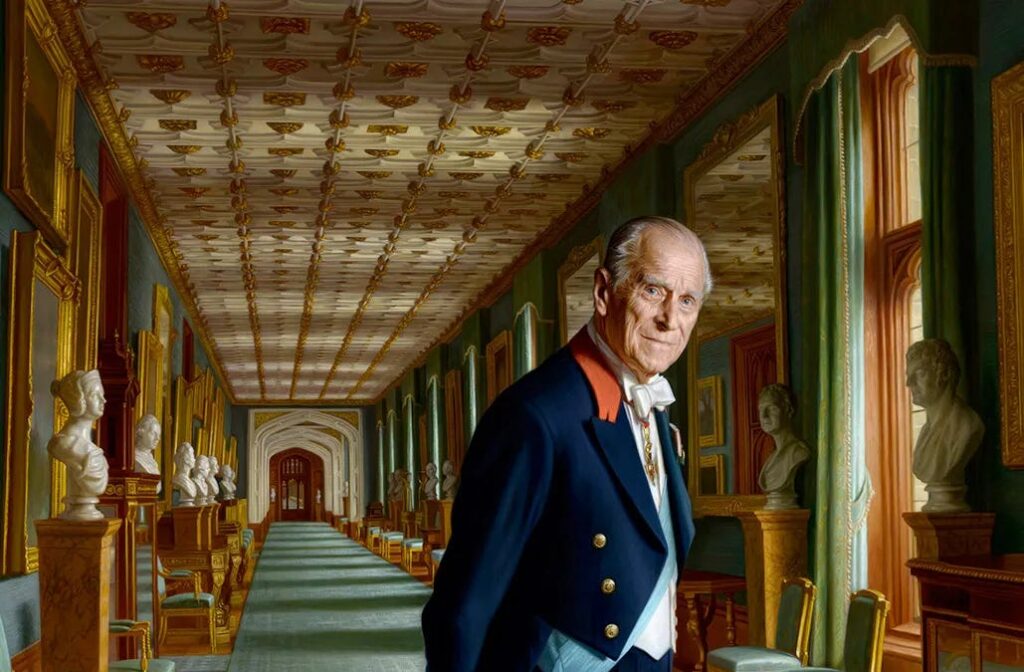
 The final official portrait of Prince Philip, the Duke of Edinburgh, in the Grand Corridor at Windsor Castle, by Ralph Heimans, 2017
April 9th will mark the fifth anniversary of the death of Prince Philip, the Duke of Edinburgh, at age 99 in Windsor Castle. On April 10th, 2021, a somber Prince of Wales, his eldest son, stood in front of his home at Highgrove and paid tribute to his “dear Papa.” As Philip often did, Charles made his brief televised remarks without notes and called his father a “much loved an appreciated figure” who “would have been amazed by the reaction and touching things that have been said about him…My family and I miss my father enormously.”
In these politically riven times, Prince Philip’s selfless life seems even more remarkable today than it did five years ago. He made myriad contributions to Great Britain and in Commonwealth countries around the world—as an environmentalist, naturalist, sportsman, decorated Royal Navy officer, and all-round modernizer. Among his hobbies, he was a polo player, competitive carriage driver, and ornithologist. He flew helicopters as well as airplanes. His most famous achievement was his Duke of Edinburgh Award that for more than 65 years under his patronage honored 6.7 million young people for meeting physical challenges and performing community service.
He had strong views and a searching intellect, and he promoted health and fitness as avidly as he sought interfaith dialogue. He was the author of nine books including explorations of religion and philosophy, science and morality. His impressive library in Buckingham Palace contained more than 11,000 books—predictably over 1,000 volumes on wildlife and conservation and some 600 on equestrian pursuits, but also more than 200 books of poetry and, perhaps most surprisingly, nearly 1,000 books on art.
No illusions about being a studio artist
It is that quiet and private artistic inclination, both as a painter and a collector, that I think deserves more attention as we reflect on the multi-faceted man behind Philip’s restless and sometimes brusque persona. Philip had no illusions about being a studio artist. He thought of himself as nothing more than a happy amateur. He influenced his eldest son to take up painting, although their styles could not be more different: the father in assertive oils, the present king in delicate watercolors. Philip was as sensitive as Charles, but he hid his emotions behind a rugged carapace.