
Top Gun Maverick was not a comeback. Forget the $1.49 billion global box office, forget the standing ovations at Cannes. Forget the thirty-six-year gap between sequels that should have killed it. None of that is the actual story.
The actual story is simpler and worse. Top Gun Maverick proved that exactly one person on earth can still do the thing Hollywood used to mass-produce. Furthermore, it proved that when that person stops, the assembly line stops with him. Tom Cruise did not save the movie star. He performed its autopsy while the body was still warm.
 Tom Cruise Final Reckoning Plane Stunt
Consider the evidence. The film earned more than any Cruise project in history. Notably, it did so by selling the most analog proposition in modern entertainment: a human face, doing a real thing, in a real machine, photographed without digital trickery. Meanwhile, every Marvel film released that same year underperformed expectations. The market spoke clearly. Audiences wanted the old thing. They just could not find anyone else selling it.
This hub explores four careers shaped by that extinction event. Tom Cruise is the last specimen. Glen Powell is the attempted successor. Miles Teller is the cautionary photo negative. And Jennifer Connelly is the ghost who returned to prove what the industry discards when it decides a woman has aged past usefulness.
Tom Cruise Built the Infrastructure of Permanent Stardom
 tom_cruise_best_movies_collage
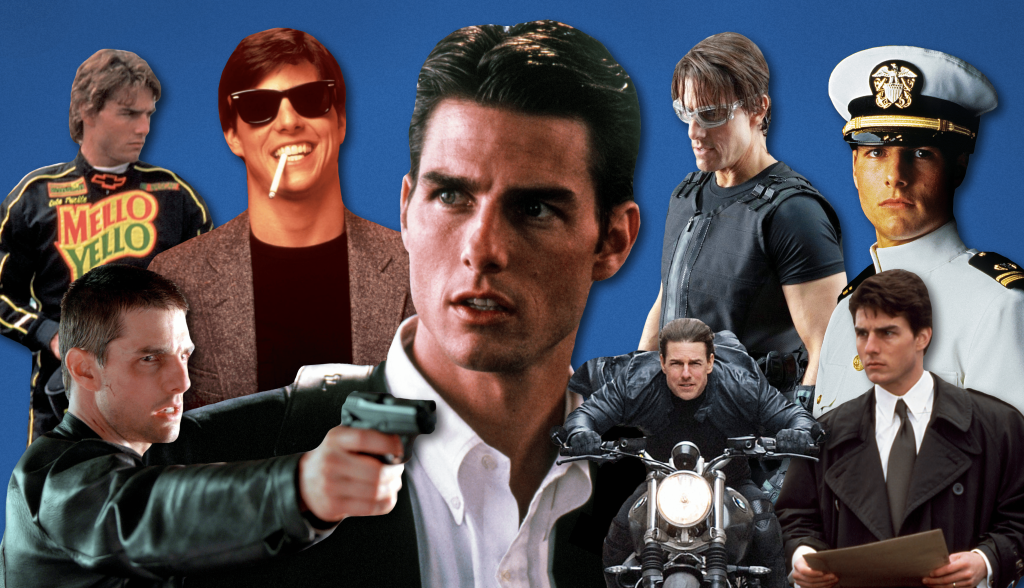
The Top Gun Maverick movie star question starts and ends with Cruise. Not because he is the most talented actor of his generation. He might not crack the top ten. The point is irrelevant. Talent is not what makes a movie star. Commitment is.
Cruise organized his entire existence — physical, financial, contractual — around a single project: remaining the last classical movie star in an era actively deleting that job description. His production company controls the pipeline. His backend deals guarantee alignment between his effort and his compensation. A physical training regimen that would hospitalize most professional athletes keeps the machine running. According to Box Office Mojo, Maverick’s domestic haul exceeded $718 million worldwide in its initial run, making it Paramount’s highest-grossing film domestically at the time.
Consequently, his net worth is not a fortune. It is a war chest. Every dollar exists to fund the continuation of a performance that began in 1983 and has never once broken character. Most billionaires use wealth to buy freedom from work. Cruise uses wealth to buy the ability to keep working at an increasingly superhuman pitch. The money serves the mission. The mission is the money.
Additionally, Cruise solved a problem no other actor has even attempted. He made the promotional circuit part of the performance itself. Watch him on a press tour. He does not promote the film. He is the film. The enthusiasm is not fake. It is simply so total, so committed, so relentless that it crosses the line from personality into athletics. He is performing the role of “person who cares about this movie more than any human has ever cared about anything” — and he is doing it at a level no one can match because no one else is willing to pay the price.
Glen Powell Waited a Decade for a Door That Barely Exists
 glen-powell-top-gun-maverick
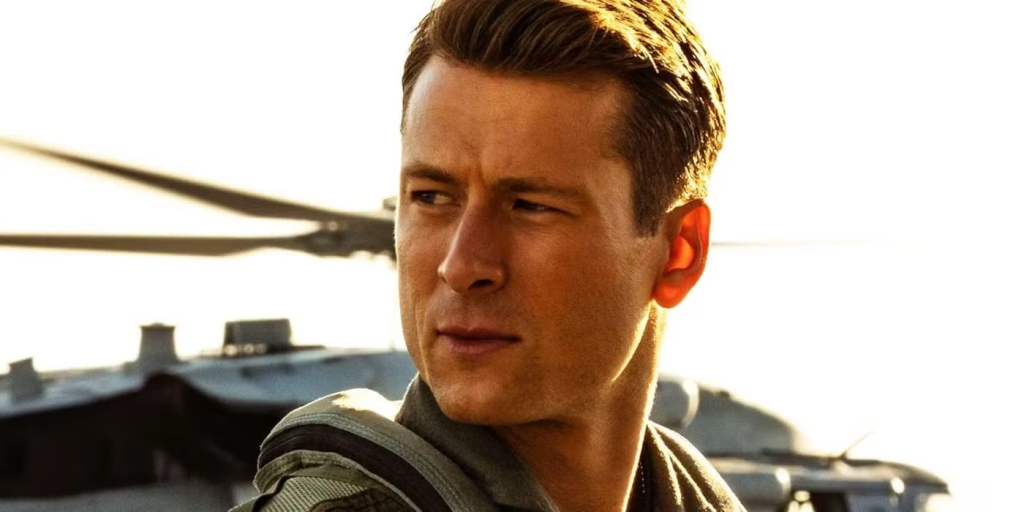
Powell’s trajectory tells you everything about why the Top Gun Maverick movie star archetype cannot be replicated. The man did every single thing right. Trained. Networked. Took small roles and nailed them. The jawline was there, the charm was there, the Texas origin story was there. For ten years, absolutely nothing happened.
Then Maverick cast him as Hangman. Anyone But You turned him into a rom-com draw. Hit Man proved he could act. Suddenly, at 35, industry coverage anointed him “the next big thing.” By contrast, Cruise was the biggest star in the world at 24. The gap is not about talent. It is about the star-making machinery itself.
That machinery broke sometime around 2015, when streaming atomized audiences and superhero franchises made characters more bankable than actors. McKinsey research noted the structural shift: studios began valuing intellectual property over individual star power. Powell did not break through the wall. The wall simply developed a crack, and he happened to be standing in the right spot.
His current position is therefore fascinating and precarious. He is trying to become a thing that might not exist anymore. Every project is a test of whether the audience wants him or just wants the idea of a leading man — any leading man — because they miss having one. The distinction matters enormously. One path leads to a career. The other leads to a placeholder.
Miles Teller Proved That Friction Used to Be Called Charisma
 Miles Teller Music Top Gun
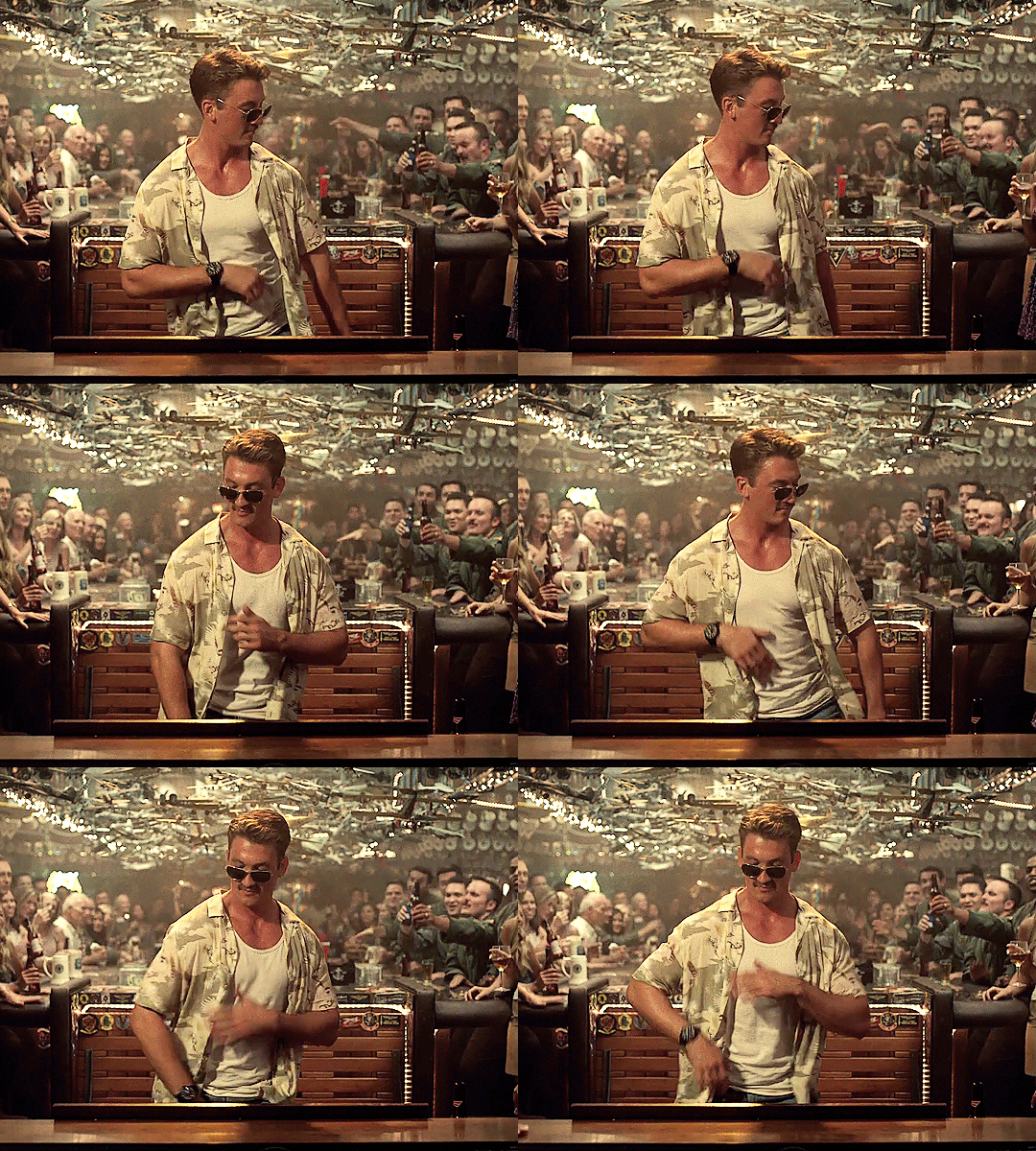
Teller arrived first. He got the prestige breakout first — Whiplash remains one of the decade’s finest performances. He got the tabloid attention first. The franchise shot came first too, even if Fantastic Four nearly buried him. By every traditional metric, Teller should have owned the lane Powell now occupies.
Instead, the lane slid sideways. Ultimately, the question is whether that happened because of choices, persona, or something more structural about how the 2020s process male actors. Powell is frictionless. Audiences root for him immediately, instinctively, without effort. Teller makes you work for it. He carries a slight edge, a hint of difficulty, a suggestion that charm is something he can deploy rather than something he cannot help.
In a previous era, that friction was called charisma. Nicholson had it. McQueen had it. Newman weaponized it. The new economy prefers accessibility over intensity. McKinsey research on media consumption patterns confirms the trend: audiences increasingly gravitate toward content — and performers — that reduce cognitive load rather than increase it. Teller increases it. That used to be a feature. Now it reads as a bug.
His Maverick role was perfectly calibrated. Rooster gave him vulnerability without softness, intensity without alienation. The film knew exactly how to use him. The open question is whether any other project will figure out the same formula, or whether Teller remains permanently positioned as the actor America respects but does not quite want to love.
Jennifer Connelly Survived the Thing Nobody Discusses Honestly
 Jennifer Connelly Beautiful Mind
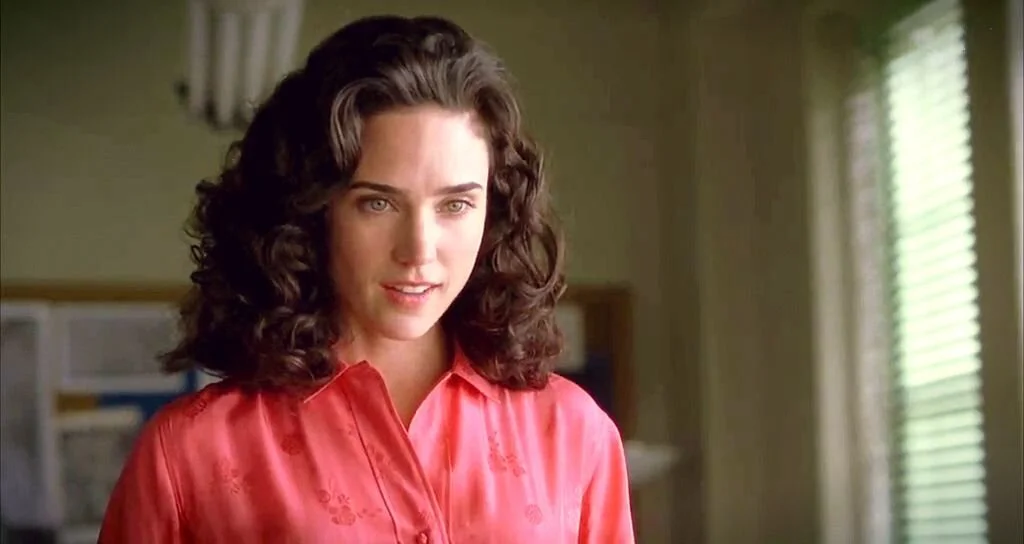
Connelly’s presence in Maverick illuminated the most uncomfortable structural truth in Hollywood. She won an Academy Award for A Beautiful Mind in 2002. She gave one of the best performances of that year, arguably that decade. Then she functionally disappeared from major studio filmmaking for nearly twenty years.
The industry did not reject her talent. It simply stopped having a use for her talent once it could no longer package it alongside the thing it primarily valued: youth plus beauty. This is not a secret. Everybody in Hollywood knows it operates this way. Nobody says it plainly because saying it plainly would require acknowledging that the system treats female actors as depreciating assets with a known shelf life.
Connelly’s Maverick return disrupted that calculus. Audiences responded to her immediately. Critics noted her presence with genuine surprise — as though a woman who won an Oscar might somehow have forgotten how to act during the intervening decades. She had not forgotten anything. The system had simply looked away, and Maverick forced it to look back.
Her career arc therefore serves as the cleanest test case for a broader phenomenon. Male movie stars age into authority. Female movie stars age into invisibility. Cruise, at 60, was celebrated for doing the same thing he did at 25. Connelly, at 51, was celebrated for still being able to do it — a framing that contains its own quiet brutality. As Bain & Company research on entertainment economics has demonstrated, the industry’s structural biases are not incidental to its business model. They are the business model.
Why the Top Gun Maverick Movie Star Dies When Cruise Stops Running
 Tom Cruise Mission Impossible
The Top Gun Maverick movie star question has a simple answer that the industry refuses to accept. The species is already extinct. Cruise is not its savior. He is its last living example, preserved through sheer force of will and an annual training budget that exceeds the GDP of small nations.
When he stops — and he will stop, because biology eventually vetoes even the most committed performer — nobody replaces him. Not because Powell lacks talent or Teller lacks intensity or Connelly lacks durability. Because the ecosystem that produced classical movie stardom no longer exists. Streaming killed the monoculture. Franchises killed the star vehicle. Social media killed the mystique. What remains is a handful of famous people and an audience that remembers, dimly, what it felt like when fame and cinema were the same thing.
Maverick earned $1.49 billion not because movies are back. Maverick earned $1.49 billion because one man refused to let them leave. The distinction is the entire story. Additionally, the Barbenheimer phenomenon that same era confirmed the pattern: event cinema survives, but only as performance, as meme, as a thing you attend rather than simply watch.
The theater lights will stay on. The projectors will keep running. Somebody will always sit in the dark and watch something enormous move across the screen. However, the particular magic of one human face justifying the price of admission, the way Cruise’s face justified it — that magic required a world we no longer live in. Top Gun Maverick was its most spectacular demonstration. It was also, almost certainly, its last.
Related Reading
You Already Know What Comes Next
There is a version of this story you read everywhere. The safe version. The version where every celebrity profile is a press release with adjectives and every lifestyle feature reads like it was written by a committee afraid of its own shadow. That version is comfortable. It is also forgettable. Social Life Magazine does not publish that version.
If you have a story worth telling — a brand worth positioning, a launch worth amplifying, a personal narrative that deserves more than a templated feature — reach out to our editorial team. We build features that move needles, not fill pages.
Want guaranteed placement and full creative control? Submit a Paid Feature and let our team craft a profile that positions you exactly where you belong.
Join 82,000 insiders who get our editorial picks, event invites, and luxury lifestyle intelligence before anyone else. Subscribe to the Social Life email list and stop being the last to know.
Polo Hamptons returns this summer with the most exclusive brand activations and VIP experiences on the East End. Sponsorships, cabanas, and guest lists are filling now. Visit polohamptons.com before the field closes.
Get Social Life Magazine delivered — five summer issues from Memorial Day to Labor Day, plus Fall and Winter editions. Subscribe to the print edition and own the only magazine the Hamptons actually reads.
If this kind of writing — the kind that treats a Top Gun Maverick movie star essay with the same rigor as a portfolio thesis — adds value to your week, consider a $5 contribution to keep independent luxury journalism alive. No paywall. No algorithm. Just work that respects your intelligence.