
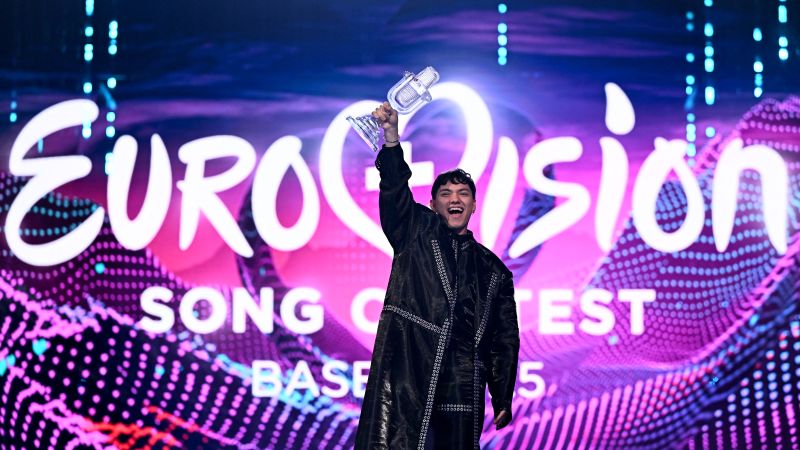
The world-famous TV pop spectacle known as much for its elaborate costumes and theatrical performances as it is for its political controversies is setting up stage on a new continent.
The Eurovision Song Contest is coming to Asia in 2026, with the Grand Final for the regional off shoot of the competition set to be hosted in Bangkok, Thailand on November 14.
Ten nations, including K-pop giant South Korea, the Philippines, Malaysia and Laos are set to compete in the inaugural competition, with more participants to be announced in the coming months, according to the contest’s website.
Eurovision, which started in 1956, is a famously eccentric festival in which artists from dozens of countries battle for the annual musical crown. It has long been centered in Europe although in recent years has begun to welcome participants outside the continent.
A broadcaster in each of the participating countries picks an artist to perform an original song, no longer than three minutes, to perform live on stage. The winners are decided by a combination of professional juries and public votes. The caveat is jurors and audiences at home are not allowed to vote for their own country; geopolitical affinities or rivalries often supersede talent.
Martin Green, Director of the Eurovision Song Contest at the European Broadcasting Union, the main organizer of the contest, said the Asian edition will reflect the “voices, identities and ambitions of the region.”
“As we mark the 70th anniversary of the Eurovision Song Contest, it feels especially meaningful to open this next chapter with Asia, a region rich in culture, creativity and talent,” Green said in a statement.
The European edition draws more than 150 million viewers globally and has skyrocketed the careers of artists such as ABBA, Celine Dion, and Olivia Newton-John.
The contest’s grand final is a defining event on the LGBTQ+ calendar and attracts interest across the continent, showcasing some of Europe’s most talented, eccentric and varied performers.
But in recent years, the glittering spectacle, meant to celebrate unity, has been overshadowed by global conflicts which have seeped onto the stage. Russia has been banned from the competition since it invaded Ukraine in 2022 and now runs its own rival version of the contest.
Several countries, including Spain, Ireland, Slovenia, Iceland and the Netherlands, are boycotting this year’s primary event — to be held in Vienna in May — after organizers allowed Israel to participate despite calls to ban the country over the war in Gaza.
Spain is one of the so-called Big Five — along with the UK, France, Italy and Germany — who contribute the most financially to the contest and get an automatic pass to the final.
Members of the European Broadcasting Union (EBU), the main organizer of Eurovision, introduced new rules this year designed to improve neutrality and limit governments from disproportionately influencing voting.
Last year, Austrian singer JJ clinched the trophy with his operatic pop anthem “Wasted Love.” Israel’s Yuval Raphael, a survivor of Hamas’s October 7 attacks, came second with her performance of “New Day Will Rise.”