
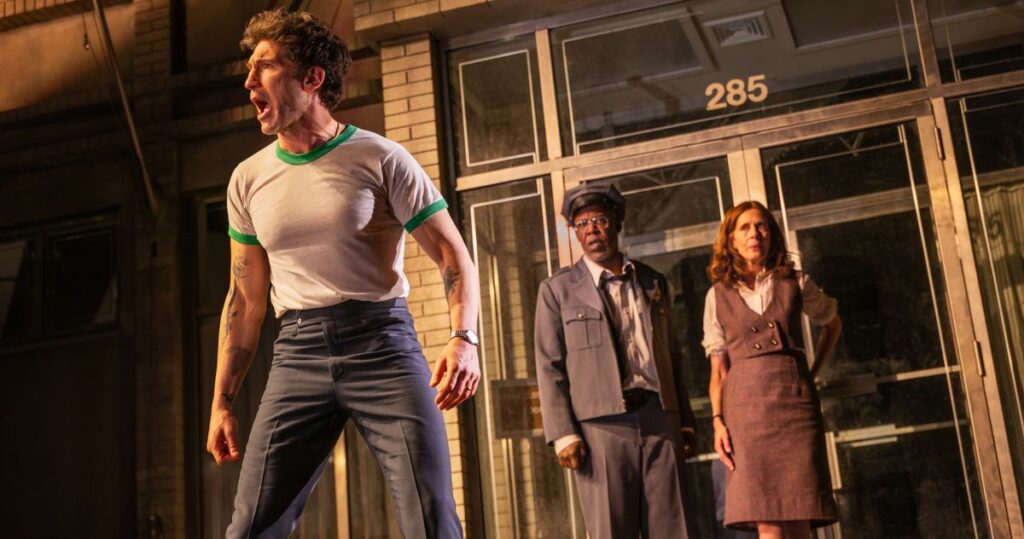
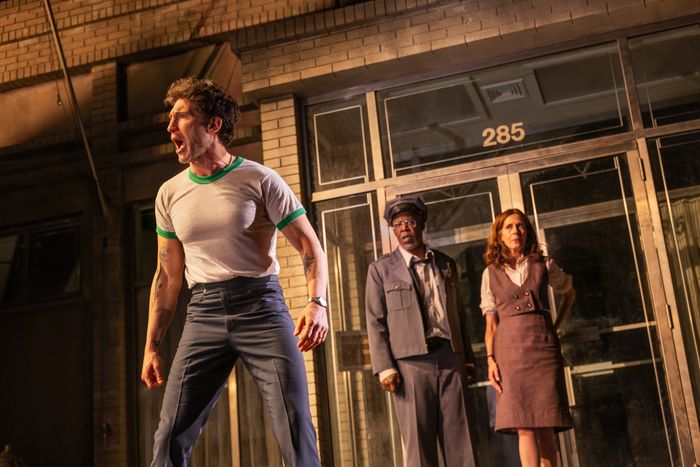
Jon Bernthal, Danny Johnson, and Jessica Hecht in Dog Day Afternoon, at the August Wilson.
Photo: Matthew Murphy
It’s probably best to walk into the new Broadway production of Dog Day Afternoon without clutching the 1975 movie too tightly in your fists. As a piece of filmmaking, Sidney Lumet’s affectingly tender true-crime classic is everything it wants to be: a wry, tragicomic character study, a sweaty slice of New York life during the Nixon years, an astute yet subtle political commentary. The faces of Al Pacino and John Cazale are unmistakable — Pacino’s eyelashes, Cazale’s tundra of a forehead, their little-boyishness in close-up, the anxiety and melancholy in their eyes. Frank Pierson’s Oscar-winning screenplay (based on the 1972 Life magazine article about the real bungled bank robbery attempted by John Wojtowicz and Salvatore Naturile in August of that year) is sensitive and succinct, leaving plenty of room for Lumet’s camera to do its work. Lumet, for his part, is a master at the height of his form.
Bring too much of that hyperspecific tone along with you to the August Wilson Theatre, and comparison may indeed prove the thief of joy. But let Stephen Adly Guirgis’s play introduce itself on its own terms, with its firm, enthusiastic handshake and garrulous demeanor (Guirgis has never been a playwright of few words), and the experience quickly endears itself. This time around, under Rupert Goold’s actor-forward direction and with Guirgis’s distinctive voiciness, the story has more in common with the canine of its title — there’s a little more swagger, sweetness, and slobber, a little more desire to please. But please, and move, it does, largely on account of its good heart.
What Guirgis has written for co-stars and real-life friends Jon Bernthal and Ebon Moss-Bachrach (interestingly, Bernthal brought Moss-Bachrach on board just as Pacino lobbied for Cazale) is more a new work drawn from the same source material than a faithful adaptation of the film. As in the old Actors Studio days, the performers here shape the characters as much as vice versa. The Stanislavskian adage (whether apocryphal or not) that there’s no such thing as character, only you in increasingly specific given circumstances, ultimately led to inimitable portrayals like Pacino’s of Sonny Wortzik (Wojtowicz, renamed for the screen) — it’s only fair that a new soul inspire a new Sonny. In this Dog Day, Bernthal’s Sonny sits easier in his skin, at least at first. Perhaps it’s the height. Pacino had to leap and, eventually, resentfully, stand on a chair to spray-paint over the bank’s cameras. Bernthal — buff and broken-nosed in a white tee à la Bruce Springsteen T-shirt — moves with an athletic lope and uses his arms and hands expressively. (It’s a smart choice here to keep him unburdened by a gun for quite a while.) A true native of Guirgis’s heightened, heart-on-its-sleeve New York, his Sonny is a born talker, charismatic and forthright, the kind of guy who’d be conning you if he weren’t so sincere.
And Sonny’s sincerity is, in its way, the central engine of the action. This is a man who shows up at a bank with two dubious associates — the glowering, hair-trigger Sal (Moss-Bachrach) and, until his stomach gives out, the wobbling hot mess Ray-Ray (Christopher Sears) — and a bunch of guns. Yet somehow, in spite of themselves, everyone kind of winds up liking him. The head teller, Colleen (Jessica Hecht, unsurpassed at seemingly wispy, buttoned-up women with muscle underneath), likes him. The guard, Mr. Eddy (Danny Johnson), likes him: Sonny initially charms his way into the bank after closing time by bonding with Eddy (Danny Johnson) over their military service. His sympathetic patter also gives Guirgis an opportunity to start weaving in the character’s politics. “It’s a national epidemic of ‘Me, Me, Me’ these days, right?” Sonny commiserates with Eddy. “From Gravesend, Brooklyn, to the fuckin’ crook in the White House — ‘Me, me, me…’ Let’s be honest, I just perpetrated an attempted ‘me, me, me’ on you, sir. And that was wrong. And I apologize.” By the time he gets to railing against the billionaire class (“You think the Rockefellers don’t steal for a living? … Thieving cheap-ass tightwad oligarchs! … And I’m the criminal?!”), we all like him.
Lumet — himself a serious theater creature who shared an ethical bent with the twentieth century’s great American playwrights — specialized in movies about little guys’ going up against the system. Guirgis has described his own work as “stories about people in pain in New York.” The dramatist’s mode is broader and brasher, calculated for the sweep of the stage rather than the close-up, with splashes of color and humor that can verge on camp. (Here, a well-meaning local detective played appealingly by Guirgis’s longtime collaborator, John Ortiz, is called Benny Fucco, and a big-dick federal agent wastes no time mispronouncing his surname.) But both storytellers share a no-bullshit moral core and an uncondescending love for folks on the fringes. David Bowie — whose transcendent anthems ring out at key moments in this production — might call them the people on the edge of the night. A pair of protagonists like Sonny and poor Sal, a suffering loner without his friend’s easy vitality, is part of what makes Dog Day Afternoon feel worth revisiting. In our doomscrolling, dangerously presentist moment, it matters to recall that our forebears have always been fighting, even when that fight turned into a fumble.
Sonny is an anticapitalist ancestor. He’s an Eat the Rich ancestor and an ACAB ancestor — “Attica! Attica!” he chants in the film’s best remembered scene, rallying the crowd that’s gathered outside the bank. (Here, that’s us, and Goold and his sound designer Cody Spencer make compelling, full-surround use of the auditorium whenever Sonny dares set foot on the street.) He’s also, most significantly, a queer ancestor. “Wait — this just in!” says a voice from the bank’s TV set several hours into Sonny and Sal’s occupation with their so-called hostages. (Yes, they’re being held at gunpoint, but they’re also all, by this time, gossiping and eating donuts together.) “The two men, Salvatore DeSilva and Sonny Amato, are apparently both known to be avowed homosexuals.” Once the media sticks its oar in, the real reason for the robbery emerges by degrees. Sonny intends to use the money to help his partner, Leon (“my wife,” he calls her vehemently, to the befuddlement of the cops), pay for her gender-reassignment surgery.
“I am a homosexual…” Sonny says bluntly to the nervous gaggle of tellers after the news outs him. “It ain’t a bad thing. Not at all … Who’s keeping you all alive in here? A homosexual. If ya ask me, it’s a lot harder, a lot more manly, to swim against the tide, to be true to oneself…” These characters may not come equipped with today’s heavy encyclopedia of identity, but what they do have is vital — the courage of their convictions. John Wojtowicz really did marry his partner, Ernest Aron, in a public ceremony in Greenwich Village in 1971. The priest who married them was really defrocked. And years later, after Wojtowicz was in jail for attempted robbery and some producers came along offering to pay for his story, he really did help Aron — by then Elizabeth Eden and no longer married to him — pay for her surgery. When she died at 41, he spoke at her funeral.
More than half a century has passed since the man who would become Sonny in fiction tried to rob a bank so that the woman he loved could be a woman. And here we sit in the midst of our own virulent and state-sanctioned wave of transphobia — not to mention an ever-deepening healthcare crisis. “He’s in real peril. You know what peril is, Leon?” Fucco asks when he finally locates Leon — who, it turns out, has been at Bellevue recovering from a suicide attempt and has extremely mixed feelings about speaking to Sonny. “Do I know what peril is? What is this, a vocabulary test?” snaps Leon (Esteban Andrés Cruz, who gives a tricky part humor along with delicacy and dignity). “My LIFE is peril, okay?!” My heart sank at that point. Here we still are.
Does it matter that some people disputed John Wojtowicz’s claims about what motivated his attempted robbery? Whatever the facts, stories make their own decisions, and in this one, Guirgis has changed Sonny’s last name to Amato. Amo: I love. Amatus: Beloved. Bernthal, who’s lithe and magnetic in the part, told my colleague Rebecca Alter that for him, Dog Day Afternoon is “an absolute celebration of love that knows no boundaries.” What’s particularly clear and poignant here is that Sonny’s love doesn’t stop with Leon — a special part of it is for Sal. Watching Moss-Bachrach, who can lead with his chest when he wants to, skulk in the shadows, so sad and sullen and aloof, keeping an uneasy eye on Sonny the way a frightened child monitors a parent, I wondered what it would feel like for him and Bernthal to swap parts. Flip a coin at each performance to see who’s the light and who’s the dark. For all the mess and muddle we find them in, the protagonists of Dog Day Afternoon balance and care for one another. The play in turn makes us care for them, out there in all their recklessness on the edge of the night. In doing so, it still serves as a reminder that love, too, is political.
Dog Day Afternoon is at the August Wilson Theatre.
Sign up for the Vulture Daily
An entertainment newsletter for the pop-culture obsessed.
Vox Media, LLC Terms and Privacy Notice
Related