
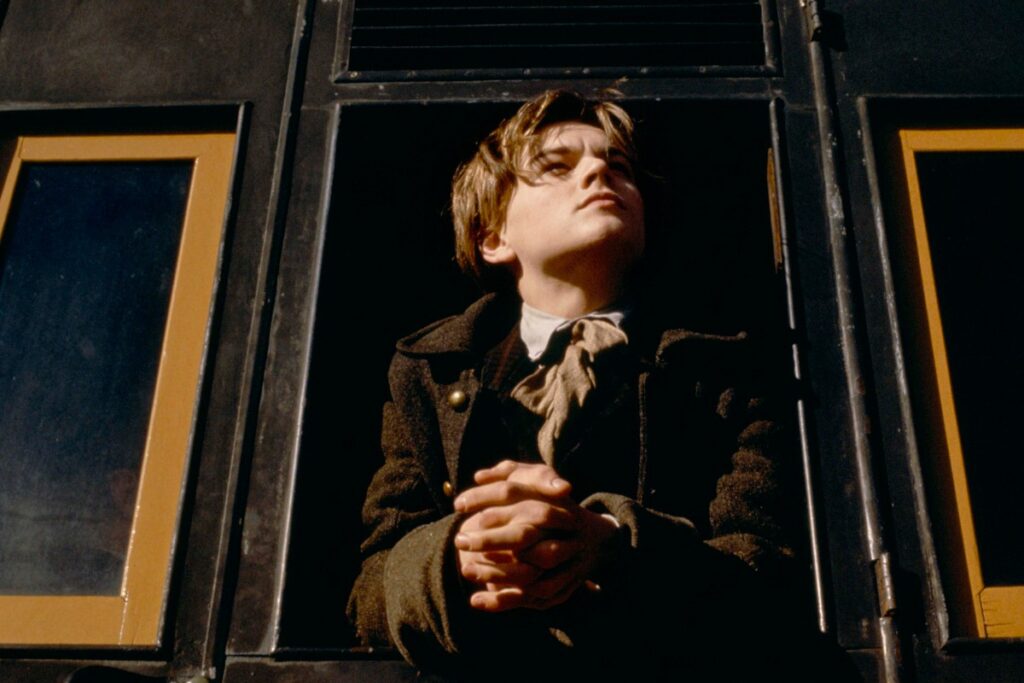
He has worked with cinema’s giants, yet one early performance has been quietly airbrushed from his legend. What made this role so contentious that it slipped from theaters to near oblivion?
Fresh from Gilbert Grape, Leonardo DiCaprio slipped into Arthur Rimbaud’s boots for Agnieszka Holland’s Rimbaud Verlaine. The mid-90s drama, opposite David Thewlis, landed with a thud, drawing just 23,234 viewers in France and $340,000 worldwide. Even DiCaprio later admitted it spoke to a narrow audience, and it’s mostly recalled for one scene rather than its story. Today, this curio of a career still exists largely off the grid, tucked away on an 18-year-old DVD.
A forgotten chapter in DiCaprio’s career
29 years ago, before awards seasons turned into a familiar ritual, Leonardo DiCaprio made an early gamble that quietly slipped from memory. The film, “Rimbaud Verlaine” (also released as Total Eclipse), paired youthful bravado with literary myth. Directed by Agnieszka Holland, it showcased a hungry actor chasing sharp edges, yet it’s now a footnote in a career built on bolder, better bets.
A rising star in cinema
By the early 1990s, DiCaprio was already impossible to ignore. His turn in “What’s Eating Gilbert Grape” in 1993, at just 19, drew Golden Globe and Oscar nominations. He would soon partner with titans like Martin Scorsese and Steven Spielberg, cementing his range and resolve. In addition to those triumphs, there sits the lesser-sung “Rimbaud Verlaine,” a detour many fans scarcely revisit.
The film “Rimbaud Verlaine” and its struggles
Released internationally in 1995 and later in some territories in 1997, the film cast DiCaprio as the incendiary Arthur Rimbaud opposite David Thewlis’s Paul Verlaine. On paper, the pairing promised sparks. In practice, the project struggled with critics and audiences alike, drawing only 23,234 viewers in France and roughly $340,000 globally. The ambition was clear; the box-office pulse was faint.
A polarizing reception, then and now
Even devotees of Rimbaud’s legacy split over the film’s choices. Many argued it leaned into sensationalism—especially a now-notorious kiss—rather than grappling with the poets’ work and context. DiCaprio later admitted the movie spoke to a niche, acknowledging that plenty who loved Rimbaud also disliked the film. Was the uproar ever really about poetry, or about how the story was framed?
Availability: a DVD issued 18 years ago, with limited access elsewhere.
The evolution of a career
“Rimbaud Verlaine” endures as a reminder that great careers are built on risk, including the misfires. Indeed, DiCaprio’s willingness to test limits—before Scorsese epics and awards-night speeches—helped shape the actor we now recognize. For those who enjoy tracking cinema’s hidden corridors, platforms like AlloCiné keep these stories alive (and sometimes reframe our sense of what mattered, and when).