
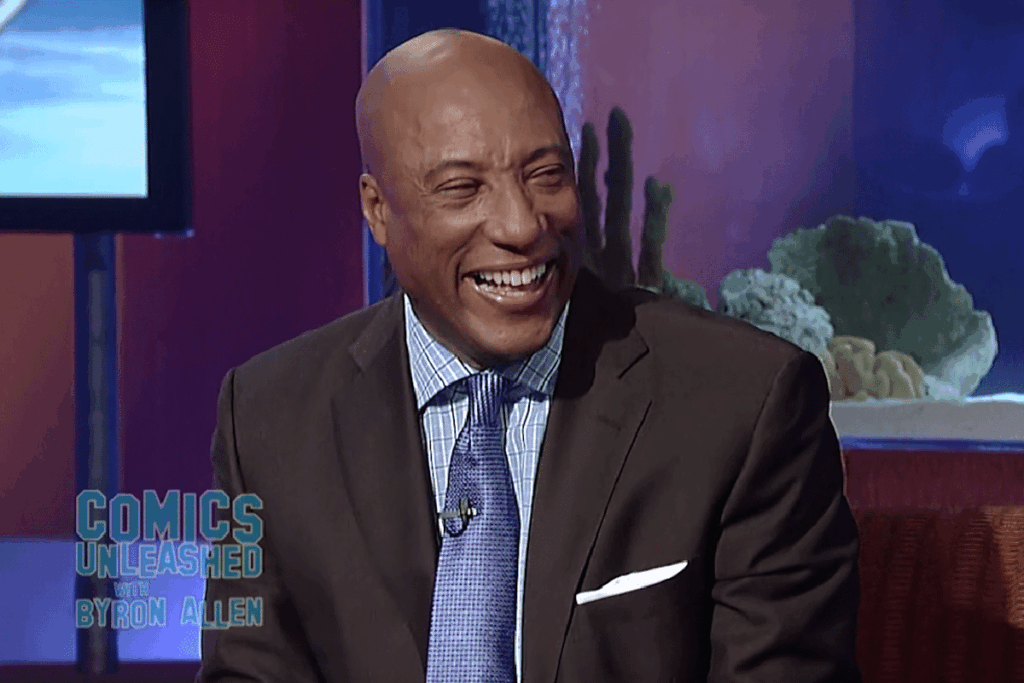
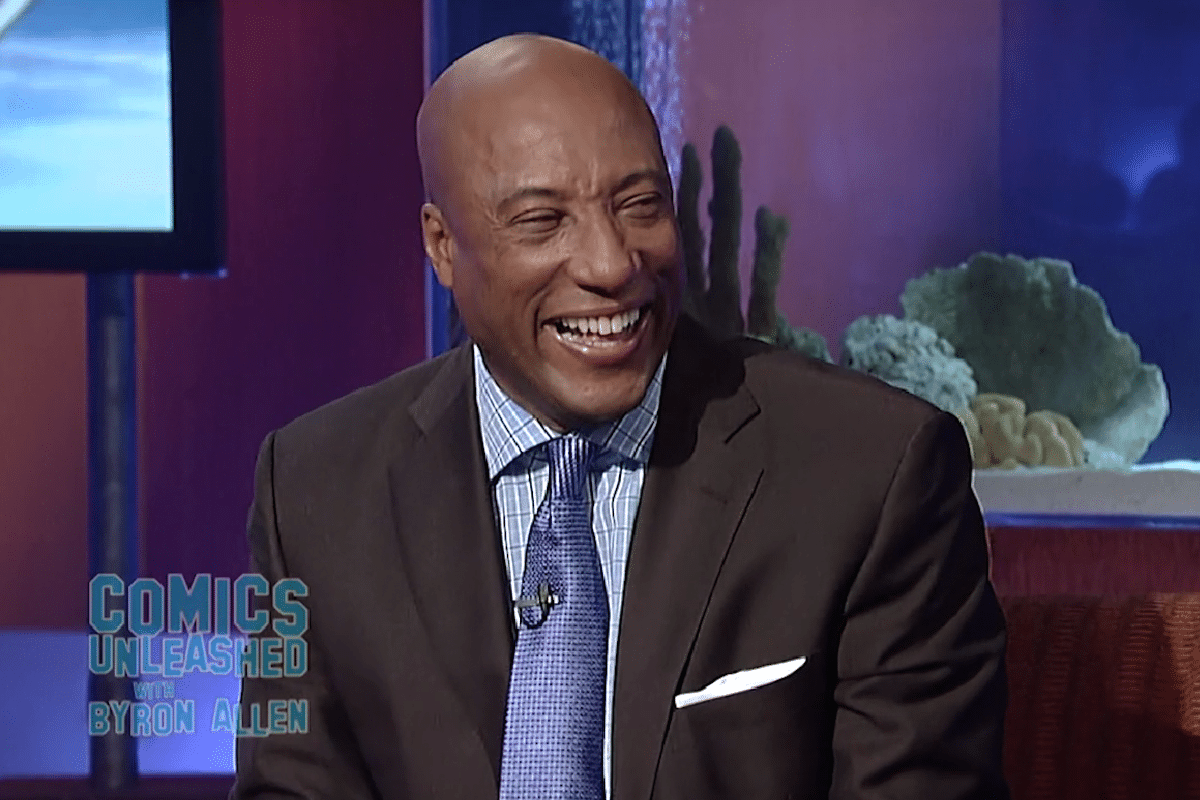
Screenshot: Entertainment Studios
Stephen Colbert’s successor is… Byron Allen—and a very different kind of late night
In a decision that marks CBS’s official departure from original late-night programming, the network announced Monday that it has sold off its hour-long time period starting at 11:35 pm, which has for more than 30 years been occupied by two of the biggest stars in late-night history, David Letterman and Stephen Colbert, to Byron Allen’s Allen Media Company.
The change will take effect Friday, May 22, the night after Colbert’s final broadcast.
Comics Unleashed, the comedy panel show Allen created in 2006, will replace Colbert’s Late Show, moving from its current spot at 12:37 on CBS, to the main room of late night, the 11:35 pm hour on a network.
Concurrently, another Allen Media program, the game show Funny You Should Ask, will slide in behind Comics Unleashed at 12:37.
The move gives Byron Allen, who also serves as host of Comics Unleashed, control of CBS’s entire late-night block for the 2026- 2027 season, through what is known in the television business as a time-buy, expanding the model the company first employed at 12:37 am after the cancellation of After Midnight.
In both cases, CBS defended its decision to walk away from supplying programming to its affiliated stations—and the nation’s viewers—as an economic necessity. CBS has said that The Late Show, the successful franchise created when CBS pulled Letterman away from NBC in 1993, was losing tens of millions of dollars.
People close to the decision to commit to another sale of network time to Allen said the same rationale was in place. Late night is “financially challenging.”
As CBS sees it, the agreement to again take payments from Allen Media means that the network will make money instead of losing it for the hours involved.
CBS also cited Allen as a good partner in the 12:37 time period, and concluded that expanding the deal with him was the sound decision to make.
For the moment, at least.
The deal is just for one year. The network is not foreclosing the possibility that some future late-night format may someday be devised that could bring CBS itself back to the time period, assuming the format came with a better financial model. As in, something that would make money for CBS, which selling off the time period is doing for the network now.
As LateNighter first reported last year, Allen’s arrangement with CBS at 12:37 has been a time-buy, meaning his company pays CBS for the airtime and sells the advertising within the show. The 11:35 deal extends that approach to the network’s entire late-night block.
The move by Byron Allen is consistent with the plan he first laid out last fall at the Advertising Week conference in Manhattan. When I asked him if he would be “putting his hand up” for the Colbert time slot as well, he said, “It’s already raised.”
Funny You Should Ask has been in syndication since 2017. The game format resembles the venerable Hollywood Squares, with comics—in chairs instead of behind tic tic toe boxes—being asked trivia questions, supplying joke answers, and contestants deciding if they believe the answers or not.
Typical joke: True or false, in mating ritual the female sagebrush cricket eats the males wings. Answer (from the late comic Louie Anderson): “Well, who doesn’t love wings?”
CBS’s move comes despite Colbert’s Late Show remaining the most-watched program in its time slot. The CBS claims that the show was losing money have been met with some skepticism, most notably from Jimmy Kimmel.
Unlike traditional late night, Allen’s shows are produced at significantly lower cost, rely on non-topical “evergreen” comedy, and are financed through direct ad sales—an approach he has used for years across syndicated programming.
“I truly appreciate CBS’ confidence in me by picking up our two-hour comedy block,” Allen said in a statement. “The world can never have enough laughter.”
The shift raises broader questions about the future of late night on broadcast television. CBS noted that “as late night evolves, there is potential to consider new forms of original programming with a better financial model,” suggesting the network may continue experimenting beyond the current deal.
For now, though, a franchise that once defined the format—from David Letterman to Stephen Colbert—will transition to a fully outsourced, advertiser-supported model.
And with it, CBS becomes the first network to fully abandon the traditional late-night paradigm at 11:35.
Get stories like this in your inbox: Sign up for LateNighter’s free daily newsletter.