
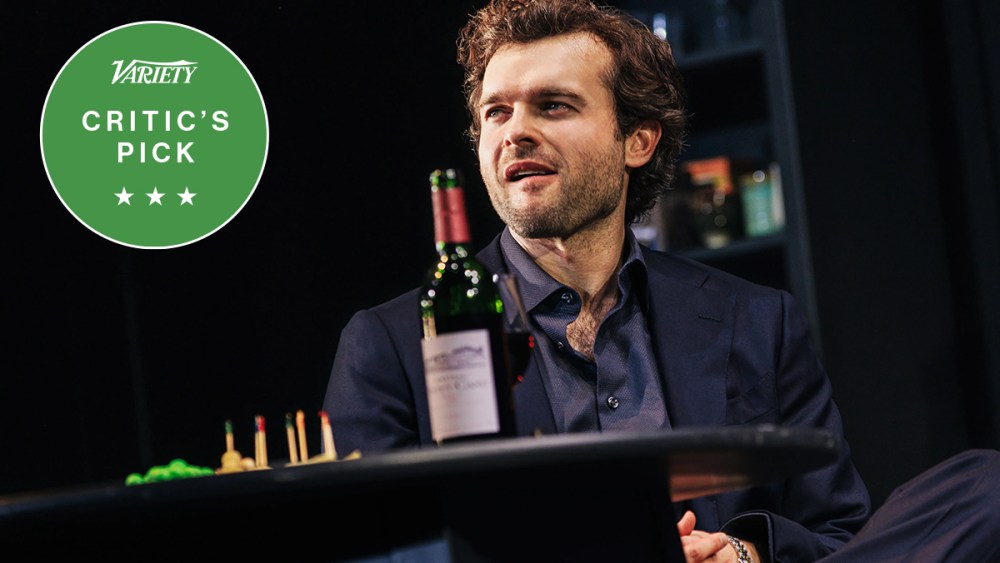
Alden Ehrenreich might be lucky “Solo: A Star Wars Story” was such a box office bomb.
Because what was bad for his bank account was fantastic for his creative freedom, liberating Ehrenreich, who had been trapped on the anesthetizing career trajectory that’s a prerequisite for movie stardom, to embrace his wild side. In “Weapons” and “Fair Play,” Ehrenreich revealed previously unseen depths as a caddish cop and a cutthroat hedge fund analyst. As impressive as those performances were, they don’t approach his work in Gina Gionfriddo’s “Becky Shaw,” a savagely funny revival that premieres this week at the Hayes Theater.
As Max, the adopted son of a dysfunctional family, Ehrenreich delivers an astonishing Broadway debut. He’s a raging, roiling alpha — a successful money manager who wields words like a battering ram, never happier than when he’s engaged in ferocious, bone-chiseling debate. Max must be in control, at all times, barking out orders to his surrogate mother, Susan Slater (Linda Emond, bringing a hauteur that could level the Upper East Side), and Suzanna, the “sister” he desperately wants to fuck (an inconsistent Lauren Patten).
But Max, who domineers the stage just as you assume he bestrides trading room floors, isn’t the title character in Gionfriddo’s comedy of mis-manners. That distinction falls to Becky Shaw (Madeline Brewer), an office worker whom Max is set up with by Suzanna and her sweet but dull husband Andrew (Patrick Ball, radiating kindness). It’s the blind date from hell, though to say exactly how and why would spoil the twisty pleasures of “Becky Shaw.” Max initially dismisses Becky, a college dropout turned temp, as a bubbly simpleton, far below his intellectual rank. She’s wearing a loud dress that Max likens to “a birthday cake,” and she doesn’t own a cellphone. “Is she Amish?” he asks with disdain.
He’s fatally wrong about his date. Becky, who Brewer portrays as a fading cheerleader with an ebullience that turns sinister in a snap, refuses to take the hint after Max tries to drop her after a night on the town. Her efforts to ignite a relationship with Max, which veer from mind games to blackmail, threatens Suzanna and Andrew’s marriage as well.
At its core, “Becky Shaw” is about virtue — its aspirational appeal as well as its tedious limitations. Max wants to repay the debt he feels he owes the Slaters for raising him by disentangling their perilous finances. That extends to footing the bill for a two-star (though Max insists it’s a three-star) hotel room when they travel to New York to settle the estate of their dead patriarch. Then there’s Andrew, so righteous he weeps while watching porn, whose savior complex makes him feel responsible for Becky’s unhappiness. His guilt over suggesting that she go out with Max leads him to send the wrong signals. Lastly, there’s Suzanna, who mistakenly believes that Max can smooth everything over with a few white lies, and who is drawn to Andrew because his morality reminds her of her late father. But is goodness alone the basis for a healthy relationship?
Gionfriddo, a Pulitzer Prize finalist for “Becky Shaw” and “Rapture, Blister, Burn,” is a master of dialogue. Her characters, particularly Max and the Slaters, live to fight; tearing each other apart is, in its own warped way, a form of affection. And it helps that both Emond (one of the best enunciators in the theater) and Ehrenreich are so verbally dexterous. Credit to director Trip Cullman for staging the show to highlight their jousting — at times “Becky Shaw” feels like “The Birdcage” by way of “Who’s Afraid of Virginia Woolf?”
As impressive as much of the cast is, Ehrenreich steals the show. What makes Max so arresting is that underneath his bullying and bluster is the wounded heart of a kicked puppy. Like Becky, he wants to be loved. He just has a toxic way of asking for it.