
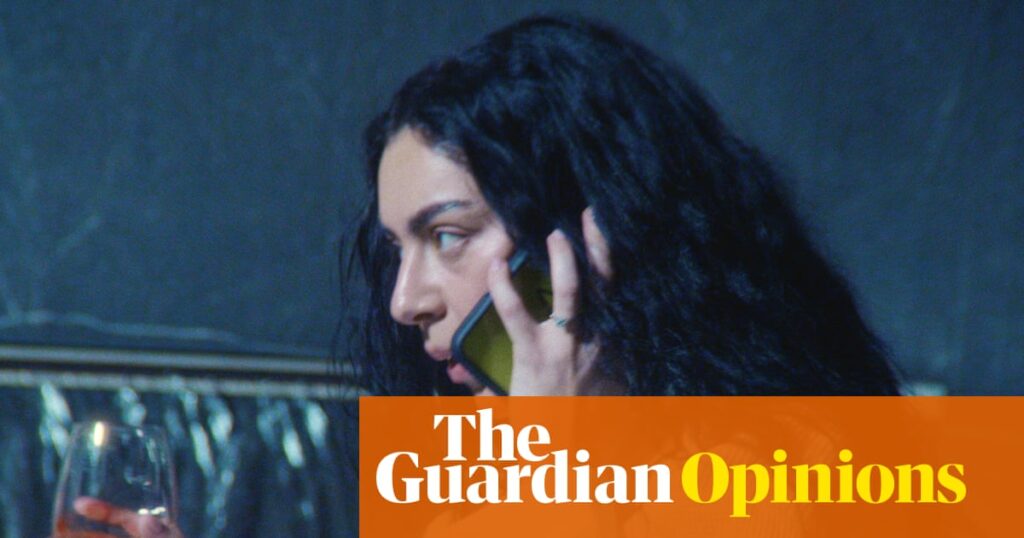
In the satirical mockumentary The Moment, Charli xcx fears (and eventually embraces) the death of Brat summer, the cultural sensation that made her sixth album a phenomenon. But the film – which stars the singer as a fictionalised version of herself – strains to land jokes out of Charli’s identity crisis and lacks the giddily intoxicating rush of that 2024 album. Watching The Moment shortly after its lukewarm reception at Sundance, I sensed something dying, but it wasn’t Brat – it was the mockumentary style itself.
How did mockumentaries grow so … tiresome? Once a novel narrative format brilliantly deployed by directors such as Christopher Guest and the late Rob Reiner, the mockumentary now feels nearly as stale as the formulaic films it aims to lampoon. It’s a sad state of affairs. For much of the last half-century, faux-documentary film-making flourished under the perverse minds of countless comedy greats, from Monty Python’s Eric Idle, who lampooned Beatlemania with 1978’s wackily irreverent mock-doc The Rutles: All You Need Is Cash, to Albert Brooks, who made his directorial debut with 1979’s proto-reality television spoof Real Life.
Then, in 1984, Reiner brought an improvisational verve to the heavy-metal parody This Is Spinal Tap, a film that dialled the comic ingenuity up to 11 and made a fictional band of tousle-haired doofuses seem realer than their MTV counterparts. Its influence still lingers; Spinal Tap’s success paved the way for Guest’s own string of mockumentary masterpieces, Waiting for Guffman, Best in Show, A Mighty Wind, which remain beloved for their kooky characters, improvised dialogue, and repertory casting. In these films, a mockumentary format brings an air of verisimilitude to characters who are at once outlandish and utterly ordinary.
Alas, Guest hasn’t directed a film in 10 years, and the recent crop of mockumentaries fails to match his work’s staying power. That includes, ironically, Spinal Tap II: The End Continues (starring Guest), which I hesitate to rag on, both because it has some funny gags (like a sleazy music promoter who’s neurologically unable to process music) and because its release was overshadowed by Reiner’s tragic murder in December. But much as Spinal Tap II lampoons the geriatric nature of dinosaur band reunions, it carries the whiff of a nostalgia exercise itself, straining, as legacy sequels do, to recreate the magic of the original film.
In some ways, the stagnation of the mockumentary mirrors the creative decline of the documentary itself, where celebrity-oriented projects now feel more like legacy-building exercises than anything else. Like so many puffy showbiz docs, Spinal Tap II and The Moment mistake high-profile celeb cameos for substance. With its handheld shots of Charli being shuttled between label meetings, tour rehearsals and meet-and-greets, The Moment superficially resembles those behind-the-scenes docs often produced by their subjects, but its satire feels meandering and toothless. A good mockumentary ought to skewer its subjects, much as 2016’s Popstar: Never Stop Never Stopping lampooned self-absorbed, Bieber-era superstars. But The Moment delivers a muddled portrait of Charli and saves its sharpest barbs for a pompous, corporate-brained director – memorably played by Alexander Skarsgård – who wants to sanitise her image for a family-friendly concert movie.
Nostalgia exercise … from left: Christopher Guest, Michael McKean, and Harry Shearer in Spinal Tap II: The End Continues. Photograph: Kyle Kaplan/AP
In this era of overly sycophantic celeb docs, The Fall and Rise of Reggie Dinkins should be just the thing to skewer them. This new NBC sitcom has a deliciously meta premise: it’s a documentary-style show that’s partly about the making of a documentary. Tracy Morgan shines as a washed-up former NFL player who hires an Oscar-winning film-maker, Arthur Tobin (Daniel Radcliffe), to help rehabilitate his image. Only problem is, Tobin wants to make a film that’s authentic and real, not a glorified commercial for Dinkins.
But The Fall and Rise never credibly convinces us we are watching the fruits of Tobin’s film-making; it’s just too phony. The show – created by two 30 Rock veterans – is rooted in quippy one-liners and snappy punchlines, a stylistic choice that clashes with its aspirations towards mockumentary-style verisimilitude. The sitcom may work as a vehicle for Morgan’s bumbling screen presence, but it lacks the looseness and the chemistry that makes a great mockumentary pop on the screen.
More dismayingly, the American right-wing podcaster Matt Walsh debased the genre in 2024 with his sub-Borat DEI takedown Am I Racist? In this pandering attempt at provocation, Walsh wanders around getting a DEI certification, attending antiracist workshops, posing as a woke scold and basically producing the feature-length equivalent of a “triggered, libs???” tweet. He encounters some white-guilt grifters, but somehow always remains the most obnoxious blowhard in the room.
Though Walsh lands a squirmingly amusing coup when he pranks bestselling White Fragility author Robin DiAngelo into paying $30 in reparations to a random Black producer, he can’t even commit to the documentary format, frequently cutting to scripted gags involving a diner waitress. He is less interested in offering his viewers anything new than in validating what they already believe – namely, that white supremacy is not real and racism is a liberal hoax.
If there is any hope for the mockumentary, it’s embodied by small, scrappy projects such as Rap World (2024) and Nirvanna the Band the Show the Movie (2026). The former, directed by Conner O’Malley and Danny Scharar, depicts four dirtbag friends making a rap album in 2009-era suburban Pennsylvania and captures the janky late-00s iMovie-to-YouTube sensibility with a nauseating degree of accuracy. The latter, a zany buddy comedy based on the web series Nirvanna the Band the Show, makes ingenious use of DIY-style camera setups and “real” footage of Matt Johnson and Jay McCarrol interacting with Toronto passersby during street sequences, such that the audience is more willing to suspend its disbelief for an absurdist time-travel plot that weaves between 2008 and the present day.
In both cases, the film-makers use mockumentary flourishes and deliberately amateurish screen presences to shore up viewer investment in the veracity of fictitious bands and their perilous misadventures. Both films are inspired and funny and were made on shoestring budgets outside the Hollywood machine. They remind us that the mockumentary is not dead; it just desperately needs some new blood.