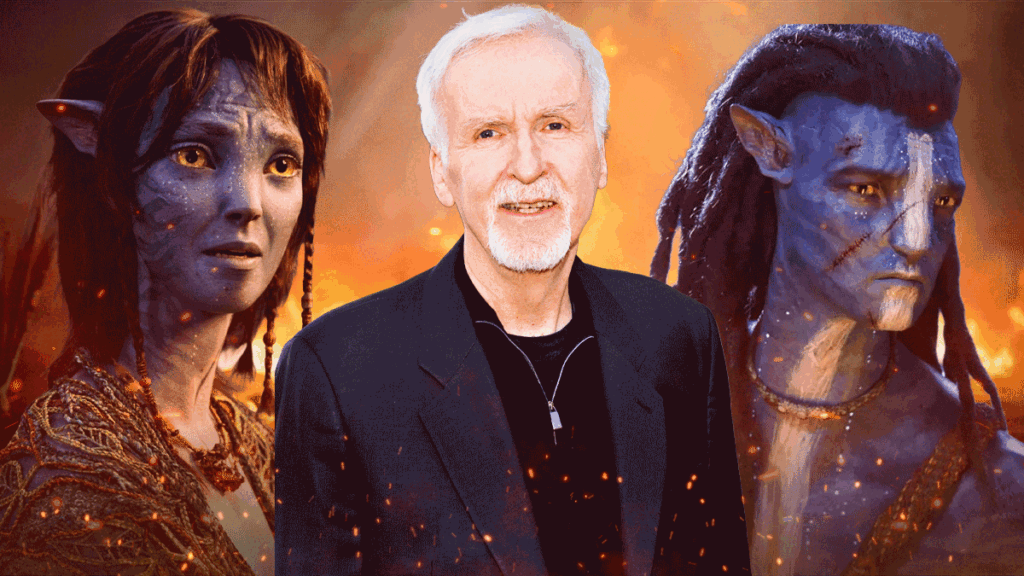
Backstage at the Saturn Awards, held March 8 at the Hilton Universal City, James Cameron, who picked up trophies for Best Direction, Best Screenwriting and Best Science Fiction Film for “Avatar: Fire and Ash,” was asked about how the response to this latest installment would influence the next film.
“To be perfectly clear, we haven’t even made a decision if we’re going forward right now,” Cameron pointed out. “But should I do that – I’d say that’s likely but not 100% – but we will learn from lessons from all three films.”
There are very tentative release dates for the fourth and fifth films (December 2029 and 2031, respectively), but insiders told TheWrap that conversations are being had about how to make future “Avatar” movies cheaper and shorter, to make the investment less risky should they move forward, with some indications that Disney could be rethinking a planned “Avatar” expansion to one of its California theme parks.
That these conversations are happening and Cameron, who initially plotted a vast, five-film saga, is questioning whether the franchise will continue after the latest release amassed $1.4 billion is surprising. After all, the first “Avatar,” released in 2009, is the highest-grossing film of all time, with more than $2.9 billion worldwide. The second film, 2022’s “Avatar: The Way of Water,” is the third highest-grossing movie ever, with $2.3 billion (Cameron is responsible for three of the top five highest-grossing films of all time). And there’s a lavish, highly interactive “Avatar”-themed land at Disney’s Animal Kingdom, part of the sprawling Walt Disney World complex outside of Orlando. Countless people visit Pandora every day.
But “Avatar: Fire and Ash” is still registering, for some, as a disappointment. Its box office tally is massive in a vacuum, but looks less impressive when compared to “Zootopia 2,” also released by parent company Disney last year, which made more than $1.8 billion. “Avatar: Fire and Ash” also made a billion dollars less than “Avatar: The Way of Water,” released just three years earlier. All on a reported budget of $350 million, with an additional $150 million marketing spend.
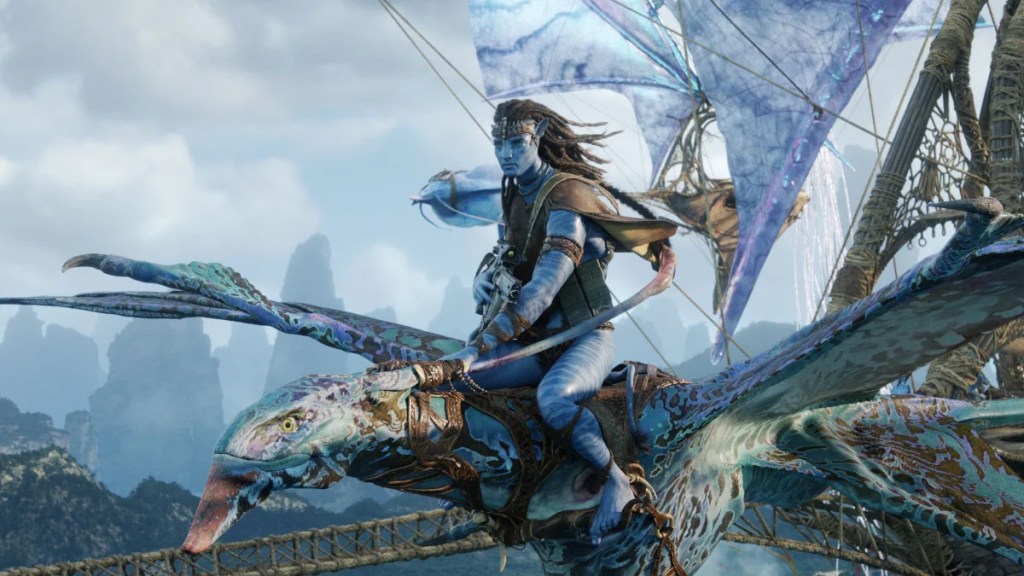 “Avatar: Fire and Ash” (Disney/20th Century)
“It’s all about compare-and-contrast – ‘Fire and Ash’ made half of what the first movie made. And ticket prices in 2009 were not what they are in 2025. That’s the level that James Cameron and the ‘Avatar’ films are operating in,” said Paul Dergarabedian, head of marketplace trends at Comscore. “When an $89 million domestic opening weekend and almost $1.5 billion worldwide would be seen — in any stretch — as a disappointment. That’s why there’s that perception. These are high-class problems to have.”
Or, as a member of the “Avatar” team put it more succinctly in speaking with TheWrap, “It’s bulls–t that the movie made $1.5 billion and people are acting like it’s ‘Ishtar.’ There’s not a guarantee that they’re all going to make $2 billion. The trilogy has made $6.7 billion, which averages more than $2 billion per film.”
A Disney representative declined to comment.
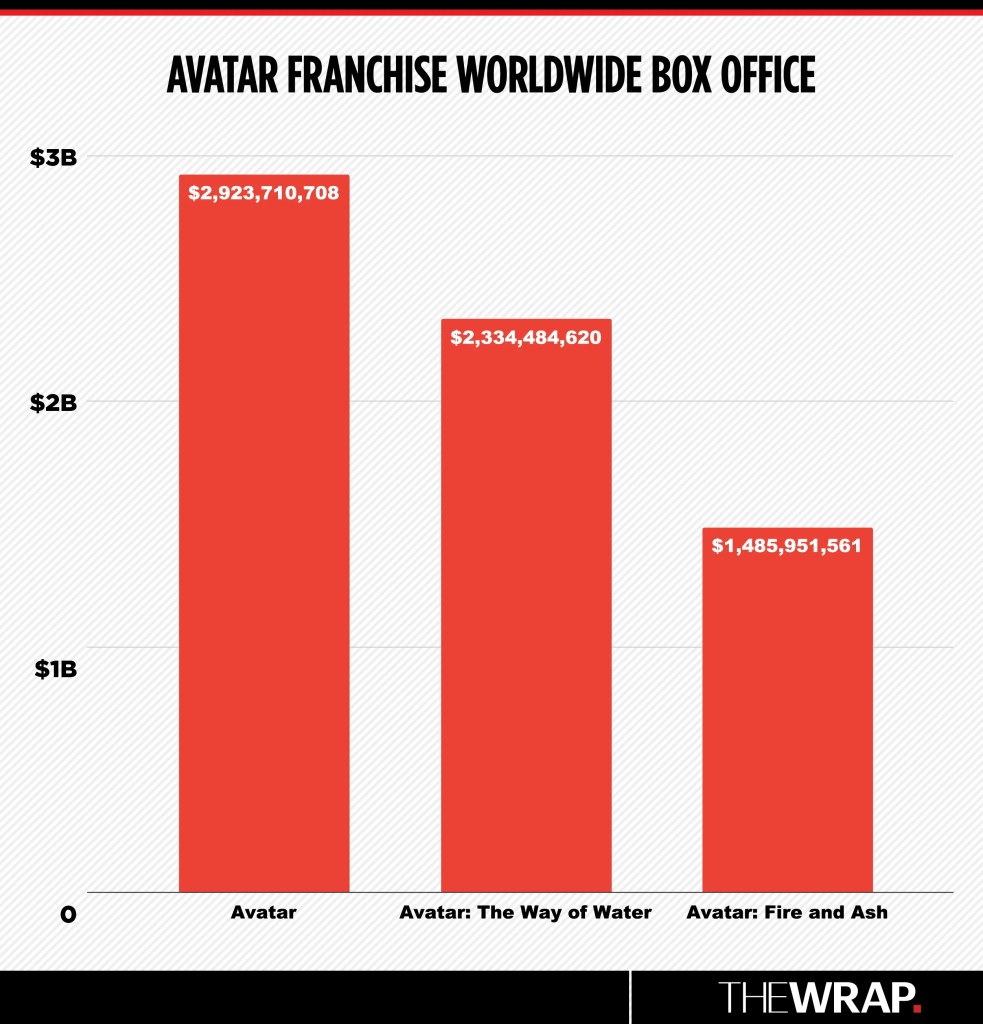 Worldwide box office of the “Avatar” franchise
Still, the question lingering in the backstage of science fiction awards shows and in the minds of executives at the Walt Disney Company in Burbank, is: How will the “Avatar” series move forward?
“Avatar” isn’t the only major franchise getting a rethink inside Disney — Marvel is under the microscope after a trio of misfires in 2025, Star Wars has its cinematic hopes pinned to “The Mandalorian & Grogu,” a departure from the Skywalker saga of films, and Pixar is leaning on sequels to ensure the animation studio’s longevity. As contraction squeezes the entire industry, even $1.4 billion doesn’t get you an automatic sequel greenlight.
It’s enough to make you wonder if we’ve spent our last Christmas on Pandora.

***
It was Jon Landau, the former Fox executive who later ran Cameron’s company Lightstorm and became his most trusted creative collaborator (he died in 2024 after a 16-month battle with esophageal cancer), who was often tasked with outlining the team’s immense vision for the “Avatar” saga.
Landau would regale visitors to Lightstorm – promotional partners, marketing executives, those new to the “Avatar” fold – with what the movies were going to be and how they would push technology and the boundaries of storytelling even further in the years ahead. Before the second film released, the “Avatar” team was already plotting out four more installments, complete with a return to Earth and epic, “Star Wars”-style space battles. The world of “Avatar” was only going to get bigger — but also, Landau would argue, more emotionally intimate — with each passing film. This was ultimately a story about family writ large, across a fantastical canvas.
And after the success of “Avatar: The Way of Water,” those plans seemed locked in.
Cameron shot sequences for both the third and fourth films during production of “Avatar: Fire and Ash” (one insider said around 22% of the fourth film has already been shot) and scripts for the fourth and fifth films are complete. Indeed, when embarking on the sequels, Cameron assembled a massive writers’ room of A+ talent, made up of Rick Jaffa and Amanda Silver, Josh Friedman and Shane Salerno, who broke the stories for the sequels together. Jaffa and Silver were mostly centered on movies two and three, while Friedman and Salerno were responsible for the fourth and fifth movies.
And the expansion wouldn’t just be at the movie theaters. To compliment the wildly popular land at Animal Kingdom in Florida, an “Avatar”-themed land at Disney California Adventure, across the esplanade from Disneyland, was announced with construction planned to begin in 2026.

But then those plans started to wobble, like an unsteady banshee in the skies above Pandora.
During the promotional campaign for the new movie, Cameron and members of the cast began openly talking about how “Avatar: Fire and Ash” could be the conclusion of the franchise. A last-minute edit made the fate of one of the characters (Stephen Lang’s villainous Quaritch) less nebulous, leaving one less potential dangling plot thread should a fourth film never materialize. And the parcel of land earmarked for the “Avatar”-themed attraction at Disney California Adventure became a hotly disputed piece of real estate, with former Imagineer Jim Shull openly hypothesizing that the land could instead be given over to a “Zootopia”-themed attraction that opened in Shanghai in 2023.
“Disney doesn’t do anything without a reason. The reality is that ‘Avatar 3’ did OK but as a cultural force, it’s exhausted. Nobody is demanding to see more. They like what they have and if they really like it, they can go to Florida and see it,” Shull told TheWrap. “California does not have a lot of land. If ‘Avatar’ had been a huge success and people were demanding ‘4’ and ‘5’ and beyond, that would change the equation. But there’s not a lot of demand.”
In Shull’s opinion, a swap to expand the “Zootopia” franchise in the California park makes sense.
“‘Zootopia 2’ exceeded expectations in terms of money and laid the groundwork for more ‘Zootopia,’” Shull said. “If I were Josh D’Amaro, in the seat, looking at the stock, I know that I could go to the board and say, ‘I’ve changed my mind for the stronger property,’ and there would be no pushback.”
Shull said that the lack of construction updates is telling. “The only time you do something like that is when you have second thoughts,” he said.

According to one person familiar with the plans at Disneyland, the parks’ operation teams are keener on the “Zootopia” attraction because it uses a similar ride system to another Disneyland attraction (Mickey and Minnie’s Runaway Railway) and could be more easily maintained. Another pointed to the fact that, since the “Avatar” attraction was a boat ride, it would also require its own water-treatment facility. Disney also, conspicuously, issued a press release on the Disney+ viewing numbers for “Zootopia 2” specifically calling out the fact that the “Zootopia” attraction at Shanghai Disneyland is the highest-rated ride at the entire park, “with one in four guests stating they came to the park specifically for the land.”
Construction on the DCA project – whatever it is – has already been pushed back a full year, which indicates something is going on with the space.
The battle for “Avatar,” it seems, has only just begun.
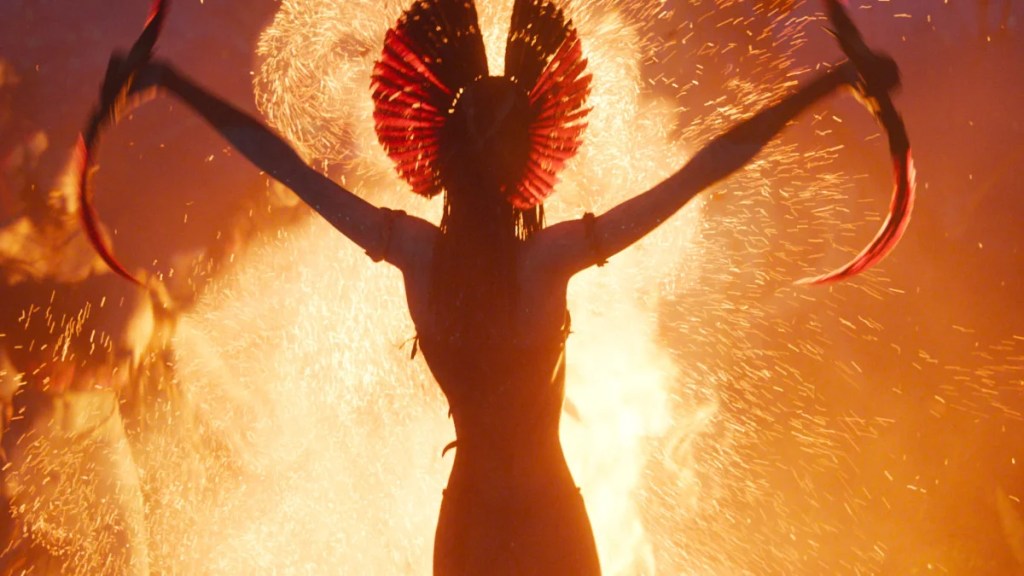 Oona Chaplin in “Avatar: Fire and Ash” (20th Century Studios)
***
Where did the disconnect with the third movie come from?
“Avatar: Fire and Ash,” was just as compelling as the two earlier movies and just as visually rich, particularly when viewed in Cameron’s preferred 3D. Reviews were less enthusiastic (it’s at 66% on Rotten Tomatoes vs. “Avatar 2’s” 76%), but audience scores were solid. It once again won the Oscar for Best Visual Effects.
In other words – on paper it would seem that “Avatar 3” should do as much boffo box office as the two earlier films, but, strangely, didn’t.
The “Avatar” team, according to a person with knowledge of its release, felt that the rollout of the film was too similar to what Disney had done for the launch of “Avatar: The Way of Water,” a film that had been released just three years earlier. The team worried that audiences would feel that they had already seen “Fire and Ash,” even though it was a completely new movie.
But Disney would probably argue that the materials they received from the film were also very similar to “The Way of Water.” After all, “The Way of Water” and “Fire and Ash” were, initially, a single mammoth movie (this is why Jaffa and Silver are credited as writers on both), with a narrative that grapples with comparable themes and is full of set pieces with parallel visuals. Both movies, for example, focus largely on the Na’vi water clans, a group of bloodthirsty whalers and the Tulkun, a species of emotionally complex, whale-type creatures that populate Pandora’s crystalline oceans.
It is a fact that, in an era when Universal can sell tickets for Christopher Nolan’s “The Odyssey” a full year before the movie opens (and sell out those tickets), the promotional window for “Avatar: Fire and Ash” felt considerably truncated. The first teaser trailer arrived online on July 28 and was attached to “The Fantastic Four: First Steps,” another Disney movie, with the full trailer for the movie not debuting online until late September. By contrast, the first teaser for “The Way of Water” arrived in early May, giving it several more months to build momentum.

You could feel, as “Fire and Ash” approached, a decided absence of crucial pre-release buzz.
“There was no anticipation,” said one member of the “Avatar” team. “They literally used the same playbook [as for ‘The Way of Water’]. By not making it an event, it crippled the movie.”
There was also the movie’s massive 197-minute runtime, the longest in the franchise, which turns a quick jaunt to the movie theater into a James Cameron-worthy production, full of logistics and related hurdles. While an idea was floated to present the movie free of pre-movie trailers, Disney still sold 30 minutes of trailer real estate, ballooning the time needed to devote to “Avatar: Fire and Ash.” It wasn’t just a movie, it was an event, one that now had to be sandwiched into the busy holiday corridor. (Unlike the first two movies, the third “Avatar” opened a week closer to Christmas, ostensibly so that Disney could give “Zootopia 2” more of a runway.)
Add to the mix the fact that many other mechanisms for awareness simply weren’t there. There weren’t “Avatar” characters on cans of Dr. Pepper or a line of T-shirts released at Uniqlo. (Do you think they even drink Dr. Pepper on Pandora?) And consumer products related to “Avatar: Fire and Ash,” besides those released at the Florida theme park, were virtually nonexistent. This is a key “lever” pulled by Disney on any of their flagship titles, but a quick search of “Avatar: Fire and Ash” on DisneyStore.com pulls up four results – three T-shirts and a sweatshirt. That’s it.
Incidentally, there are pages of “Zootopia” stuff on the Disney Store website.
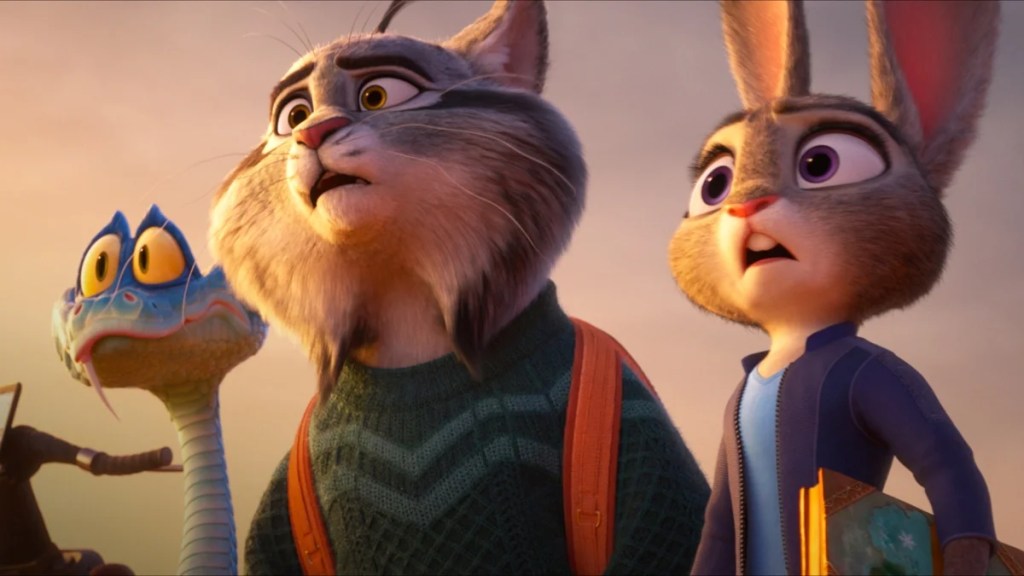 “Zootopia 2” (Disney)
***
Based on conversations with people at Disney and those with knowledge of the “Avatar” team’s thinking, all agree that a further “Avatar” movie needs to be shorter and cheaper. But the question remains – how?
When it comes to getting the movie’s budget down, Cameron and his team have mentioned that they are determined to find a way to simplify the process, which is so complicated that we hesitate to even wade into the Pandorian waters to explain. It involves at least two full “shoots” – one where they are doing performance capture of the actors and another, mostly inside the computer, to figure out staging, camera movements and the intricacies of performance (along with the addition and staging of creatures and other elements). It’s a lot.
Costume designer Deborah Scott, who was nominated for an Oscar for her work on “Fire and Ash,” designed each costume and its associated props, fabricated those in real life and then fed them to the animators and designers, refining each look along the way. This, in a microcosm, explains how cumbersome, time-intensive and expensive each element of the “Avatar” films are, taking years to complete and requiring the hard work of hundreds of specialized technicians and artists.
Some might point to using AI somewhere along the way, to make something easier. Cameron, despite authoring the first two “Terminator” movies, which explicitly warned of the threat of artificial intelligence, joined the board of StabilityAI in 2024. But in the rollout of “Avatar: Fire and Ash,” Cameron went to great lengths to assure viewers that no AI was utilized. Not only did he talk about it in interviews but a brief presentation ran before screenings of the movie, including the one I attended on the Walt Disney Studios lot in early December, emphasizing the role of human artists in the creation of “Avatar.” AI was not a part of the “Avatar” lexicon.
There’s also the question of what a cheaper, more streamlined “Avatar” would even look like.

The “Avatar” movies are, to many, the last bastion of the really-for-real theatrical experience. Sure, you can watch them at home months after the fact — but do you want to? These movies are staggering accomplishments, full of aural and visual details only properly digestible on the largest screen you can find. Consider that, after the first film was released, some viewers complained of Pandora withdrawal — the movie was so vivid, so dreamy, that they actually got depressed when not watching.
There really is nothing like “Avatar,” anywhere, and it’s that overstuffed-ness that makes it a draw.
“I love these movies and I love the fact that it’s James Cameron making these movies,” New York Magazine critic Bilge Ebiri told TheWrap.”If James Cameron makes a fourth and fifth ‘Avatar’ and he makes them in his James Cameron way but he makes them for a budget, I’d still trust him. He’s not somebody who is going to phone it in or cut corners unnecessarily.”
Cameron has brought up the possibility of simply handing the movies off to another, younger filmmaker. He’s done it before. When it came time to make “Alita: Battle Angel,” based on the manga series by Yukito Kishiro and a project he had been flirting with even before he embarked on “Avatar,” he ended up handing the reins to Robert Rodriguez. Cameron still produced (with Landau) and co-wrote the script with Laeta Kalogridis, who worked on the first “Avatar.” But the experience showed that, with his time so committed to “Avatar,” he could delegate duties on a true passion project.
But, again, a Cameron-less “Avatar” feels wrong, somehow. These are movies that are built around the passion and obsessions of Cameron himself – ocean exploration, the importance of the environment, how cool big machines look when exploding midair. T uncouple the filmmaker and the films, like untethering an avatar from its human pilot mid-mission, could be catastrophic.
“It’s his vision, it’s his sensibility, that’s what drives these films. I also think that they have a legacy to preserve,” said Ebiri. “If they start giving us these janky fly-by-night sequels, it’s going to make us feel less good about the ‘Avatar’ movies.”
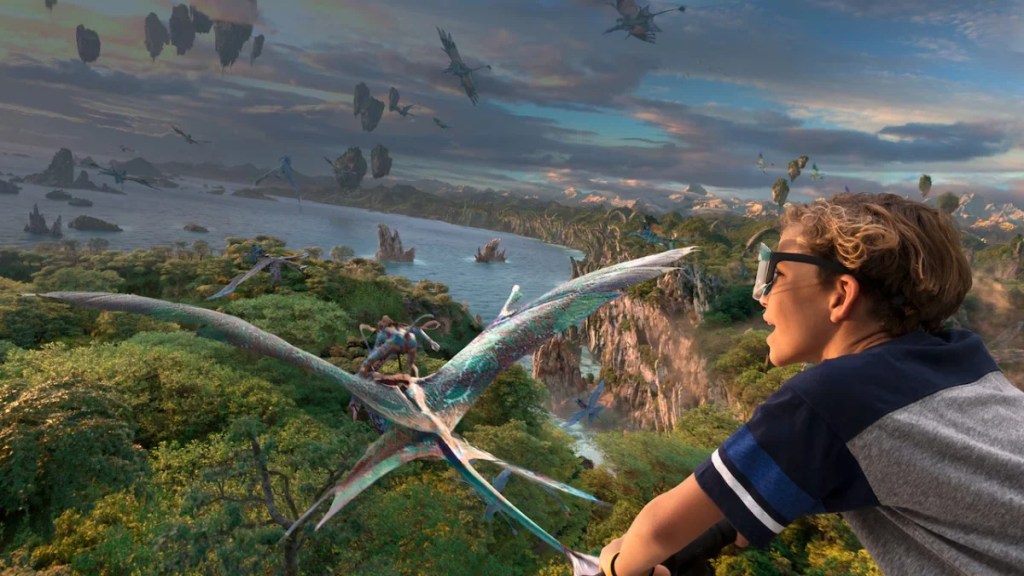 Pandora – The World of Avatar attraction (Walt Disney World)
***
Where does that leave things now?
On the theme park side of things, Shull floated the possibility that the “Avatar” attraction planned for Disney California Adventure could still be used elsewhere. There’s an expansion pad, tentatively marked for a future attraction, show or additional retail or dining, tucked behind the current “Avatar”-themed land at Disney’s Animal Kingdom. And it could be used in a future overseas park – Shanghai’s second gate, dubbed Project Atlas, is in the planning stages and has seen an overhaul from an EPCOT-of-the-east-type science and technology park to something centered on Disney “adventures,” like “Avatar.” There is also talk that the third Tokyo gate, DisneySky, is back on the drawing board. And wouldn’t the floating mountains of Pandora fit perfectly with that theme?
And as for the additional two “Avatar” sequels, “Avatar: Fire and Ash” producer Rae Sanchini last week told Inverse, “Right now we’re figuring out the schedule. We’re working hard on it right now, budgeting, scheduling, planning, building out our new pipeline for them. As far as we’re concerned, we’re full speed ahead.”
As one industry insider with knowledge of the “Avatar: Fire and Ash” situation noted, the movie still made money and it will continue to make money for the company for decades to come. It just debuted on PVOD and has a physical release scheduled for later this spring — Cameron fans are certainly Blu-ray collectors. Every time a new “Avatar” movie comes out, the previous installments shoot to the top of the charts for both paid digital downloads and streams on Disney+. More people will visit the “Avatar” land in Florida. More people will buy tiny banshees that sit on their shoulder from the gift shop.
A member of the “Avatar” team thinks that, had “Avatar: Fire and Ash” made $2 billion, Cameron would have probably engaged with another project before returning to Pandora. Now, though, he’s determined to deliver four and five, which are said to be as radically different from “Avatar: Fire and Ash” as “Star Wars” was from “The Empire Strikes Back,” in spectacular fashion.
The analogy that the “Avatar” team member made was to the Michael Jordan documentary “The Last Dance.” Jordan usually took at least two weeks off after the conclusion of each season. But after a so-so season for the Bulls, he told his teammates that he’d be in the next day to start training. His teammates questioned him, “The next day?” But Jordan was determined.
“This time, I could see him being like, I’m on a mission,” this “Avatar” team member said. “I believe unequivocally that he will finish his five-film saga. Never bet against James Cameron.”