
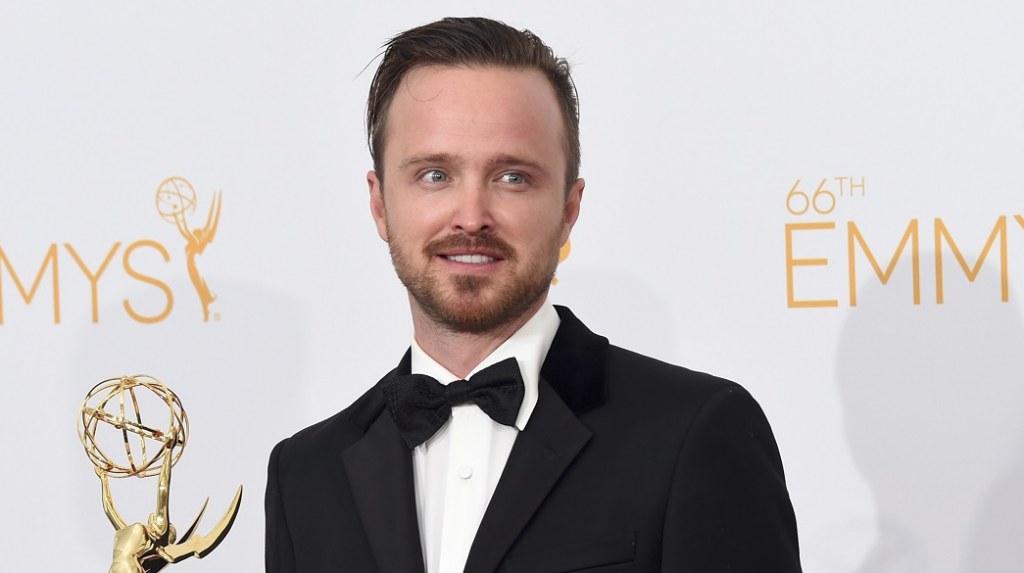
The Before
Aaron Paul net worth begins in Emmett, Idaho, population 6,500. His father was a Baptist minister. The entertainment industry does not recruit from Baptist parsonages in rural Idaho. Paul moved to Los Angeles after high school. He arrived with no money, no connections, and no backup plan. He worked as an usher at Universal Studios, seating tourists for the Waterworld show. That is the most Hollywood origin story possible because it involves both ambition and watercraft.
Early career highlights included a Price Is Right appearance and small television roles. The specific Los Angeles grind produces either working actors or bartenders. Paul was heading toward bartender territory when Vince Gilligan called.
The Pivot Moment
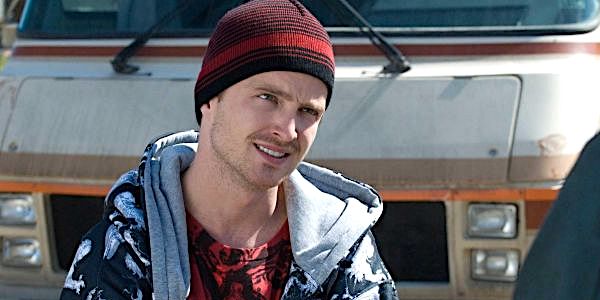 Breaking Bad Aaron Paul
Jesse Pinkman was originally slated to die in Breaking Bad’s first season. The original plan had Jesse killed to motivate Walter White’s darker turn. Gilligan changed his mind after seeing Paul’s performance and the specific chemistry between Paul and Cranston. That decision generated $30 million in career value. It also generated one of the most emotionally devastating character arcs in television history.
The Three Emmy Phenomenon
Paul won three Emmy Awards for Outstanding Supporting Actor. He became the first actor to win the award three times for the same drama role. His per-episode salary reached $200,000 by the final season. Total Breaking Bad income likely reached $5 million to $8 million. However, the Emmys generated career value that exceeded the direct compensation by an order of magnitude. Each win repositioned him in the marketplace. Each repositioning increased his asking price.
The Climb
El Camino, the Breaking Bad sequel film on Netflix, gave Paul a rare opportunity: a feature film built entirely around a supporting character. Need for Speed provided studio action income. Westworld on HBO added prestige television credibility outside the Breaking Bad universe. BoJack Horseman voice work generated steady animation income over six seasons.
The Mezcal Empire
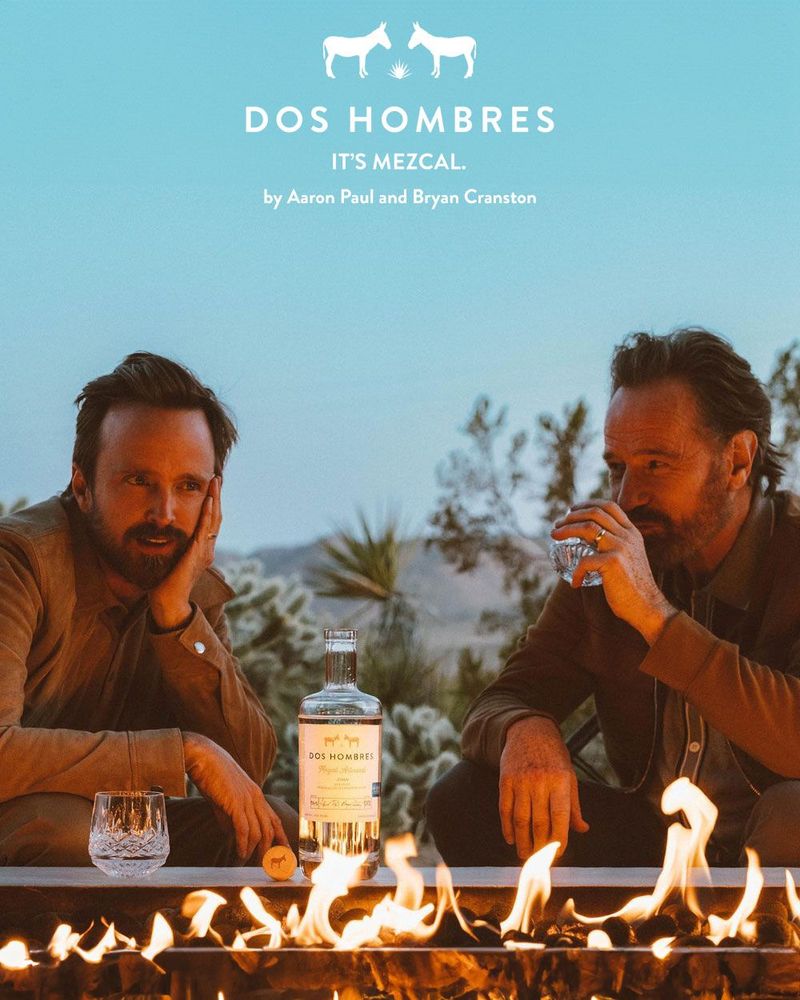 Aaron Paul_Bryan Cranston_dos_hombres
Dos Hombres mezcal with Bryan Cranston represents the most strategically brilliant celebrity brand extension in this pillar. Two actors who played meth manufacturers now sell premium liquor. The brand leverages Breaking Bad nostalgia without requiring either actor to perform. It generates revenue while they sleep. That passive income quality makes Dos Hombres worth more to Paul’s long-term net worth than any individual acting role.
What He Built
Aaron Paul net worth at $30 million reflects a career that started with a death sentence and ended with three Emmys and a spirits empire. The Baptist minister’s kid from Idaho built a fortune on a character who was not supposed to survive the pilot. Every dollar traces back to Vince Gilligan’s decision to keep Jesse alive.
The Soft Landing
Paul is forty-six. He has two children with wife Lauren Parsekian. Dos Hombres provides financial stability independent of his on-camera career. The Breaking Bad credential will generate opportunities for the rest of his life. Three Emmys sit wherever Emmys sit in a household that was once funded by an usher’s salary at the Waterworld show. They are permanent proof that talent identified in time is worth more than talent that arrives too late.
Read more about the full cast in our Breaking Bad Cast Net Worth hub, or explore the Prestige TV Antihero Cast Net Worth pillar.
The Long View
The Idaho-to-Los-Angeles trajectory deserves attention because it illustrates the specific economic barriers that actors from non-industry backgrounds must overcome. Paul had no family connections. No trust fund. No understanding of how Hollywood worked beyond what he had absorbed from watching television in a Baptist parsonage. The cost of that ignorance, measured in years of minimum-wage employment and audition rejections, is the invisible tax that actors without industry backgrounds pay for the privilege of eventually being discovered.
The Compound Effect
His marriage to Lauren Parsekian, co-founder of the anti-bullying nonprofit Kind Campaign, adds a philanthropic dimension that enhances his public image and, by extension, his commercial value. Brands seeking celebrity partnerships evaluate the celebrity’s entire public profile, not just their acting career. Paul’s association with anti-bullying advocacy makes him more attractive to family-friendly brands, which expands his endorsement potential beyond the Breaking Bad demographic.
The Deeper Layer
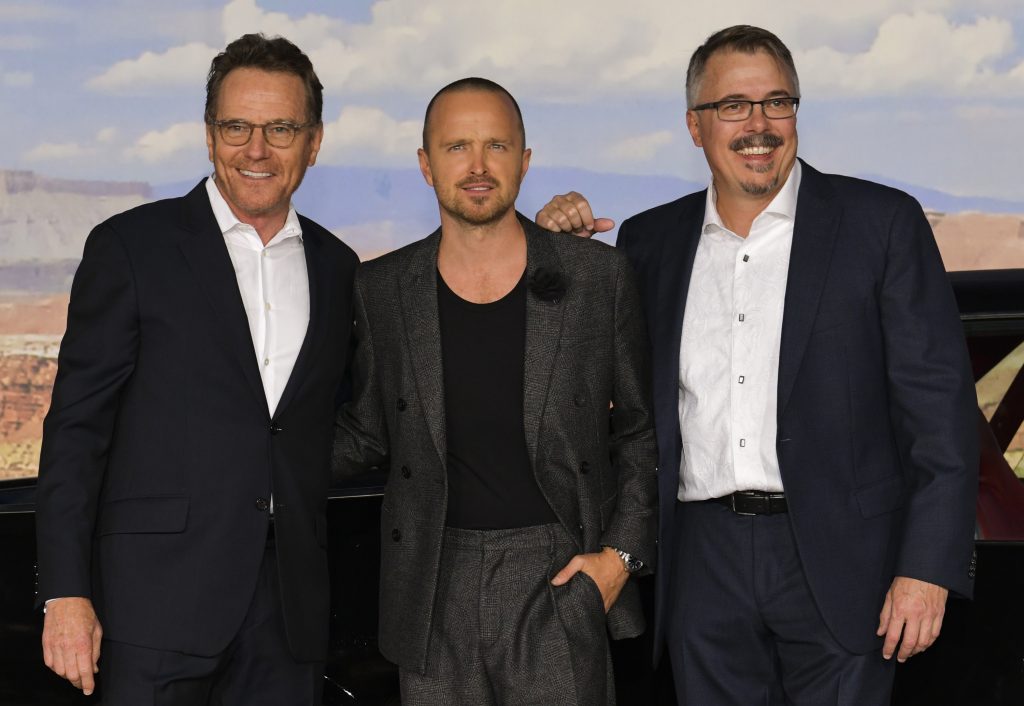 WESTWOOD, CALIFORNIA – OCTOBER 07: (L-R) Aaron Paul, Bryan Cranston, and Vince Gilligan attend the premiere of Netflix’s “El Camino: A Breaking Bad Movie” at Regency Village Theatre on October 07, 2019 in Westwood, California. (Photo by Rodin Eckenroth/FilmMagic )
The El Camino economics are worth examining separately because they represent a rare experiment in character-specific spinoff filmmaking. Netflix reportedly paid a substantial license fee for the film. Paul’s compensation as the sole lead likely reached $3 million to $5 million. More importantly, the film proved that Jesse Pinkman, independent of Walter White, could sustain an audience’s attention for two hours. That proof has long-term value because it establishes Paul as a leading man rather than a supporting player, which increases his asking price for all future projects.
The Wider Impact
The BoJack Horseman voice work across six seasons generated income that operates on different economic principles than live-action acting. Voice actors work shorter hours, face lower physical demands, and can record from anywhere. The trade-off is lower per-episode compensation. However, the consistency of six seasons of steady income, combined with residuals from streaming distribution, makes voice work a meaningful contributor to Paul’s net worth. At forty-six, he has built the kind of diversified income architecture that most actors do not achieve until their fifties or sixties.
The Real Returns
The Coachella origin story of his relationship with Lauren Parsekian is the kind of biographical detail that humanizes a celebrity net worth profile. They met at the music festival. Got engaged in Paris. Married in 2013. The relationship, by all public accounts, is stable and private. That stability matters financially because divorce is the single largest wealth-destroying event in most high-net-worth households. Paul’s avoidance of that destruction, through what appears to be a genuinely functional marriage, is itself a form of wealth preservation that his more tabloid-prone colleagues have not achieved.
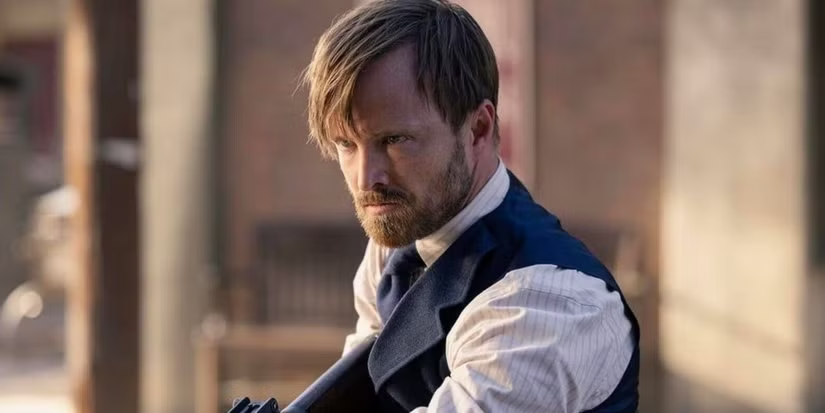 Westworld-season-4-Aaron-Paul-as-Caleb
His Westworld role on HBO demonstrated something crucial about Paul’s range: he could carry a science fiction narrative without any reference to Jesse Pinkman. The show’s declining ratings limited its career impact. But the performance proved that Paul’s talent extends beyond the specific working-class energy that Pinkman demanded. That versatility has long-term value because it means he will not be typecast as the show enters its legacy phase and new audiences discover it for the first time.
The $30 million net worth, examined alongside Cranston’s $40 million, reveals the economics of leads versus supporting players. Cranston’s per-episode rate was higher. His subsequent film career was more robust. His Broadway income added a dimension Paul has not pursued. The $10 million gap between them reflects the structural advantage that leading-man status provides at every stage of a career. Paul’s three Emmys could not close that gap because the Emmys reward excellence, not leverage, and leverage in Hollywood is still determined primarily by billing position.
You are reading this because you already understand something most people scroll right past. The intersection of culture, money, and taste is not a Venn diagram. It is a mirror. Social Life Magazine has spent 23 years holding that mirror up to the people who shape the Hamptons, Manhattan, and the corridors between them. If you see yourself in these pages, we should talk. Reach out at sociallifemagazine.com/contact.
Your Brand, Your Launch
Your personal story belongs in front of 82,000 affluent readers and a digital audience that keeps growing, our editorial features are built for exactly that moment. Learn more at Submit a Paid Feature.
Our email list reaches 82,000 subscribers who actually open, read, and act. If your audience is high-net-worth, culturally engaged, and based between Park Avenue and Montauk, you are already in the right place. Join the list.
Polo Hamptons returns to Bridgehampton this July with 1,200 guests, Getty Images coverage, and seven years of BMW title sponsorship behind it. If your brand belongs in that conversation, visit polohamptons.com.
A print subscription to Social Life Magazine puts 25,000 copies per issue into the boutiques, lobbies, and living rooms where decisions get made, from Westhampton to Montauk every summer and Upper East Side doorman buildings for Fall and Winter. Subscribe at sociallifemagazine.com/subscription.
If this publication has added value to your world and you want to support independent luxury journalism, you can contribute directly at our donation page.