
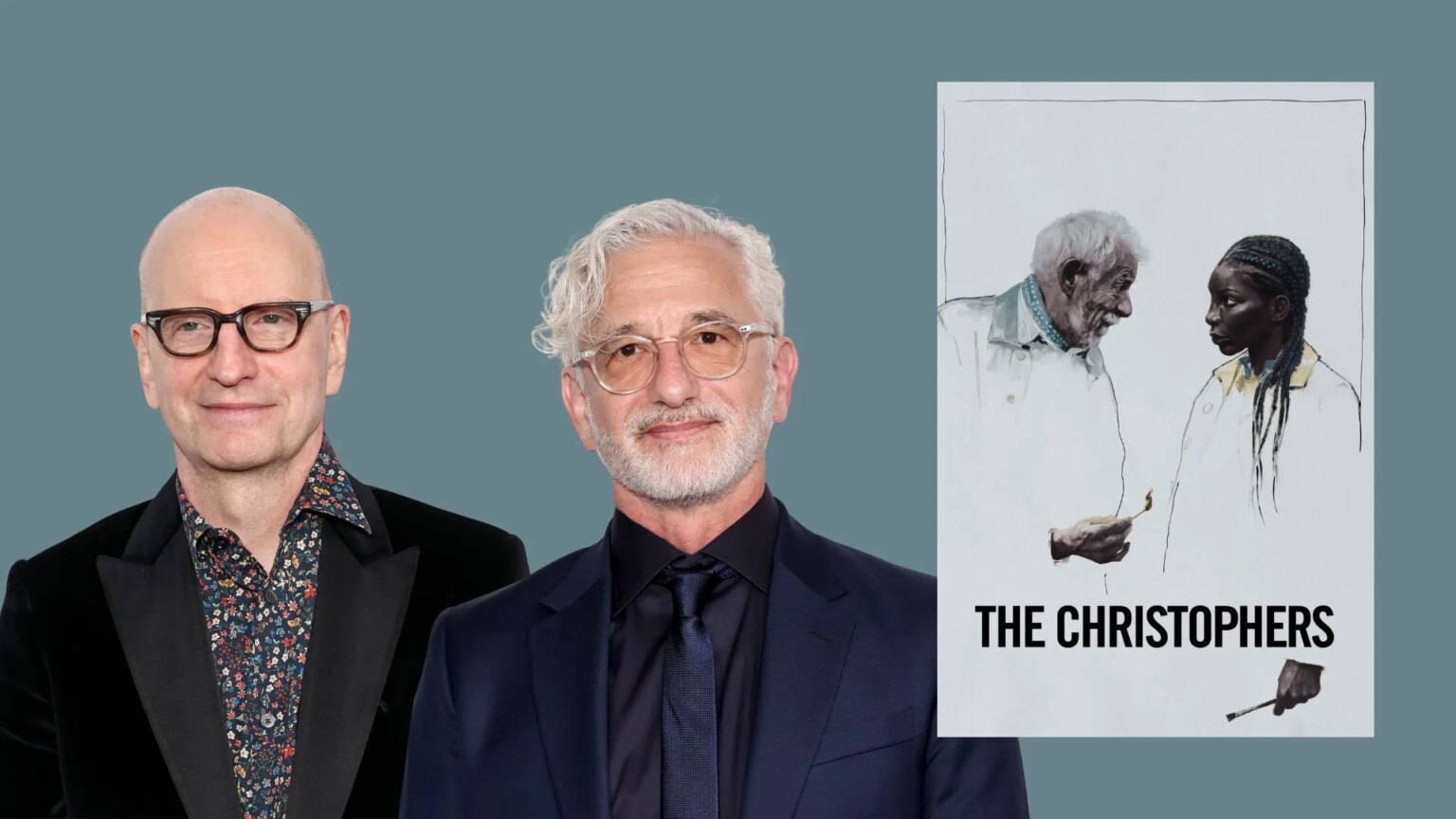
In The Christophers, Michaela Coel plays Lori Butler, a painter hired by a pair of bumbling siblings for an odd sort of job. They want her to go work for their father, a renowned artist named Julian Sklar (Ian McKellen), who has largely shunned the art world, spending his waning days being the Simon Cowell on an obscene reality show called Art Fight and recording Cameo messages to fans for lunch money. What Julian’s kids really want, though, is for Lori to put her skills to work secretly forging a set of paintings to complete their father’s great masterwork, a long-running series of portraits called “the Christophers.”
Directed by Steven Soderbergh and written by Ed Solomon, what starts as a con movie quickly morphs into something far more delicate and layered. Staged as a kind of a two-hander, and largely confined to the narrow spaces of Julian’s multi-level London home, the flamboyant, witty painter quickly susses out that the young forger has more to her than mere interest in a job, though her plan eludes him. Testing and prodding her, the two begin a contentious dialogue about pouring themselves into art and having their relationship to it transformed by the public’s—sometimes harsh—reaction.
Solomon’s funny, lively, florid, and moving script wrestles directly with what it means to lose touch with the reasons people make art in the first place. The film examines how the artist persona can distract from a real sense of purpose, embittering artists in the process. It’s a film about the painful realities that often stop artists in their tracks. It’s also a film about legacies, both positive and negative, and the complicated give-and-take of artistic inspiration. All of it anchored by unfussy, clear-eyed direction from Soderbergh, and a pair of incredible performances from Coel and McKellen, whose interplay feels like watching an acting masterclass.
The Christophers is the fourth collaboration between Soderbergh and Solomon, best known as the writer of Bill & Ted’s Excellent Adventure and Men in Black. They first linked up for the unusual, experimental TV series Mosaic, an HBO drama that was made available as an interactive app in which the viewer could experience the story from different characters’ points of view, resulting in multiple pathways through the plot and unique endings. They followed that up with the cool neo-noir film No Sudden Move, and the HBO Max miniseries Full Circle.
I’ve interviewed Soderbergh before, but after being floored by The Christophers at TIFF, I knew I wanted to talk with him again, along with Solomon, about the film, which seemed to come from a personal place for them both. Solomon, who had a stretch as one of Hollywood’s more successful jobbing screenwriters working on the scripts for movies like Super Mario Bros., Charlie’s Angels, and Imagine That, has since shifted into work with more obvious creative passion behind it. Soderbergh has never stopped working, often releasing two or three movies per year, even after announcing his retirement from film in 2013. I was interested in how Soderbergh and Solomon related to their own work, and how they saw themselves in The Christophers.
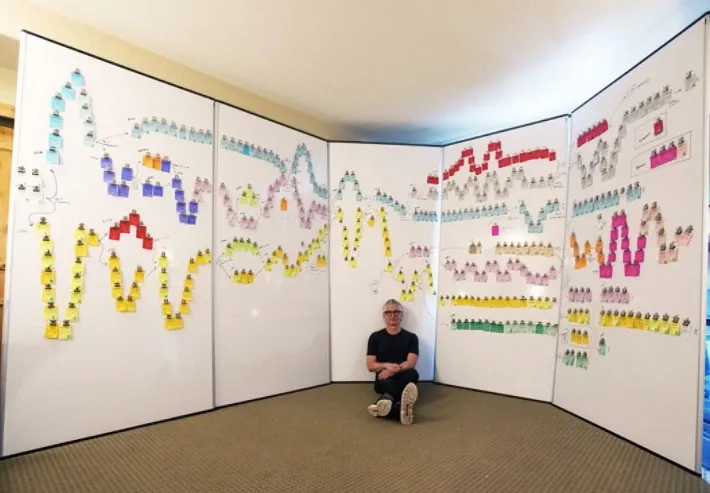
When I got on the Zoom call with the two of them, though, I was immediately distracted by the large whiteboard behind Solomon, all covered in different color cards.
Is that how you write? Is that how you outline?
Soderbergh: That’s how Ed writes.
Whoa.
Solomon: Well, this is a TV show, so each board is a different episode. The white cards are just the basic story. And then I put colors for each character up. Just so I can track where each character appears and where they are. Then there are different codes as well, for “friend group dynamic,” “procedural element,” et cetera, just so I have a sense visually. This was not how we put together The Christophers.
I would think not. But you have done a couple of TV shows together. Was that what it looked like?
Soderbergh: Yeah, pretty much.
Solomon: Oh, yes. In fact, there’s a picture of me sitting on the floor against this massive board that we did for Mosaic that was in the room between the writing space and Steven’s cutting space. It was the whole show done in this way. It’s bonkers.
That must have been, because that one was choose-your-own-adventure.
Soderbergh: Yeah. It was quite a process.
At TIFF, you had mentioned that on The Christophers, you went to Ed looking to do a Patricia Highsmith kind of story, and it evolved into this. Could you talk about how that happened?
Soderbergh: I think it was just in my one-sentence pitch, kind of darker, more cynical, [laughs] less hopeful. Initially I was thinking more of Lori as a Tom Ripley than she became. And when I say “became,” by the time we had a second discussion about it, it had already evolved into something very much like what you see now. It had already taken on a much more complex emotional structure. That’s typical I think of any project that you start, in which it’s literally one sentence. It kind of allows you to jump in a lot of different directions. And just by chance, when I described it to Ed, it dovetailed with a bucket of experience that Ed has had in his life that he hadn’t been able to pour into anything else.
Okay, so which parts were from your life? Did somebody once wring you out on a reality show, or…?
Solomon: [Laughs] That part, thankfully, I don’t think was. However, I have had working experiences with people who are now film executives, for instance, who were once critics. I did have one really quite meaningful conversation with somebody who had eviscerated something of mine. Twenty years later, I mentioned it, and he had a vague memory of it, and I said, “Well, here, I can refresh you.” [Laughs] He read it and he was just like, “Ooh, I was in my mid-20s.”
[Laughs] It’s a great excuse.
Soderbergh: Oh my God, if there had been social media when I was younger, especially in my teens, I never would’ve had a career. I was such a punk. I was so opinionated. I would’ve burned bridges that I didn’t even know existed just to prove a point. I feel very lucky that I didn’t grow up with that stuff.
I feel like that’s pretty normal, although Ian McKellen’s character in the movie is kind of like that even in old age.
Soderbergh: Yeah, which is what makes him fun to watch, but when you’re in the exhaust of his jet-engine opinions, it can be a little disorienting and destructive. The idea of legacy was something we talked about a lot. I think every creative person who reaches a certain stage in life is grappling with this issue of, Is my best work behind me or in front of me? You want it to be in front of you, but depending on how you’ve structured your life, you may not be aware that your best work is behind you. That’s one of the reasons I don’t read reviews. So then I can postpone that issue until I’m dead.
Solomon: [Laughs] You’ll finally read the reviews when you’re dead.
Soderbergh: Yeah. When I’m dead, I’m gonna go back. [Laughs]
Some artists like to engage with reviews, and it becomes a part of their thinking. I guess neither of you are into that.
Soderbergh: Well, to me it becomes the equivalent of explaining a joke to somebody. Nobody’s ever had a joke explained to them and then laughed. It just doesn’t work. I think it’s just a fool’s errand to tell somebody, “No, you’re looking at it wrong. If you look at it like this, you’ll really like it.” I don’t know where that goes.
Solomon: Yeah, I get so tempted. If I accidentally see a comment on something on social media, 14 posts down, I’ll read it and I’ll go like, “No, no, you should read what that person said on Instagram instead of…” And it’s just crazy. It’s a labyrinth. It’s a set of landmines. And you don’t know where those landmines are, and as soon as you kinda open it up, you’re gonna step on one. And I just sort of feel like I’d like to keep my limbs as long as possible.
But it’s interesting, because in a lot of ways the movie is a validation of criticism, not always of being correct, but as being part of the discourse of art and legacy.
Solomon: I’ve had mentor figures in my life, some of whom I had met and had very intense personal relationships with, and some of whom I just admired their work. A few of them had received negative criticism on something. In fact, I’m thinking of two in particular who kind of dined out on the fact that they were critical darlings and press favorites. Until suddenly they weren’t. And the effect it had on both of the people I’m thinking about, caused them to go completely inward, and one gave up altogether. Like, literally stopped making work altogether and just sat in his backyard basically for a decade. And another one did the equivalent of what we do in the film with Art Fight. Basically said, Fine, I’m gonna give up all artistic aspirations and I’m just gonna go make money off my name. When they gave up, that was really, strangely painful.
One person who had given up, I’d never met, but when they sort of gave up creatively, I realized that I did have a relationship with them through their art. In this case it was a filmmaker. The criticism was a part of their changing their perception of themselves. They started to get criticized and then went where the love is. Because I think by that time, if someone is famous, the fame is almost more important. The notice, the attention becomes more important than what you’re actually getting attention for, sometimes, with some people. So that’s what we were exploring in terms of Julian’s relationship with his audience, quote-unquote. Who caused the turn? Who caused the criticism, and how did he react to it? And by reacting negatively, people reacted more, and then he got into an antagonistic relationship with the people for whom he was originally making the art, other than himself. Another theme in this is when Michaela says, “Well, maybe just do it ’cause it’s fun. Maybe just paint for yourself.” He gave that up. He became more aware of his audience, and when they started to, let’s say, get bored or sigh, he got self-conscious and then he pushed away from that and lost the ability to do it just for himself.
Soderbergh: Yeah. And he doesn’t continue to work and not show. He stopped working. And that’s a different animal. That indicates something even deeper than just criticism. If you were just worried about criticism, you’d keep making stuff and then let people see it after you’re gone. He won’t even do that. So this is clearly bigger than just a few people going, “I don’t like your paintings.” I mean, the trick if you’re a creative person is you have to keep evolving. But what if you evolve into something that people don’t like? Then what do you do? Not that the goal ultimately is to be liked, but most people I know who make things would like them to be appreciated.
Presumably, certainly if you’re showing work, you’re making it for an audience, right?
Soderbergh: Yeah.
Which comes up in the film. Along with the idea then of the public’s ownership and right to react to that art. But also, people like to draw biographical or psychological conclusions about the artist based on that. There’s an interesting aspect to the movie in Julian and Lori’s interaction, where in some cases she seems to know more about his inner world than he knows himself.
Soderbergh: Oh, sure.
She brings out these buried things. Is that an experience that you’ve had, where you’ve encountered, not necessarily criticism, but situations where you’re like, Oh, maybe I’m revealing more of myself than even I understood?
Soderbergh: I’ve had the experience of, after it’s all done, thinking, Oh, that’s what it was about. That there was something pulling me toward it and through it, but it required some distance, and occasionally some conversation, to really understand what I was exploring. That happened most recently on Presence. It should’ve been obvious to me that it was about my mother and her life as a parapsychologist. [Laughs] That the reason I was interested in that idea was having lived inside a belief system in which all those things are possible and are real. Things that you can’t see. That didn’t really hit me until it was done done and I started having to talk to people about it.
Solomon: You just reminded me, Steven, of a big thing that you and I once talked about. In a conversation Steven and I were having, I realized, Wait a minute, my mother is a painter. My mother quit for 12 years, and it broke my heart. She quit to be a mom, and then she resumed. But it was very painful for me to see her give up her dream right in front of us. We were too young to even understand what was happening, and then 12 years later when she resumed painting and I was an adult, it became clear, looking back, how painful that actually was to us that she extinguished that spark that really was her drive. Every day, into the studio, which was in our garage. Now, my mother was not someone who disappointed me by quitting or whose art disappointed me, but it broke my heart when she quit. Like what Steven just said about his mother, this movie is probably a lot about that, honestly. That relationship that I had forgotten about. Meaning, I just discovered it again in this conversation. Exactly what your question was.
What you’re talking about, in that case, amounts to lost time, right? I think the easy read on The Christophers is as a generation-gap story. But it’s more about legacy, and about what you’re doing with that time. Do you worry about that with yourself? Is that why you’re so productive?
Soderbergh: Well, I try to be productive because you don’t get any better by just thinking about it. But, you know, what this makes me think of is, what I’m looking to do is to find a version of conscious unconsciousness. You know what I mean? I wanna be operating on instinct that is supported by study and experience and passion. I’m trying to find this sort of flow state where it’s purely an instinctive process and not an intellectual process. There are stages in a thing that you’re making that require more of an intellectual, critical eye than other stages. But generally, I’m trying to go with what feels right. As Ed and I like to say, “what the thing wants.” The thing wants something. Figuring that out to me is more an emotional, instinctual process than a technical, intellectual one.
Solomon: Steven, are you aware, or are you, Corey, of the Noel Burch conscious competence learning matrix?
No.
Solomon: So it’s exactly what you were talking about, Steven. There’s four stages to it, the first being unconscious incompetence. It’s a lack of any awareness. Literally you don’t know what you don’t know. The second one is conscious incompetence. You’re starting to understand what you don’t know. It’s a kind of awareness. Third, conscious competence. You know what you know, and you’re conscious about what you’re doing. And then within this matrix, the place to try to get to, the one that Steven is talking about, is unconscious competence. Some people call it a flow state, where you’re not thinking about what you’re doing. You’re doing it, and the work is coming as a result of just the fact that you’re doing the work. You’re not trying to program it out or matrix it yourself. To me, that also speaks to your earlier question, Corey, which is, is it lost time or loss of purpose? Each of these characters, they gave up and lost their reason to live, or their reason for existing. The thing that gave them fulfillment, and gave them a sense of purpose.
So when you were writing the script, you said you didn’t have the same kind of fancy whiteboard outline, but were you writing it in a flow state or close to it?
Solomon: More than anything else I’ve done. In the last couple years, I’ve been trying to work from more of a—a flow state is aspirational. It doesn’t always happen that way, obviously. But I have been trying to. This board [gestures behind him], after I’d written the scripts, I put them up as a chart. I didn’t work from this board. But I’ve been trying to work more freeform. From the point of view of the characters, what would be surprising right here? What is the next truthful move that this person would make?
Soderbergh: The trick was to sustain a feeling of movement in the story without violating the characters in order to create that movement. We both felt the fact that it’s so intimate, and is almost a two-hander, it means the believability of everything they say and everything they do has to be at its maximum. There can’t be any moment in this movie that you feel is manufactured or it all falls apart. I think both of us drain toward things that feel somewhat real, even when we’re working on stuff that is in an unreal universe or context. But behavior is behavior. When you watch this movie, there’s never, to me, a moment where somebody says something predictable or unbelievable. I feel like you’re just watching these two people interact, and it’s just happening in front of you. That was the goal, and I felt like we were achieving that.
The dialogue, it’s not heavily stylized, but it definitely has a sort of rhythm to it, and witty, florid lines. How do you make that real?
Solomon: You embed it in the characters themselves. So in Julian’s case, he is a larger-than-life character. There’s a presentational quality to the way he speaks, as a human. He’s putting on a show. He’s creating a portrait of himself for people. It was very fun to write in that way, because knowing that he had his own lexicon and his own way of speaking that was slightly elevated allowed it to be written that way but still feel truthful.
I remember originally I was thinking maybe Lori’s got a few friends, and Steven’s like, “I think she’s a loner.” It was a really strong notion, because I think her power is in not speaking. And it’s a tough thing to do as a performer, to hold the screen with someone who is a flamboyant character, a big, larger-than-life character, but hold the screen with equal power. I really like her as solitary, and him as solitary. They don’t have a lot of people left in their lives. She probably never had a lot of people in her life, and he did. He had a lot of people in his life and sort of—
Pushed them away.
Solomon: Yeah, pushed them away one by one, and then in masses.
Were you thinking of specific actors when you were writing it?
Soderbergh: I told him that’s who I envisioned.
Michaela and Ian?
Soderbergh: Yep.
Oh, wow.
Solomon: We didn’t know them. Neither of us knew them.
That’s amazing. First of all, what made you think of them two, and also what made you think that they would work so well together?
Soderbergh: I just loved the image in my head of the two of them sharing a frame. I just thought that was really loaded. And obviously I like their work, but as Ed was saying, it really came down to, they’ve gotta be really well matched or the setup doesn’t work.
Did they take convincing?
Soderbergh: No, no. We got a very fast yes, which is what you want, and is a good sign. It’s fascinating to see two people who are equally compelling and powerful, but just in completely different ways. What they share that I think is kind of impossible to extinguish is just this raw intelligence. I think people who are good at things are fun to watch, you know. Proficiency. Immediately, you know she’s smart and probably very capable, and then you get more examples of that as the movie goes on. He’s obviously talented and smart. I enjoy watching somebody who’s really good at something do that thing.
What’s it like watching them actually perform it? First of all, were you on set?
Solomon: Oh, yeah.
So what was it like then, seeing them bring it to life the way that you were envisioning on the page?
Solomon: Well, I should say, I have come to not believe in the phrase people are always saying, “Is it your vision?” You know, so to speak. I don’t buy that. What I have come to know is that the tension between how it was originally envisioned and what somebody who is talented brings to it, that gap is where all the excitement is. All the excitement, all the energy. And so it was beyond a thrill to be in there while they’re learning the part, and rehearsing the part, and reading. Ian would read a line out loud before we started shooting, then speak his subtext. I remember once leaning to Michaela and going, “Can you believe this is happening right in front of us?” And she was like, “Yeah, I know. We’re always gonna have this.” So to me, that is my favorite part, watching the director and the actors discover it. That’s the joy to me, leaning back against the wall and watching them discover what it is, what the it of it is.
What were you discovering, Steven? What was surprising you through the process of it?
Soderbergh: Just little things, you know. It has to be better than the script. When I say, “it has to be,” that’s the job. No matter how good the script is, when you get everybody in there and you’re in the space, it should be even better than it reads, because now it’s alive. We’re looking at cut footage every night, so we have the luxury of looking at it, talking about it, and often going back and picking up things or doing things again that we felt weren’t better. I like that process.
A tiny example is, it’s just one shot, in the interview scene, he gets up to go put water in the vaporizer. It’s him leaving frame, and she’s in the room all alone. The shot’s on the floor looking toward her. I saw it, and I was like, it’s clear that she’s put on a mask to engage with him in this initial interview. I just wanna see a physicalization of her having a, Holy shit, what did I get myself into? moment. And so the day after we looked at that scene, I go, “Oh, I just wanna do that one shot again and literally just have her put her head in her hands as though, I don’t know if I can sustain this, and then switch it off.” When he comes back into the room, she’s back in character again. You’re just looking for a series of little things like that that just add up over the course of 93 or 94 minutes. The architecture and the furnishings were all correct. This was filigree as far as I was concerned.
Solomon: But if you think about that moment. What it does contextually for that relationship is actually quite big. A little discovery like that, it enriches that relationship quite a lot, when you have just that access to that part of her mind.
Soderbergh: Her inner state. Yeah.
Can you guys talk at all about—particularly in Julian’s case, but you see it in both characters—the antipathy towards the industry that they’re in, and especially the capitalistic models that guide it. Obviously, you guys work in Hollywood and work in these systems. How much of that was part of the genesis of the movie?
Soderbergh: Well, I think the issue of gatekeepers, cultural gatekeepers, is interesting. It’s different in the business Ed and I work in, because these things are expensive. If you’re a painter, you can kind of go to the wall and do your work. And the good news is nowadays, with social media, there are people that have become very successful and high-profile painters by just doing their work, their very good work, and posting it. They’re not as beholden to the gallery class as they used to be, which is fantastic. But it is complicated by the fact that for the most part it costs money to go make a movie. You can make a movie for cheap, but even cheap is expensive compared to buying a canvas and some paint.
The reason I ask is because it feels like Julian drives himself into a hole creatively in part because of his antipathy towards the system he’s a part of.
Soderbergh: Oh, totally. As she says at one point, he took hold of that narrative after he was already getting punched. He transferred the criticism from his work. He sort of deflects it into this other area. Oh, this business is corrupt and the people that run it are Philistines. But the fact is, he wouldn’t have been saying that if people kept loving his shit.
Solomon: [Laughs] That is exactly it, yes. One-hundred percent.
Ed, have you kind of felt that way through your career at all?
Solomon: The state of the industry and how it is evolving makes me want to work, more and more, in the way that we worked on this, which is without anybody paying attention. Creating something that we wanna create in the way that we wanna make it, and taking the gamble on ourselves. The last twelve years since we started Mosaic, and everything else I’ve done in between, I’ve written on spec. On the stuff with Steven, there’s not much interference from outside forces. On Bill and Ted Face the Music, there was not much interference ’cause nobody cared. But I have not had that experience where I have gone, Oh, it’s their fault that I’m not succeeding. I have the unfortunate other gene which is, This is all my fault. [Laughs] I have no healthy defense system in place.
[Laughs] That’s me too. That’s where I tend to go with that. It’s always a “me” problem. Steven, obviously you went through the “retirement” era. The only reason I would even connect it, to be honest, is because you announced it publicly, so it became a bit of a performance of retiring. Looking back on that, and the fact that, frankly, you never actually stopped working, did that experience change your working process at all?
Soderbergh: No, it didn’t change the process, it just changed the angle on the job. I conflated two things that were actually separate. That is, the state of the business and my frustrations with the business, and the job of directing. They’d gotten sort of blurred together in my mind, and it wasn’t until I went back to work, that I realized, Oh, I love this job, I just don’t like the business very much. I was so frustrated with it that it was kind of occluding my vision. Yeah, so I won’t make that mistake again.
Sure. But you do seem to have kind of gotten into a bit of a mode where you’re just working on the projects that spark your interest, and where they can be, they’re pretty small. Does that protect the work, trying to approach it that way?
Soderbergh: That’s partially a function of liking to work like that because of the freedom. But it’s also partly a function of other large-scale projects that don’t get made.
Right. Do you wish they would?
Soderbergh: Yeah! There have been a couple of things that are much larger in scale that just didn’t happen.
Well, I guess the Star Wars thing is one.
Soderbergh: Yeah, that’s one of them. That’s the most high-profile of them, but it’s not the only one. It can be frustrating at times, if somebody feels like, Yeah, he’s kinda, kinda hitting singles and doubles. Doesn’t sound like he really wants to get up there and smack one into the upper deck. That’s not true. It’s just the fact that occasionally when I have one of these bigger ones, they haven’t gotten made.
You guys have now worked on the two TV shows and the two films.
Soderbergh: Yeah.
It’s been a great collaboration.
Solomon: I wanna say 12 years ago, Casey Silver, who produced No Sudden Move and Mosaic and Full Circle, came to me and said, would I be interested in this little 10-minute experimental thing with Steven? And I was like, “Uh? Are you kidding? Absolutely.” A chance to try something in a genre that was new, but also in a medium that literally didn’t exist. So I was like, “Hell yeah, let’s, let’s try.” I think a lot of other people probably just didn’t wanna do it. [Laughs] We both were very excited by the idea of trying something completely untried, of leaping off the cliff and just hoping there’s water at the bottom. I think we forged in that a relationship that I’ve found incredibly meaningful. Trust that has been given me at times has allowed me to really do better work and to improve my own craft and skill set. I think we also both share a desire to not go backward. To keep trying new things and keep pushing forward.
The Christophers is also about moving forward, and legacy, and the next generation of artists. Are there filmmakers or things that you’re seeing in film that are exciting you?
Soderbergh: All the time. I think what I’ve noticed over the last five to six years—and this is partially just because of this issue of who gets opportunities and who gets access to resources—a lot of the most interesting, exciting work is in the genre space, and specifically in the sort of horror-thriller space. Typically, if you have a really good idea, you don’t need as much money as you do on a lot of other things. And genre is just a great delivery system for whatever you wanna talk about.
Have you seen anything in particular that’s caught your eye?
Soderbergh: I’m a little behind as we speak, but I really enjoyed Weapons last year. I enjoyed Sinners also. But Weapons, I just thought had really good movie ideas in it, and it used structure in a way that just kept you leaning forward and kept surprising you. And again, it reinforced this idea, Ed and I were talking about this the other day, the other thing about genre: having parameters, having a box of a certain shape and size is a good thing. So to watch what filmmakers do within a specific box, whatever genre that is, is really exciting. It’s fun to watch how far people can push it before it breaks.
Have you been seeing similar stuff, Ed?
Solomon: I am the father of a child, of a two-year-old. [Laughs]
That’s a lot of Zootopia.
Solomon: Yeah. [Laughs] We haven’t watched anything with him yet. Although he’s just starting to go to plays, and it’s so sweet to see. So I’ve been in a bit of a vacuum culturally. I would say I’m excited to venture out again shortly, as soon as this show is done.
I was curious about it less for you to name some movies, and more what’s exciting you, and in turn inspiring you?
Solomon: Well, I am very fortunate that I’m married to a person [Lucy Prebble] who is just such an incredible writer who’s working on very exciting things. I get very inspired by her, and I’m blown away by the way she thinks about work and the way she’s always pushing herself. Steven, you guys have a real similarity in terms of the drive to really push beyond yourself, you know? So I have gotten a lot from her, honestly, and watching as she’s now starting to think about working again, ’cause we had the baby, so she’s taken a couple years off. That’s been very inspiring for me.
What could be better than that?
Solomon: It’s true.
Recommended