
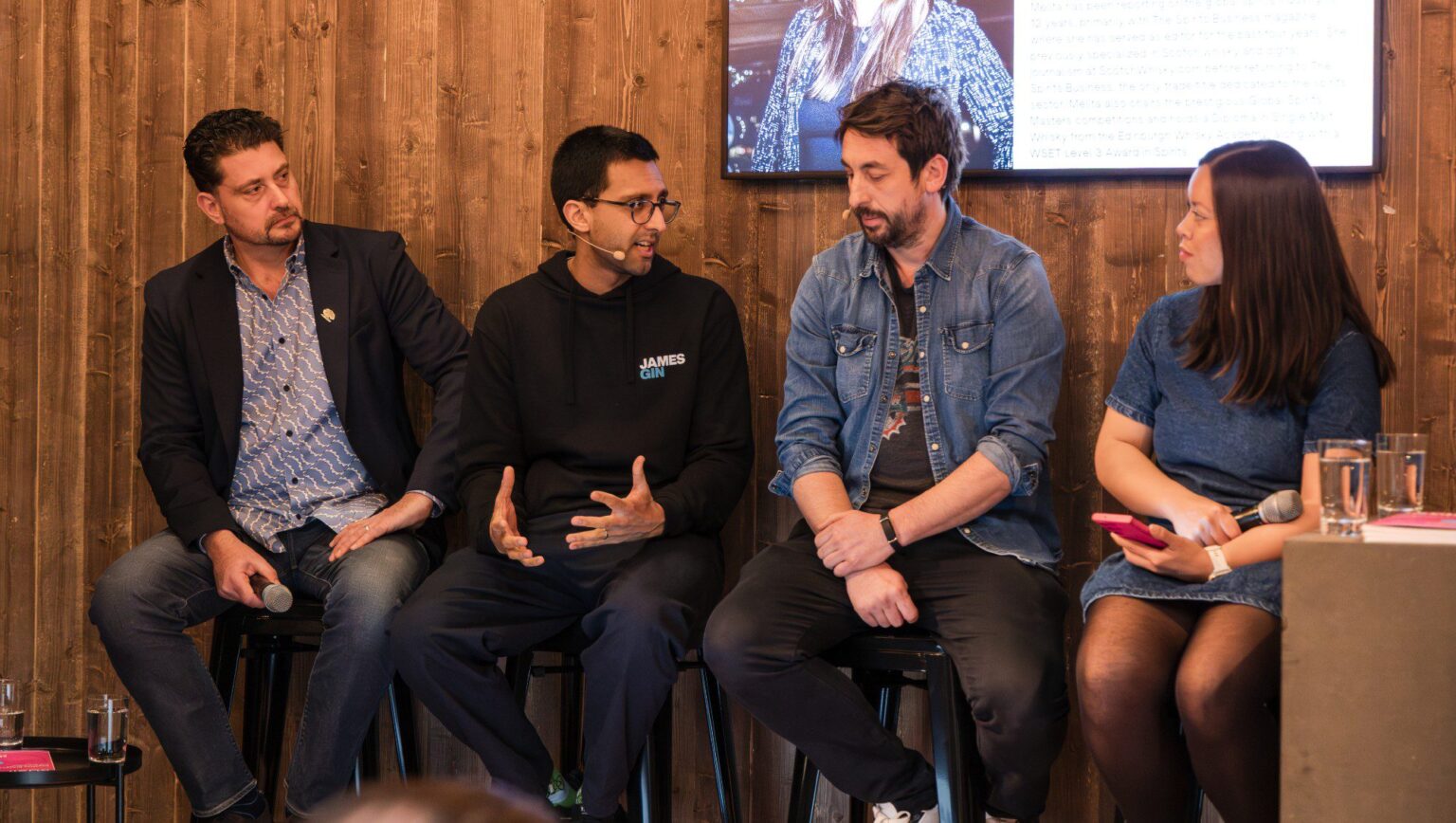
Is the perception of celebrity spirits in the trade changing? And how are brands working to prove their credibility with on- and off-trade professionals?
 L-R: Vincent Hanna, Vishal Patel, Duncan Frew and Melita Kiely
During ProWein 2026 at The Spirits Business Hub, three experts joined a panel discussion to offer candid insights into the world of celebrity spirits, titled ‘Behind the celebrity spirits: people, stories & strategy’.
Moderated by Melita Kiely, editor-in-chief of The Spirits Business, the speakers were: Vincent Hanna, CEO and co-founder of Brother’s Bond Bourbon, also co-founded by The Vampire Diaries actors Ian Somerhalder and Paul Wesley; Duncan Frew, co-founder of Wolfie’s Gin, co-founded by musician Rod Stewart; and Vishal Patel, CEO of James Gin, founded by former Top Gear presenter James May.
The first question posed to the panel was whether the perception of celebrity spirits among the trade was changing.
Patel answered: “In terms of changing, I think the perception is probably more negative. When I’m speaking to buyers, speaking to distributors, they say: ‘Oh, you’re just another celebrity gin brand, I’ve got two a penny of those’.
“So, I think it’s incumbent upon the three of us and other founders and CEOs of celebrity spirits to try to convince people that actually there isn’t a negative stigma, there isn’t fatigue of too many celebrity brands. We’re trying our best to try to show people that we’re more than just a celebrity brand – we’re a brand on our own.”
So, how can celebrity-owned or backed brands break through and convince the trade of their quality and seriousness about the industry?
Wolfie’s Frew said: “If you go into a credible bar and say, ‘Hi, I’ve got Rod Stewart’s whisky’, they’ll tell you to piss off. It’s as simple as that. And most bartenders we’re working with probably don’t even know who Rod Stewart is, to be honest with you.
“So, fundamentally, your brand itself needs to stand up. It needs to have a positioning. The liquid obviously needs to be very, very good.
“Does a celebrity being part of the company help? Absolutely. What it’s helped us with fundamentally is opening doors, making noise and gaining awareness. But it doesn’t create rate of sale; it doesn’t create reorders and repeat orders. That’s where the brand needs to come in.”
Hanna concurred with Frew, adding: “If you’re relying solely on fame to sell, you’ve got a short runway. The story has to be there. It has to be authentic. It has to be quality-driven. It’s product first.
“I think what we’re learning – [along with] a lot of celebrities who did throw their hat in – the ones coming in today are far more involved because they know that the headwinds are huge.
“The days are gone when it was slap your name on a bottle and you could sell it and retire. That doesn’t exist anymore. I always tell people who want to get in [to the spirits industry], if you’re ready for the long road, you’re not going to make money for a while. You’re going to sweat a lot. You’re going to be on the road constantly. And it’s a community you have to become a part of; you can’t just expect to be welcomed in. You have to prove [yourself].”
The full conversation is available to watch on YouTube and via the video link below.
Related news
The most successful celebrity-backed spirits brands
Consumers pay 73% more for celebrity spirits
Ten of the best celebrity-fronted spirits campaigns