
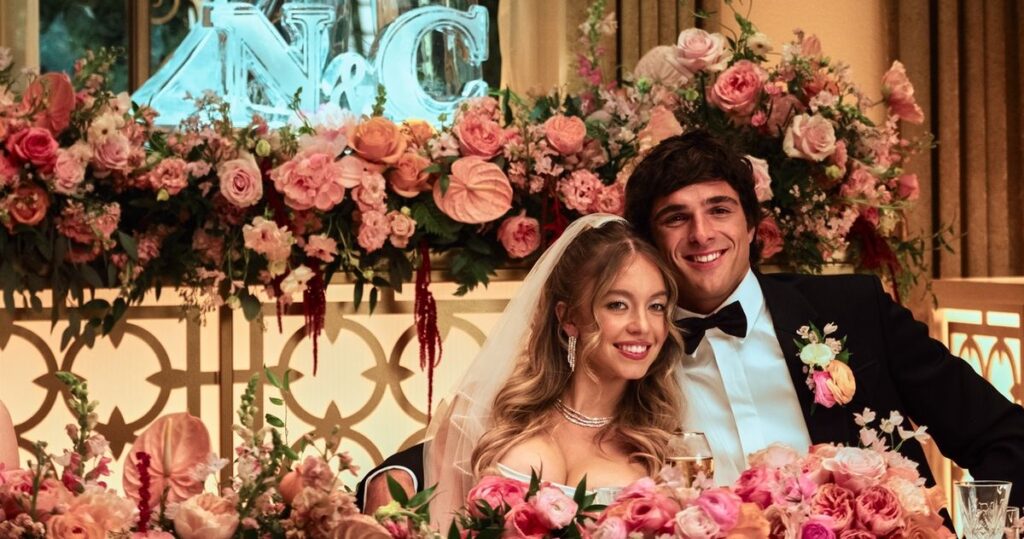
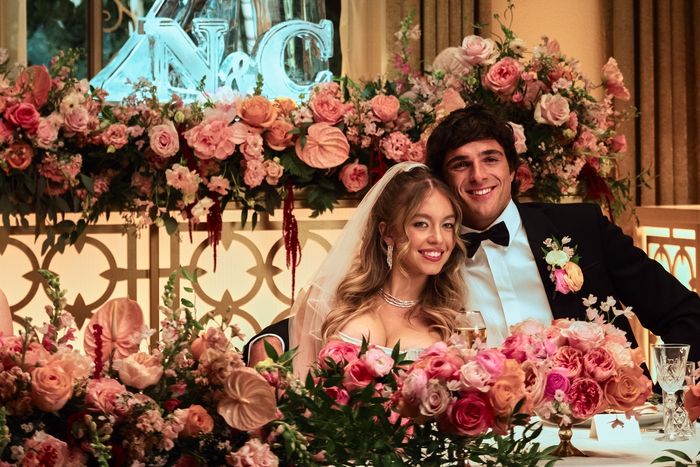
Cassie (Sydney Sweeney) doesn’t want $50,000 worth of wedding florals to prove that her marriage to Nate (Jacob Elordi) is pure; she wants it to prove that they’re not poor.
Photo-Illustration: Eddy Chen/HBO
Need more? Sign up for Euphoria Club, a newsletter overanalyzing season three of Sam Levinson’s HBO fever dream, for subscribers only.
Spoilers follow for the third season of Euphoria through the third episode, “The Ballad of Paladin.”
When Cassie asks her ex-best friend Maddy “Who am I?” in the second episode of this season of Euphoria, it’s played for a laugh. But Sydney Sweeney delivers the line with such genuine curiosity that the question falls onto us and lingers like so much iridescent body glitter. Who is Cassie these days? She’s a Gen-Zer who has direct experience with how the internet can commodify and weaponize sex but somehow didn’t know anything about OnlyFans. She’s an adult complaining to her fiancé that they haven’t renovated various rooms in their hideous nouveau-riche mansion and insisting that $50,000 isn’t an exorbitant cost for wedding florals, but she has no grasp of their actual finances. Rue might miss high school, but Cassie’s the member of this sorta-friends group who seems to have regressed the most since then, clinging to heteronormative gender rules as if they’re the only things she’s ever learned. So far in Euphoria’s third season, she’s a cipher, a character defined more by her garish costumes — sexy dog, sexy baby, sexy American flag — than by any sense of what’s actually going on internally, behind what Nate calls that “pretty face.”
In third episode “The Ballad of Paladin,” Cassie is still this show’s avatar of all-cleavage sexiness, her breasts overflowing out of her wedding corset as she walks underneath multiple arches of pink roses and down an aisle lined by vases similarly stuffed with flowers. Her physical voluptuousness echoes the vivaciousness of the blooms, and their hues of pastel pink and cream evoke demure femininity under the gaze of her soon-to-be husband. But the idea that Cassie is acquiescing to anything is an illusion: “My moment is walking down that aisle, surrounded by my friends, family, and $50,000 worth of flowers,” Cassie told Nate as they fought about the wedding’s rising costs. As she usually does, Cassie got what she wanted, and we finally get some clarity about who she is now: a woman who doesn’t actually want $50,000 to spend on flowers. What she actually wants is the ability to throw away the money on flowers and call that waste happiness; she wants a gaudy wedding not to prove that her marriage to Nate is pure but that they’re not poor.
This season of Euphoria persistently laces characters’ carnal desires with capitalist complications. Rue asks Jules to come to Nate and Cassie’s wedding not as a straightforward date but as a business arrangement; Zendaya gives Rue a joking tone when she says she’s Jules’s “sugar daddy” now, but Rue still tucks cash into Jules’s bra. Cal learns about Cassie’s foray into OnlyFans from another member of his Sex and Love Addicts group, but when he asks Nate about it, he seems less concerned that his son’s relationship with Cassie is in trouble than he is that this online launch means Nate is ruining the construction business Cal built from the ground up. Every relationship is either a transaction, an investment, or both; when Maddy learns Cassie and Nate are engaged, she looks at Cassie’s gigantic diamond ring and thinks about how “that dumb bitch waited years … just to clear her conscience” and receive a material reward for her morally questionable choices. And when Cassie justifies her OnlyFans work to her neighbor Heather, she quickly abandons her initial description of it as something that helps men feel cared for in favor of economic terms of “supply and demand.” Cassie isn’t doing this because she actually cares about making lonely guys feel like she’s paying attention to them. She’s doing this because she’s looking for a direction in which to point herself, and upward mobility is the only thing people in her “right-wing suburban bubble” care about, or respect.
All of these disparate moments come together in a stomach-churningly voyeuristic fashion during Cassie and Nate’s first dance as a married couple in “The Ballad of Paladin.” Their wedding is already a horror show. Cassie’s mother, Suze, slipped into a stream-of-consciousness rant about Cassie’s awful and absentee father while walking her down the aisle. Maddy looked brokenhearted as Nate’s mother blathered on racistly about how before Cassie, Nate dated “a girl that isn’t right.” Naz, Nate’s partner in his failing plan to open a retirement community, crashes the wedding to demand the hundreds of thousands of dollars that Nate owes him. After Naz reveals the truth about Nate’s debt, Cassie’s rigor-mortis smile and gushing tears as she insists to sister Lexi, speaking directly into the camera, that she’s happy because “of course, it’s my wedding day,” is the first moment of her façade crumbling, and her choreographed dance with Nate shatters it completely.
As Nate insists that she “smile, smile” and explains that they’ll have to “downsize” to pay Naz, Cassie reacts with all the hyperbole of a girl who, since puberty, has been reassured implicitly and explicitly that her body will get her everything she wants. Because here she is, squeezed into a minidress and grinding on Nate in front of all their friends and family, and for what? Is his “Trust me, I love you” actually enough? As Nate pantomimes reeling Cassie toward him like a hooked fish, she starts acting like one — flailing around and gasping for air before she cries out, “I don’t want to be poor!” Cassie wiggles her body in an erotic pantomime as she legitimately weeps at the realization that this wedding might be her defining, and final, moment as a rich person, and it’s a moment that finally clicks Cassie’s whole deal into focus. Her terror at being knocked down the class pyramid motivates both her enmity toward Nate (“You’re not a man. Men provide,” she snarls at him after their dance), and her woe-is-me sobbing as Naz’s enforcer attacks Nate in their home. (“This is my wedding night … This is so unfair,” she cries while Nate’s getting the shit beaten out of him in the background.) After Naz and his guy leave, Cassie’s presumably less concerned about Nate’s cutoff toe than she is about what Nate’s failings mean for their bank account.
If we’re to believe Nate, one of the primary reasons his company is in such staggering debt is because the construction of the assisted-living facility is being held up by the growth of an endangered native flower, the white fritillary, on their proposed site. (In an appearance on Fallon, Elordi referenced the flower as a “good phrase … for my season.”) White lilies have alternately symbolized purity, desire, and decay for hundreds of years, and their role in potentially ruining Nate and Cassie’s futures reflects how Euphoria has long used flowers to color in this pair’s relationship. Back in season two, floral wallpaper lines the bathroom from which Cassie, secretly dating Nate behind Maddy’s back, calls to tell him, “I’m not a good person. I don’t like what we’re doing,” and in that episode’s final moments, hundreds of roses, a gift from Nate, line Cassie’s vanity as she weeps over the tumult of their affair. Cassie is emotionally overwhelmed but still, she feels chosen by him and his gift of all these flowers, and the little smile playing over her face reflects that feeling of specialness. Now, with the wedding florals — so similar to that season-two image in color palette, volume, and association with Nate — Cassie wants to be able to buy them for herself with money people give her for looking the way she does.
“You don’t know how much power you have,” Nate told her in that episode, but years later, Cassie understands. Cassie’s obsession with gaining the approval of men, and the financial way in which men demonstrate that approval, feels like the most multifaceted thing about her. It’s frustrating that Euphoria is applying versions of this framing to Jules, Maddy, and Rue, too, like the only way it knows how to give female characters interiority is through adjacency to sex work. But for Cassie, her OnlyFans turn and wailing exclamation that she refuses to be poor are the long-gestating payoff to incremental character development that blossoms into a bouquet of significance in “The Ballad of Paladin.” For Cassie love is now secondary to abundance, and, as crassly greedy as her character has become, at least it’s a kind of growth.
Sign up for Euphoria Club
A newsletter overanalyzing season three of Sam Levinson’s HBO fever dream, for subscribers only.
Vox Media, LLC Terms and Privacy Notice
Related