
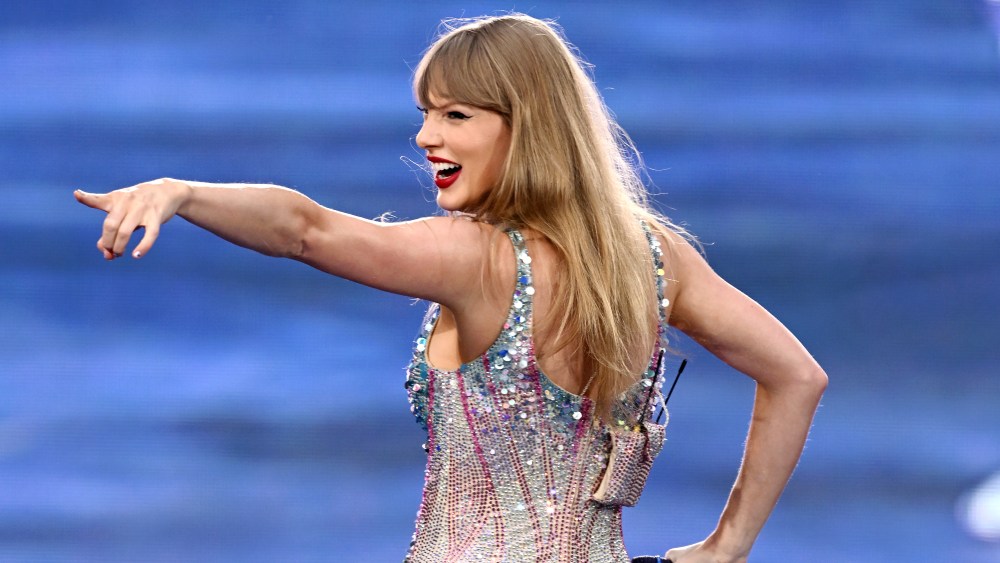
Taylor Swift has taken a new legal step seemingly aimed at protecting her identity in the age of AI — following in the footsteps of actor Matthew McConaughey.
On Friday, April 24, Swift’s company filed three trademark applications with the U.S. Patent & Trademark Office. Two relate to sound trademarks covering her voice: one is “Hey, it’s Taylor Swift,” and the other is “Hey, it’s Taylor.”
The third trademark is a visual trademark covering “a photograph of Taylor Swift holding a pink guitar, with a black strap and wearing a multi-colored iridescent bodysuit with silver boots. She is standing on a pink stage in front of a multi-colored microphone with purple lights in the background.”
Here’s the image from the trademark application filing:

U.S. Patent & Trademark Office
The filings, made on behalf on Swift’s TAS Rights Management, were spotted by intellectual-property attorney Josh Gerben of Gerben IP. According to Gerben, her trademark applications reflect growing concern among talent in the entertainment industry about potential danger of AI to steal artists’ ability to control their voice and likeness without their consent.
Variety has reached out for comment to reps for Swift and to Rebecca Liebowitz, partner at law firm Venable, who is listed on the trademark applications.
Historically, trademarks aren’t designed to protect an individual’s general likeness, voice or persona. But the theory pursued by McConaughey’s legal team is that such trademark protections would provide additional legal remedies beyond traditional right-of-publicity claims to fight against AI-generated content that misappropriates someone’s likeness.
Swift’s likeness has been used without permission in numerous AI fakes, including by Meta’s AI chatbots and in pornographic images that have circulated on the internet. In addition, in the run-up to the 2024 U.S. presidential election, Donald Trump shared AI-generated images of the singer inaccurately suggesting that Swift had endorsed Trump.
Swift’s trademark filings come after lawyers for McConaughey secured similar trademarks. In 2025, the U.S. Patent & Trademark Office granted eight trademarks for the actor. Those include a sound mark on audio of McConaughey saying, “Alright, alright, alright!” — his memorable line from the 1993 comedy film “Dazed and Confused” — and audio and video clips of him.
The lawyers behind McConaughey’s “trademark yourself” strategy believe it gives them an additional legal arrow in their quiver if they were to challenge an AI-generated replica that tried to capitalize on the actor’s image and likeness without permission. Individual states, including New York and California, already have right-of-publicity laws that prevent unauthorized commercial use of a person’s image and likeness. But trademark infringement lawsuits can be filed in federal court — a potentially potent greater deterrent to misuse, because those cases apply nationwide.
In a blog post Monday, Gerben discussed how Swift’s trademark strategy could be used to defend her name, image and likeness rights. (Gerben does not represent any parties involved in the Swift trademark filings.)
“Theoretically, if a lawsuit were to be filed over an AI using Swift’s voice, she could claim that any use of her voice that sounds like the registered trademark violates her trademark rights,” Gerben wrote. The singer’s image-based filing “serves a similar purpose. By protecting a distinctive visual, down to Swift’s commonly worn jumpsuit and pose, Swift’s team may gain additional grounds to pursue claims against manipulated or AI-generated images that evoke her likeness.”
The “trademark yourself” approach has not yet fully been tested in court with respect to AI. However, in theory, an actor or artist with such trademark protections could issue takedown claims against an AI platform similar to the way a studio can enforce its copyrights. In December 2025, for example, Disney sent a cease-and-desist letter to Google, alleging the tech giant’s Gemini AI platform was being used to illegally generate copies of dozens of its trademarked characters. By the next day, Google had pulled down the offending videos.
“Ultimately, Taylor Swift and Matthew McConaughey’s recent trademark filings are testing new theories on how trademark law will work in the AI age,” Gerben wrote.