
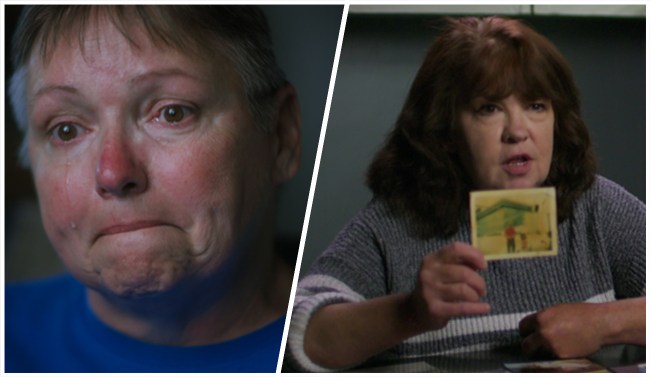
The search for dozens of bodies drives My Killer Father: The Green Hollow Murders — but by the end of the three-part Paramount+ docuseries, the biggest question isn’t where they are. It’s whether they were ever there at all.
The series centers on Lucy Studey McKiddy, who claims her late father, Donald Studey, murdered scores of women and forced her, as a child, to help dispose of the bodies. It’s a story that sounds almost too extreme to believe — something director Aengus James admits he wrestled with from the start. “I had a very hard time believing Lucy,” he tells Gold Derby. “I’m really distrustful of people, and I think people lie. I’m not a conspiracy theorist.” But the deeper he dug, the more complicated the story became — and the harder it was to walk away.
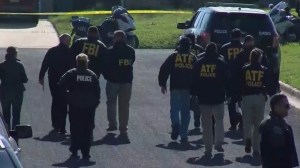

The case first caught his attention when it made national headlines, but it wasn’t the claim of “dozens of women” that hooked him. It was the pattern surrounding Donald Studey’s wives. “What really stuck for us immediately was that there were these three wives,” he says. “All died, and he had made the 911 call for all three of them.” Two were ruled suicides. A third raised questions. And when James realized law enforcement wasn’t actively investigating, the project shifted. “We were in this position of, well, do we really become the investigators in this story?” he says. “If we weren’t going to do this, it might not happen.”
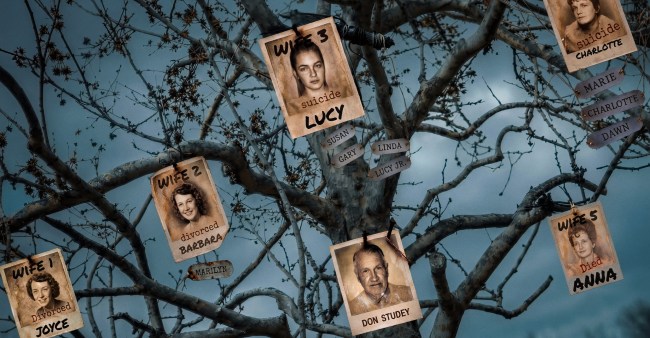 Family tree of Don Studey’s wives and girlfriends in ‘My Killer Father: The Green Hollow Murders.’ This Is Just A Test LLC/Paramount+
That decision pushed the filmmakers into unusual territory, including helping fund the exhumation of one of Studey’s wives. “It crossed every line for sure,” James admits. “Not a place I’m used to being.” But without that step, he says, “there was going to be no real investigation.” It also helped answer a key question before taking the project out to networks. “I really needed to know if there was a there there,” he says. “I didn’t know that.”
At the center of it all is Lucy — a compelling but deeply polarizing figure whose testimony drives the series even as it raises doubts. “She’s been told her whole life she’s a liar,” James says. “So in some ways, giving her voice was just amazing.” But working with her was far from simple. “A lot of it … was absolutely infuriating,” he says. “She’s incredibly demanding, incredibly distrustful.”
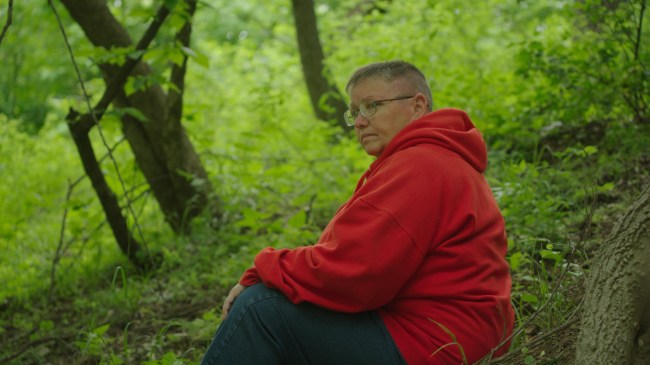 Lucy Studey McKiddy in ‘My Killer Father: The Green Hollow Murders’This Is Just A Test LLC/Paramount+
That tension boils over at the end of Episode 1, when Lucy suddenly explodes in anger — a moment that forces viewers to reassess her credibility. For James, it wasn’t new. “We were really on the receiving end of a lot of anger,” he says. “It was like a switch … exactly the way people described her dad.” That parallel is hard to ignore: a man widely described as charming, but volatile and violent. At the same time, James is careful not to reduce Lucy to that moment. “What’s not disputed is how much trauma is there,” he says.
Still, separating trauma from truth proves difficult. Lucy’s memories are vivid — including being asked to dump lye into a well as a child, not fully understanding what she was doing — but often lack verifiable details like names or confirmed victims. “Lucy’s very sure of things until they turn out sometimes not to be true,” James says. “But she’s also equally sure of things that… in my mind are definitively true.”
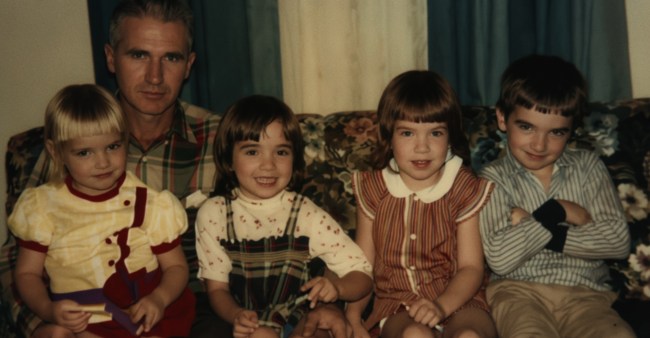 Don Studey, Lucy Studey McKiddy (far left) and her siblings in ‘My Killer Father: The Green Hollow Murders’Lucy Studey McKiddy/Paramount+
If Lucy believes her father was a serial killer, her sister Susan is just as certain the entire story is fabricated. “One person believes their father is responsible for dozens of deaths,” James says. “And the other looks you in the eye and says, ‘He never even had a temper.’” Navigating those opposing realities became one of the documentary’s biggest challenges. “It was really confusing… for both to be seemingly at times inaccurate.”
Other accounts only deepen the ambiguity. A man eventually comes forward claiming he helped Studey carry a body into the woods, though he can’t identify the victim. Studey’s sister Marilyn — who once fiercely defended him — delivers what she calls a “deathbed confession,” backing up parts of Lucy’s story while also making sweeping claims of her own. “She believed he killed two people,” James says. “But also believed he might have killed a hundred.”
That escalation speaks to the mythology surrounding Studey. Stories about the “Monster of Green Hollow” circulated for decades, long before Lucy spoke out. “What of this is legend and what of it is true?” James says. Even Studey himself may have encouraged the lore. “He would love this,” James adds. “He loved the lore around him … in a really perverse way.” The result is a case where fact, memory, and exaggeration are nearly impossible to untangle. “I don’t think his own children have any idea what the difference is,” he says. “And I don’t know if we ever will either.”
The investigation itself yields little concrete proof. Despite days of excavation, the team is unable to locate the well Lucy insists contains bodies — or any remains at all. “It was incredibly frustrating,” James says. Historical records confirm wells once existed on the property, but the terrain has changed significantly over time. “We know there were over 20 homes up there … and these wells were about a hundred feet deep,” he says. “We maybe just needed one more day.”
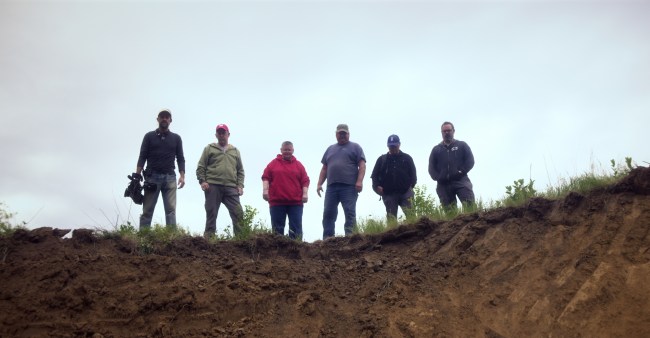 Lucy Studey McKiddy and dig team in ‘My Killer Father: The Green Hollow Murders’This Is Just A Test LLC/Paramount+
The lack of answers raises another question: was something overlooked — or ignored — decades earlier? The series touches on the possibility of a cover-up, though James leans toward a simpler explanation. “I tend to believe that this was incompetence,” he says. “They didn’t cross records … they didn’t look into it further.” More broadly, he points to systemic bias. “It was a different time,” he says, noting that documented abuse often went unpunished and allegations from women weren’t taken seriously. “I tend to agree with what you said,” he adds, acknowledging that authorities may have simply believed Donald over the women accusing him.
Still, there are lingering unknowns, including a 612-page FBI file on Donald Studey that remains unreleased and accounts from family members who say they were told to “leave it alone.” For James, those details keep the door slightly open. “I don’t believe there’s some big wide cover-up,” he says. “But what if there is something there?”
That uncertainty comes to a head in the final episode, when Lucy and Susan confront each after Lucy’s quest to prove her father is a serial killer comes up short. The scene is chaotic, emotional, and revealing. “I kind of called it the ‘Jerry Springer’ moment,” James says. But beneath the shouting, he saw something more telling. “Through that … there was a lot about each of their positions that came out.” He encouraged the confrontation, knowing it might force both women to engage directly. “It was very easy for them to stick with their stories in isolation,” he says. “What happens when they press each other?”
In the end, the divide between Lucy and Susan doesn’t come down to what may have happened — but what can actually be proven. After years of defending her father, James says even Susan began to show signs of fatigue. “She’s just exhausted about being this lone person who defended her father,” he says, recalling a moment after hours of confrontation when her resolve finally wavered.
But even then, her position held. “Well, even if he did, you can’t prove anything.”
At that point, James says, the story stopped being about uncovering the truth and became something else entirely. “It’s no longer about whether he did it or not,” he says. “It’s about whether or not you’re proving it.”
My Killer Father: The Green Hollow Murders is streaming on Paramount+.