
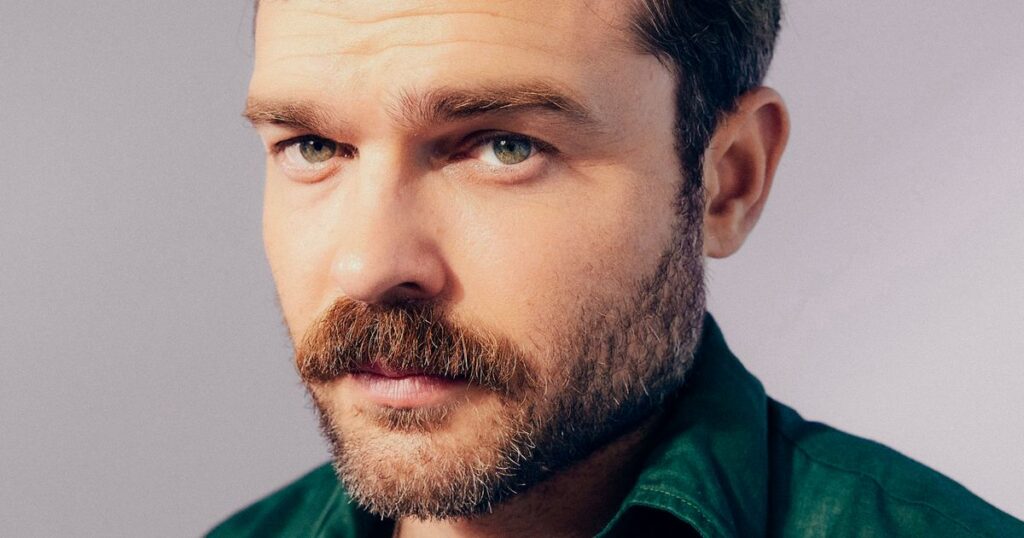
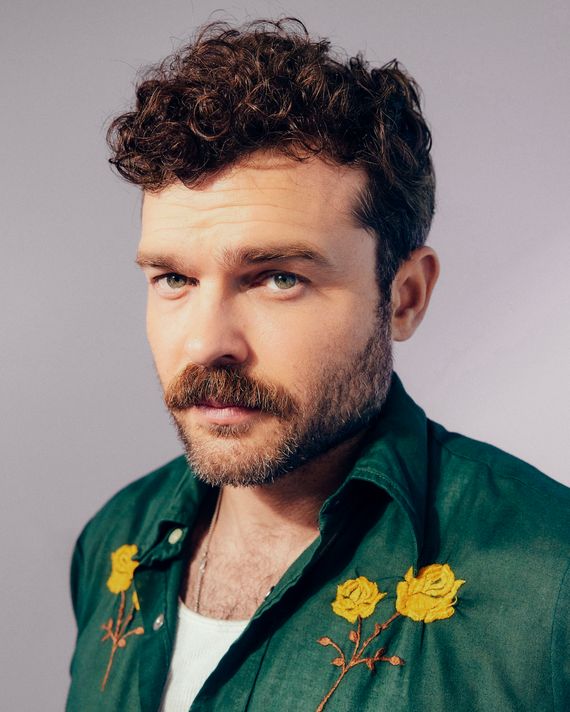
Photo: Corey Nickols/Getty Images
When Alden Ehrenreich visited the Los Angeles County Museum of Art with his mother as a kid, she encouraged him to play a game where they’d walk around a gallery saying which pieces they hated. “It was a very smart trick,” he tells me, because he’d start by naming the works he, as a sullen preteen, found stupid or boring, and then, by process of elimination, arrive at the pieces he liked. “Then she’d go, ‘Why do you like it?’” Ehrenreich says. Suddenly, he had to learn to express why he was into art.
The actor, moderately incognito in jeans, a baseball cap with the insignia of the Explorer’s Club, and a slim wristwatch, is walking me through his cultural education as we wander around the Neue Galerie on the Upper East Side, which occupies a crucial spot in that history. He grew up in the Pacific Palisades, near the coast of Los Angeles, where his mother worked as an interior designer and his father as an accountant, but he remembers visiting the gallery’s small but very striking collection of Vienna-adjacent artists on a trip to New York when he was 13. “It was an epiphanic thing,” Ehrenreich says. Ehrenreich’s family is Jewish and had a background in Germany and Austria, but he hadn’t thought deeply about that history and got fascinated by it. He bought books from the gallery’s bookstore — when we wrap up our interview later, he says he’s going to buy some more. “I looked at all this stuff and thought, There’s something about this I love.”
If you’ve seen Ehrenreich on film, or in his talk-of-the-spring stage turn in the comedy Becky Shaw on Broadway, you might be familiar with his perpetually furrowed brow, or his offhand, often deadpan sense of humor. At 36, he’s got a shock of curly hair, the clear skin of a movie star, and the careful manner of someone who’s seen a lot in his time in the industry. Most notably, he played Han Solo in a Star Wars prequel; the film, released in 2018, had a tortured production process, tepid reception, and no sequels. Ehrenreich has since pursued a lower-profile career, though a fulfilling one, with memorable supporting performances in films like Oppenheimer, as a skeptical aide, and Weapons, as a mustachioed cop. As we tour a room of drawings by Egon Schiele, with twisted, expressive bodies in ruddy hues, he notices a plaster death mask of the artist’s pinched face. “I’m so glad we don’t do that anymore,” he says, then laughs. “The closest thing we have now is when you get your face cast for a Marvel TV show.” He knows from experience, having acted in Disney+’s Ironheart. “They cover you in a mold,” he remembers. “Some people freak out.”
The concept of a Marvel death mask is an observation that might appeal to Max, the brutal finance guy that Ehrenreich is currently playing in Becky Shaw, where he’s landing whoppers of cynical dialogue to shock and acclaim. “Love is a happy byproduct of use,” goes a typical Max line. Or, more pointedly, “I would like you to try harder the next time you attempt suicide.” Gina Gionfriddo’s play presents a quartet of intermeshed young people: Max is the adoptive brother of the similarly blunt Suzanna (Lauren Patten), whose proto-hipster boyfriend (Patrick Ball of The Pitt) suggests setting Max up on a date with the titular Becky (Madeline Brewer, of The Handmaids Tale), who presents as a babe-in-the-woods type but has her own grasping ambitions. Their date goes horribly wrong. (The production also sports an icy and delicious soupçon of Linda Emond as Suzanna’s mother.) Becky Shaw was well-received when first performed and a Pulitzer finalist in 2009, but this spring’s blistering revival, directed by Trip Cullman, benefits from the way it thrusts Gionfriddo’s end-of-the-aughts frankness in front of a more buttoned-up 2020s theatergoing audience, like a cannonball into a swimming pool. The production also benefits from the fact that it’s introducing Ehrenreich’s impressive talents as a stage actor to New York at a time when theatergoers have been looking for a jolt of energy. He plays Max’s meanness to a hilt while weaving together an understanding of his wounded past, a “superb” performance in which, as Sara Holdren wrote on Vulture, he is “as unafraid to be horrid as he eventually is to be broken.” In the New York Times, Laura Collins-Hughes called Ehrenreich’s work “a show-stealing Broadway debut.” People can be skeptical when screen stars parachute into plays around Tony season to burnish their reputations. A sentiment I’ve heard several times over in the last few weeks has run along the lines of, Alden Ehrenreich, who knew? And, How have they been hiding this guy from us in California?
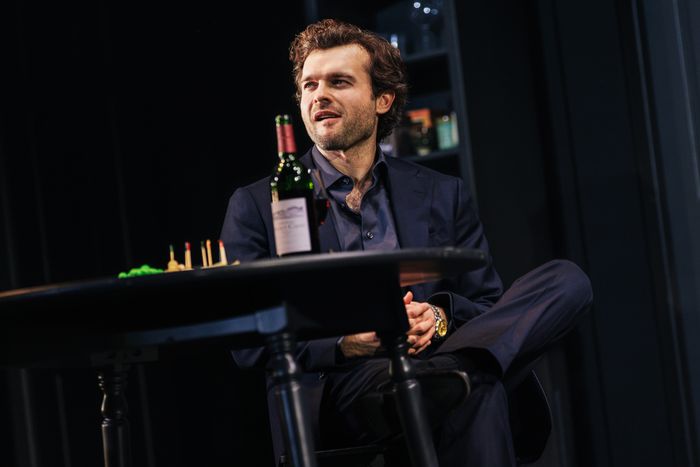
“There are nights where I am very much the bad guy, and then there are nights where they’re very much on my side.”
Photo: Marc J. Franklin
Ehrenreich hasn’t read his own rave reviews, and as we sit down for a lunch at the Neue Galerie’s Café Sabarsky, admits to being a little weirded out by the experience of having to do press for a thing he’s still performing in. Usually, you’ve wrapped a film by the time you’re doing an interview; you don’t have to talk about it and then go onstage a day later. But he is very much enjoying the experience of getting direct feedback from his audiences. Audiences tend to shift their allegiances between the characters in Becky Shaw every show, which keeps the ensemble on their toes — they like to talk about whether Max or Becky is more in favor each night backstage. In the performance the day before we met, Ehrenreich was coasting along with a rowdy, fun-loving audience that was laughing alongside Max, up to the point where he delivers a line about how Becky “looks like a cupcake” in a bright-pink dress. A lone voice responded to that joke with a forcible, “Jesus Christ.” Ehrenreich felt the tide turn against him. Everyone in the theater clammed up, as if embarrassed to have endorsed Max with laughter. “Scientists could do interesting studies on this,” he says. “There are nights where I am very much the bad guy, and then there are nights where they’re very much on my side.”
Ehrenreich can talk for long paragraphs about the strange dynamics of performer and audience, which he does, pausing to order a pea soup. Then, after seeing our waiter deliver my order of bratwurst, he realizes he would prefer to have bratwurst too. (“I’ll have what she’s having, basically,” he tells the waiter.) He’s always had an affinity for theater, he explains, without the professional credits. He spent three years at NYU studying acting, where he founded a theater group with some fellow students. And mid-pandemic, in 2021, he bought a former trolley station near the intersection of the 110 and the 5 freeways in L.A. that he’s been working on turning into a nonprofit theater, dubbed the Huron Station Playhouse. They’re running acting classes and development circles for playwrights — if this sounds like a lark, he has legit names involved, like the playwrights Clare Barron and Agnes Borinsky — and plans to start producing two productions a year. Ehrenreich’s goal is for it to be a place for people who might’ve felt themselves making compromises in their art to get ahead in the film industry to be “totally insulated from thinking about the business,” he says, “and to try to make better shit, frankly.” In a neat coincidence, Ehrenreich had just spotted and said hi to the actress Alia Shawkat, currently starring in Barron’s play You Got Older downtown, across the room at Café Sabarsky. She was having her own lunch on a day off for the theater. She’d also done a reading at Huron Station.
As Ehrenreich discusses the dangers of “internalized commercial corporate thinking,” it’s fair to ask if he sees it in his own decisions earlier in his career. “I have never done a movie just for that reason,” he insists, and that even in his work with a more commercial bent, there was always a character he cared deeply about. “But I definitely feel that pressure, and it’s probably kept me from taking the time to do other things,” he says. “Right now, I’m only working on things that I’m really interested in.” After rising to the top of a much dissected short list of actors up to play a young Han Solo at the end of the 2010s, he agonized over whether he wanted to take that job, and “because of the way they approached the character in the material I’d done up to that point, I was like, I love this guy and I do want to do it.” In the process of making Solo, the film’s original directors, Phil Lord and Christopher Miller, were fired and replaced with Ron Howard. In an interview published this January, Kathleen Kennedy, the departing head of the Star Wars studio Lucasfilm, insisted she had no regrets about her tenure, except for a “bit of regret” about Solo, because she had come to realize you couldn’t replace Harrison Ford in the eyes of an audience. In casting Ehrenreich, Kennedy said, “We put him in an impossible situation.” Did Ehrenreich feel that he was in an impossible situation? He makes a pained, squinting expression and takes a deep breath. “This is a world where I have to be very smart about what I say,” he says, collecting himself. “I don’t have the same point of view on that. I see that differently.”
Before Solo, Ehrenreich had already assembled an impressive and famously charmed Hollywood career, aided by a series of bold-faced auteur mentors, which may help explain his even keel amid the buffets of fame and scrutiny. He was first noticed as a teen by Steven Spielberg via a comedy video he’d made for a friend’s bar mitzvah. That led to an agent, which led, right at the end of high school, to a role in Francis Ford Coppola’s film Tetro. (Coppola had his actors rehearse more than any other director Ehrenreich’s worked with; he compares that process to a play.) He spent five years, between ages 19 and 24, meeting with Warren Beatty as the actor and director developed his 2016 film Rules Don’t Apply and regaled Ehrenreich with stories over dinner about legends like Noël Coward and Lillian Hellman. He gave a breakout performance in the Coen brothers’ Old Hollywood fantasia Hail, Caesar!, also released in 2016, as an oblivious Roy Rogers–esque singing cowboy, forced by his studio into starring in a drawing-room comedy. (In the film’s funniest scene, he keeps stumbling on the line “Would that it were so simple” while an effete and increasingly angry director played by Ralph Fiennes tries to coach him.) For the role, he took riding lessons and learned to do rope tricks and twirl a gun. It fulfilled the kinds of fantasies he’d had when, as a kid, his parents showed him classic films. Being in Hail, Caesar!, he says, “was what I thought Hollywood was going to be growing up.”
Ehrenreich talks about Hollywood, and acting in general, with a combination of earned nostalgia — he really did learn from some of our master filmmakers — and seasoned weariness. He greatly admires people like John Cassavetes, who led his own theater company in L.A. in the 1980s; loves reading biographies of famous artists, having just finished one on John Steinbeck; and studiously avoids the internet, preferring to carry around a giant flip phone. He had to get a smartphone briefly, because it was helpful in renovating his theater, but lost it and decided not to replace it. He’s aware this paints an image of himself as a stuffy elder millennial, but he’s stalwart in his tastes and convictions. He’s excited to read Ben Lerner’s Transcription, he says when we end up discussing literature, and thinks the humor in Leaving the Atocha Station was underdiscussed, adding sheepishly that Infinite Jest was really funny too. Talking about the pressure to commodify yourself for a career, he wonders whether he’s experiencing the same forces that have existed on artists for millennia, or whether there’s something especially pronounced in a moment of mass consolidation and technological overreach. Maybe this is also the experience of being in your 30s. “I don’t know, probably both,” he says.
After Becky Shaw, Ehrenreich has cleared time for himself this summer to work on his draft of a feature screenplay. He made a short film in 2023 and really wants to direct more — “Certainly not the first actor to say that,” he deadpans. If he cloaks some of his earnestness in dry humor, the underlying thrust of it is still palpable. “I had the best film school in the world working with these people,” he says, “and I just want to take their ideas and methods and take it as far as I can in my own voice.” It’s not too far from the energy of Max, who — you realize in Becky Shaw’s second act — cares deeply in his own weird way about trying to protect and pay back the family that took him in. And it’s also the experience of a kid who, walking through a gallery, has worked through what he doesn’t like until he’s realized there is some art he’s in love with. The most caustic people in the world often have the softest underbellies — at least if Alden Ehrenreich is playing them. “We just have to believe in some kind of something,” he tells me, midway through describing the anxiety that is palpable in Los Angeles right now, facing a conflux of crises including industry contraction and recovery from last year’s wildfires. The line starts to sound like a personal mantra. “We just have to believe in the possibility of some kind of renewal.”
Related