
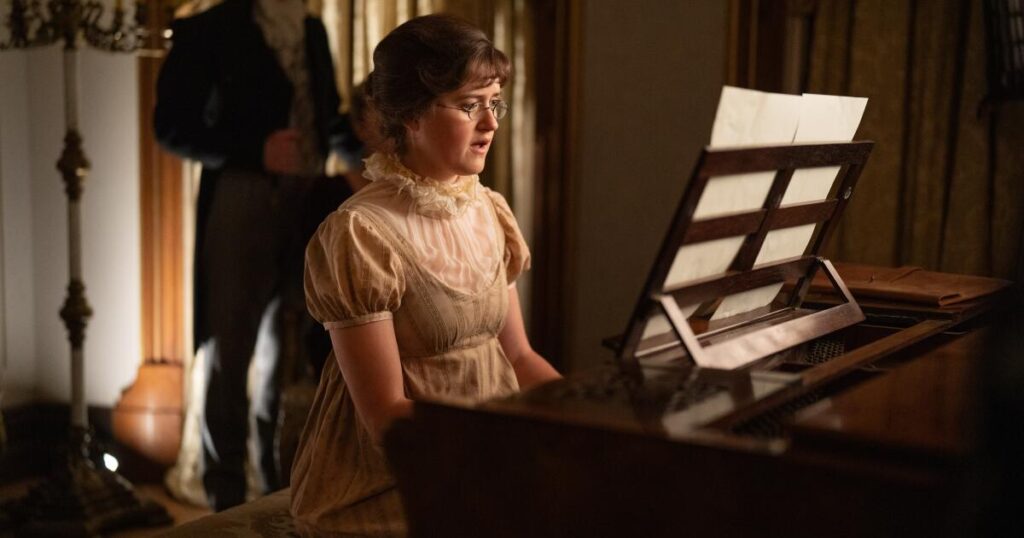
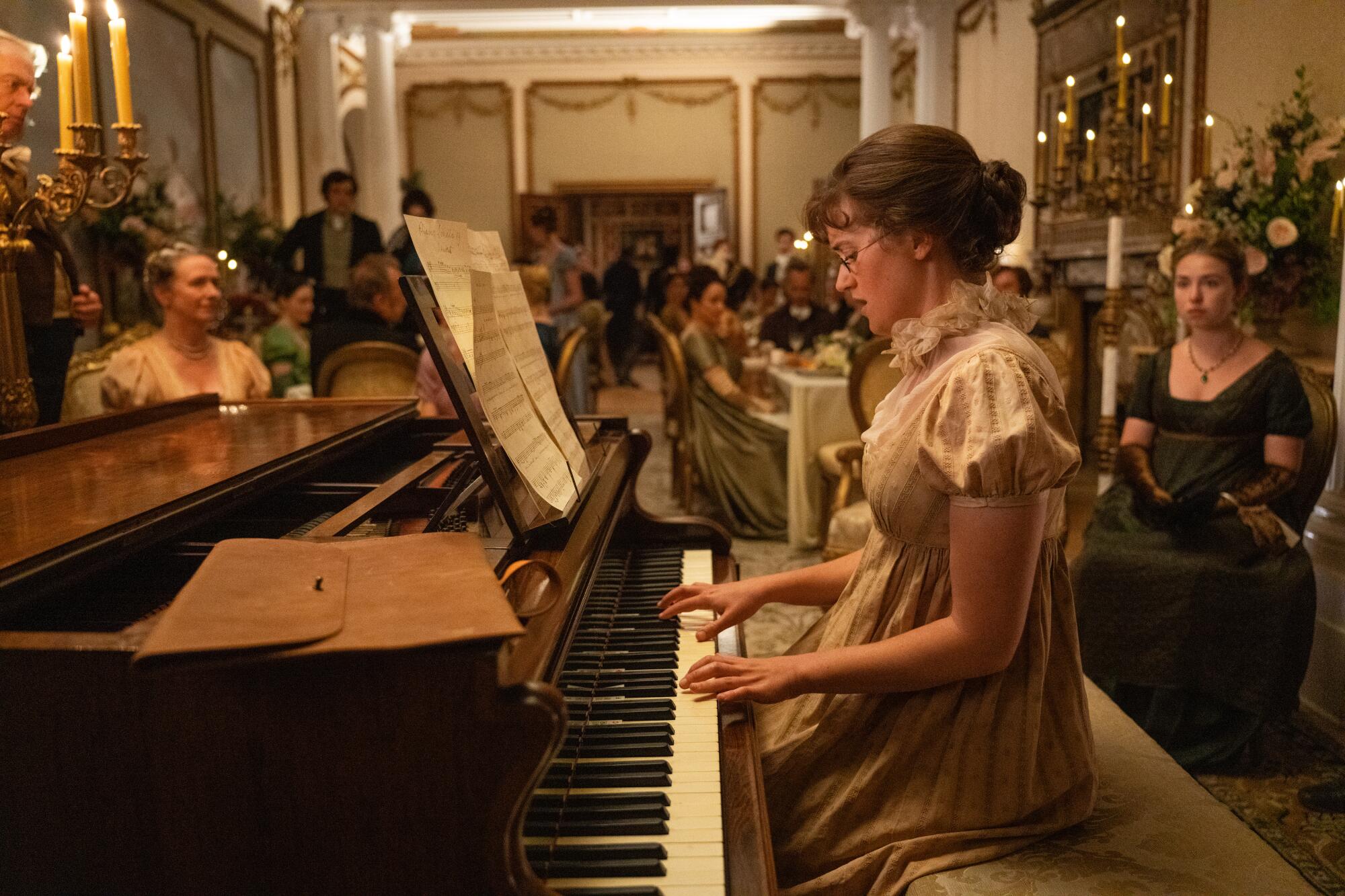
It’s the day of the Netherfield Ball and Ella Bruccoleri is nervous. We’re on the set of “The Other Bennet Sister,” a 10-episode adaptation of Janice Hadlow’s beloved novel, and Bruccoleri is preparing to perform a song as Mary Bennet. On this particularly sunny July day, the production has taken over Dyffryn Gardens, a National Trust estate outside of Cardiff in Wales. Crew members are packed into the entry hall as preparations are made to shoot the big scene inside one of the grand rooms.
Unfortunately, that means the only place Bruccoleri can rehearse is in a tent on the front lawn. She is dressed as Mary in a beige gown and wire-framed glasses, and she’s feeling the pressure of this particular moment from Episode 2, where Mary takes it upon herself to sing and play piano to impress Mr. Collins.
“I’m in a band in real life,” Bruccoleri says. “I wouldn’t say I’m an amazing singer, but today I have to do this badly. And you can practice as many times as you want, then suddenly you’re doing it in front of the camera and in front of the crowd and it all goes to pot. Mary has taken this really happy song and made it slow and sad.”
The scene is famously depicted in Jane Austin’s “Pride and Prejudice” from the perspective of Elizabeth Bennet, who entreats their father to step in and prevent Mary from showcasing a second musical number. But in “The Other Bennet Sister,” premiering May 6 on BritBox with three episodes, everything is filtered through Mary.
“We’re very much anchored to Mary in every scene because it’s her story,” says Jennifer Sheridan, who directed Episode 2. “We get to see the Mary beyond the ‘Pride and Prejudice’ version, who was just kind of haughty. We get to see that version too, where she’s playing that she doesn’t care, but in other moments we see she feels so deeply. She is a very sensitive soul who’s been beaten down by societal pressures on women.”
Mary’s humiliation at the Netherfield Ball was originally what triggered Hadlow’s interest in writing a novel from the perspective of the less-discussed Bennet sister. Although Mary has a presence in “Pride and Prejudice,” there is little empathy for her.
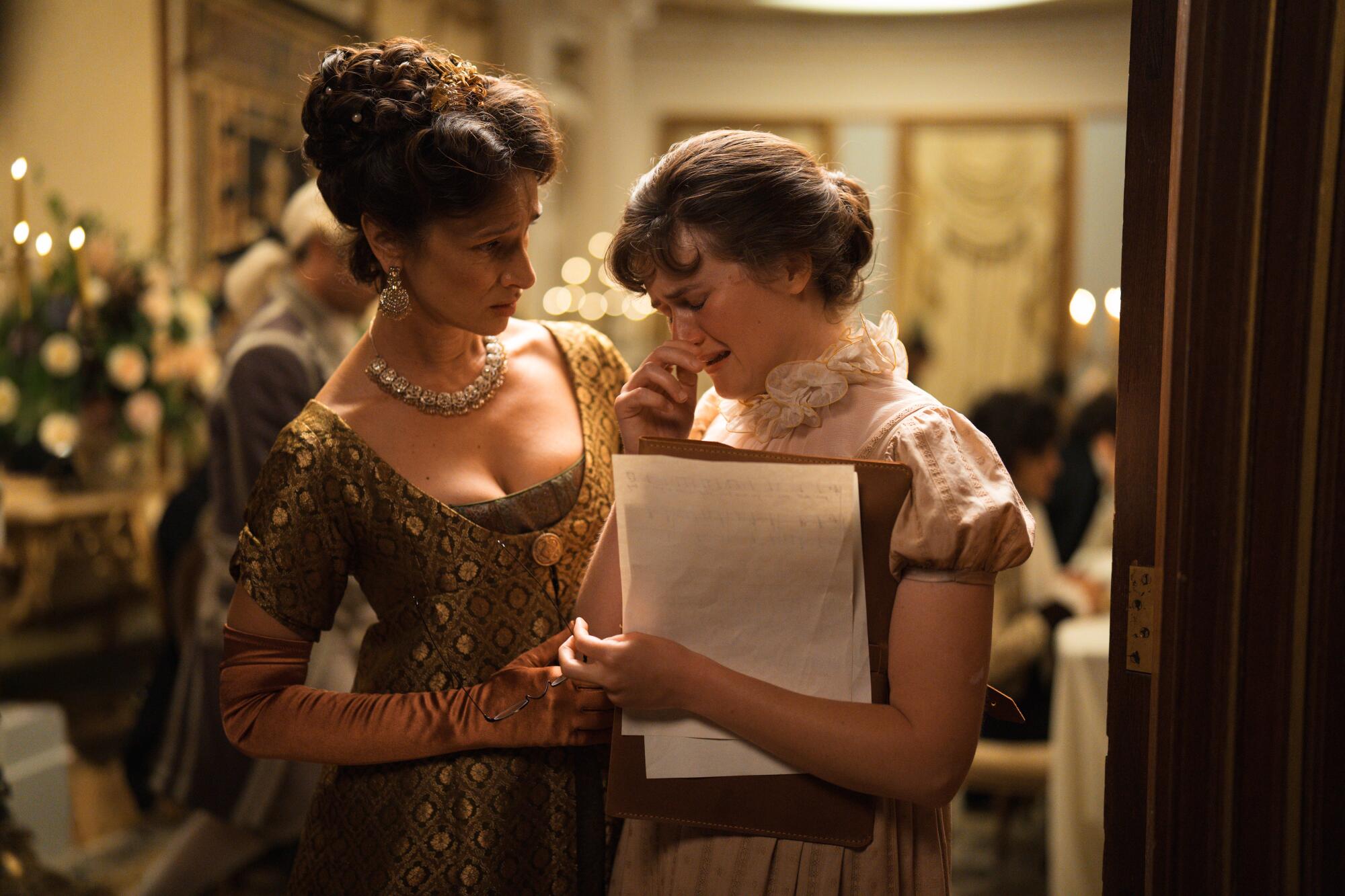
In “The Other Bennet Sister,” Bruccoleri had to perform a humiliating moment as Mary at the Netherfield Ball: “Mary has taken this really happy song and made it slow and sad.”
(James Pardon / BritBox)
“I suddenly thought, ‘What must have that have been like to be Mary and to have been publicly humiliated in that way?’” says Hadlow over a video call. “That made me think more about what the whole novel looked like from her point of view. Austen tells you quite clearly that Mary has become this bookish, studious, rather priggish young woman because it’s made clear to her by the family that she can never compete with any of her sisters in any other way.”
Hadlow’s novel was optioned for TV before its release in 2020 and producer Jane Tranter enlisted Sarah Quintrell to adapt the book. “It’s quite scary to go into that world in the UK,” says Quintrell over a video call about adapting a story based in the Austen universe. “But it’s really a coming-of-age story about being the odd one out and I felt such a connection to that.”
Quintrell largely stayed true to the novel, although she had to distill a lot of the story down to fit the vignette-like episodic format. There are a few new characters, like Ann Baxter (Varada Sethu), and some scenes were invented for the show. Hadlow offered notes and guidance throughout the process.
“Janice was brilliant about letting us adapt it the right way,” Quintrell says. “I loved the book so much I nearly curtsied when I first met her, so I think she knew that every time I asked about changes it was always coming from a place of love and respect for the book.”
“I was very keen to try and keep a sense of a language that I tried to write in the book,” Hadlow adds. “I wanted it to have some of the resonances of the way Austen writes — the way they address each other and the formality of the society. I didn’t want it to sound as though it was a pastiche, and I think Sarah has captured that brilliantly.”
Hadlow’s novel was invaluable to Bruccoleri, who appears in nearly every scene of the show. Like her bookish character, she did extensive research on “Pride and Prejudice,” Austen and the time period. She highlighted moments in Hadlow’s book and made extensive notes.
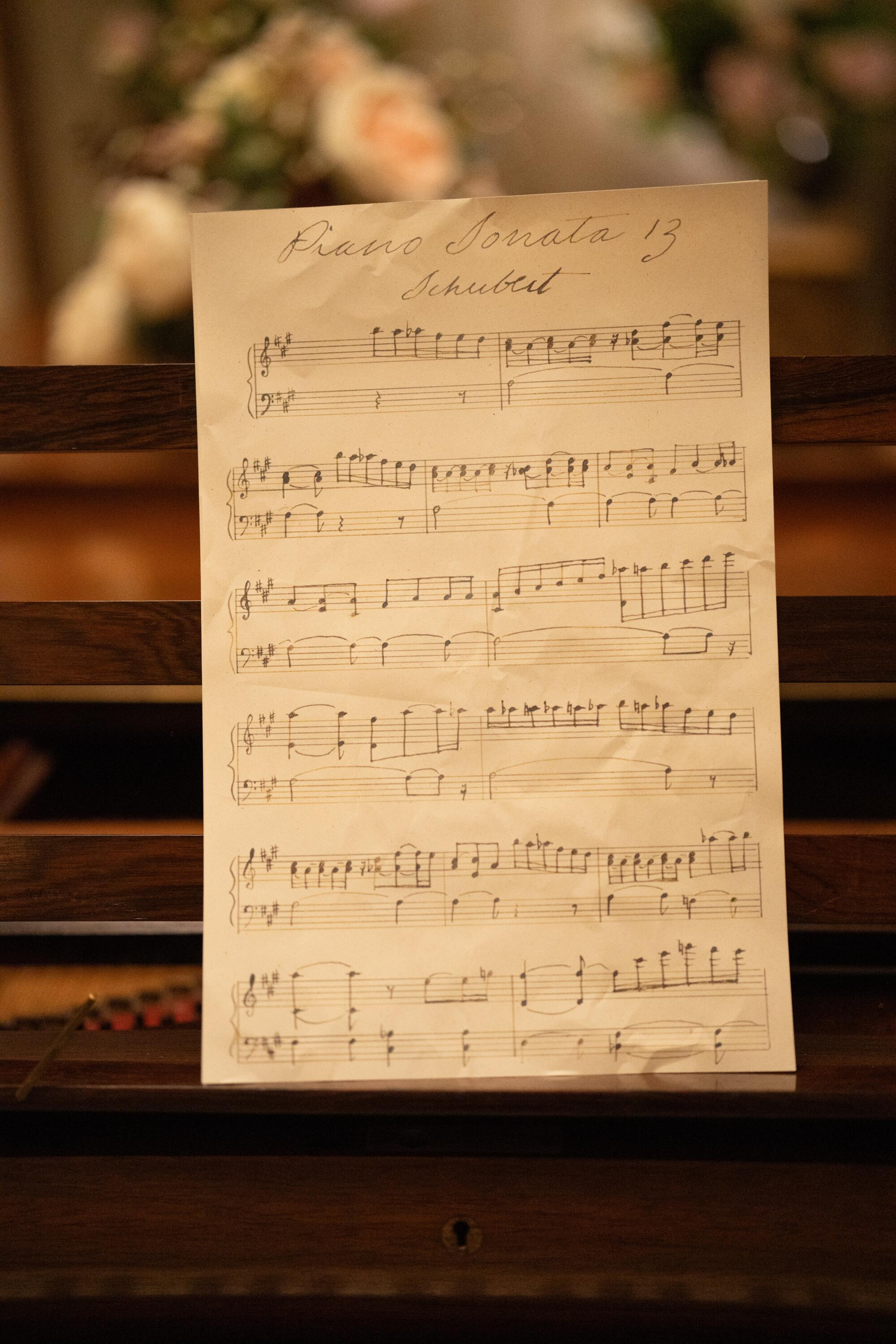
Sheet music for Schubert’s “Piano Sonata No. 13” on the set of “The Other Bennet Sister.”
(James Pardon / BritBox)
“It’s such a massive book and it goes into so much detail, so I basically used it as a Bible for breaking down moment by moment what was going on in Mary’s head,” Bruccoleri says. “It was so helpful for me. Normally for smaller roles you get cast a couple of weeks in advance and you’re just thrown into it. For this I had about nine weeks, which feels like a Robert De Niro amount of time to prep for something.”
That preparation included lessons in calligraphy, horseback riding, piano and Regency dancing. She spent a day at Merthyr Mawr House, which stands in for the Bennet home of Longbourn House, ahead of production. “I asked if I could spend a day in Mary’s bedroom and just hung out and read my books in there,” she says. “I’ve never had the opportunity to do stuff like that for a role before.”
Hadlow and Bruccoleri didn’t have any conversations about Mary, but the author says that Bruccoleri’s approach “shows in the performance.”
“I’ve felt watching her that this is somebody who really understands who Mary is,” Hadlow says. “If she was called upon to say, ‘What do you think Mary would do in such a situation?’ you feel she’d have an answer. She really entered into the character and understands her dilemma.”
The cast consists of a few well-known actors, including Ruth Jones as Mrs. Bennet, Richard E. Grant as Mr. Bennet and Indira Varma as Mrs. Gardiner. But there’s also a spotlight on up-and-coming talent like Bruccoleri. “Young Sherlock” star Dónal Finn plays Tom Hayward, a potential love interest for Mary, and Laurie Davidson plays the dashing William Ryder, who also catches Mary’s fancy. Tanya Reynolds offers a broader glimpse of Caroline Bingley, a character who often belittles Mary.
“She’s a really misunderstood human being,” Reynolds says. “In ‘Pride and Prejudice’ she is the antagonist. And she is antagonistic in many ways. She’s cruel and sarcastic and cutting, but all of that has to come from somewhere. And I think it comes from this deep insecurity she has. She’s also a victim of the period.”
“The Other Bennet Sister,” like “Pride and Prejudice,” is set in the early 19th century, a time when women had few choices, other than to marry or suffer. Without a male heir for Longbourn, Mrs. Bennet knows she has to secure strong matches for her five daughters — Elizabeth (Poppy Gilbert), Jane (Maddie Close), Lydia (Grace Hogg-Robinson), Kitty (Molly Wright) and Mary.
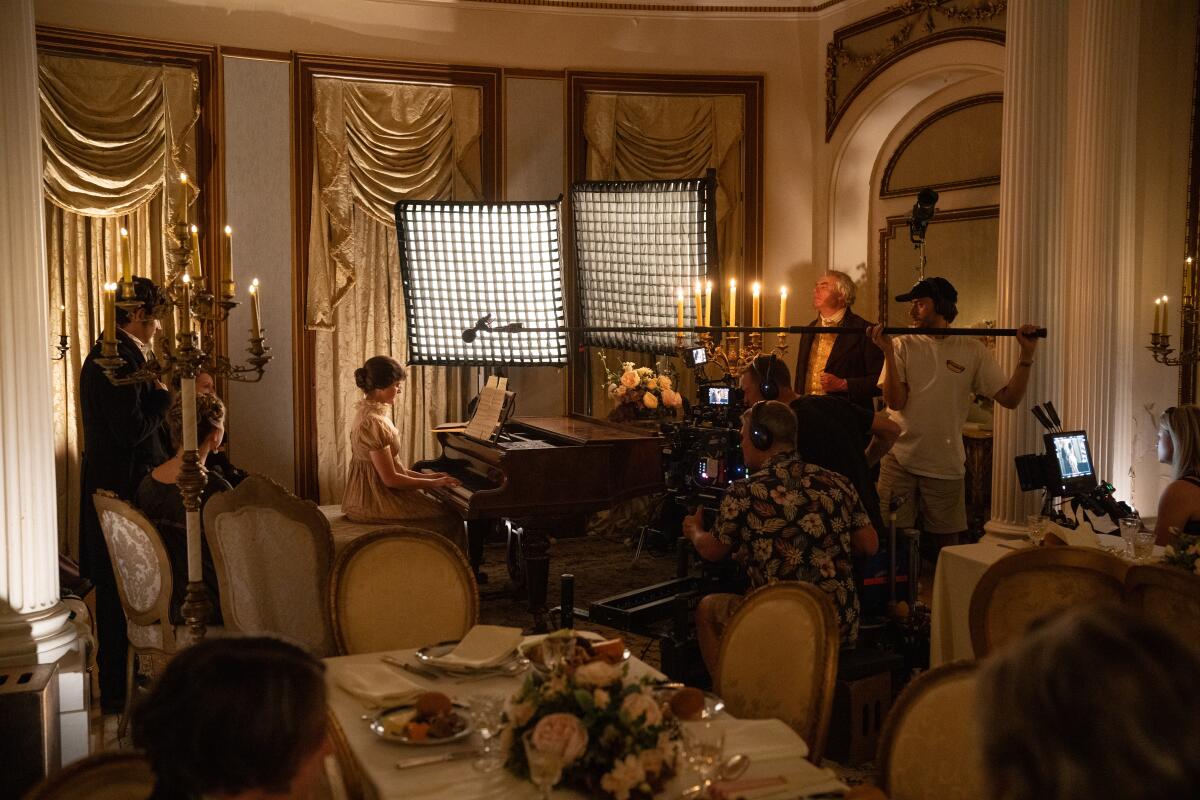
Behind the scenes on the set of “The Other Bennet Sister,” where Bruccoleri is performing the famous scene as Mary singing and playing the piano poorly. (James Pardon / BritBox)
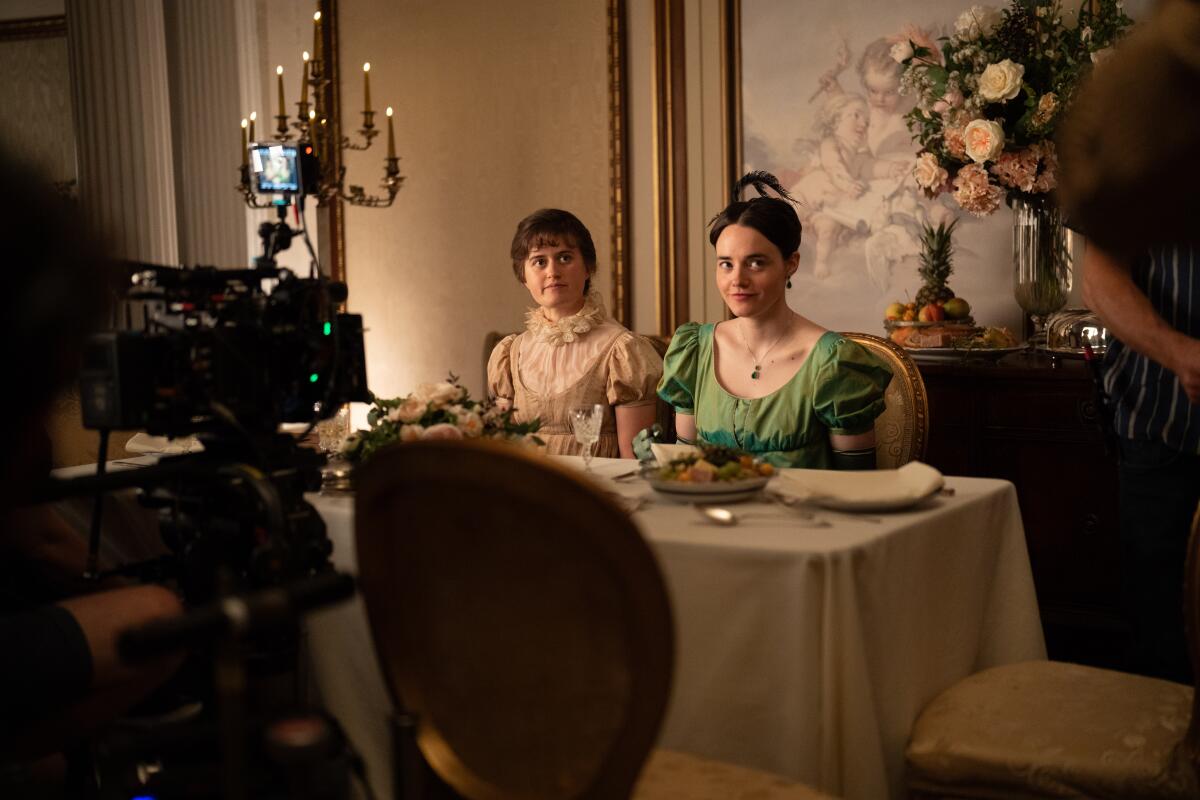
Mary (Bruccoleri) with Charlotte Lucas, played by Anna Fenton-Garvey. (James Pardon / BritBox)
“She’s desperate,” Jones says. “These women have got nothing because Longbourn will go to the nearest male relative. It’s shocking. And there are these five daughters who are essentially going to be left homeless unless they marry somebody.”
Jones came to think of Mrs. Bennet as a businesswoman who needs to offload properties — four of them will get snapped up — but Mary’s not moving. “She’s reduced the price. She can’t shift this property and it’s become a bit of a millstone around her neck.”
The first two episodes follow the events of “Pride and Prejudice” from Mary’s point of view. There are hints about the courtships between Jane and Mr. Bingley and Elizabeth and Mr. Darcy, but the audience stays with Mary. The rest of the series is about what happens when Mary goes to London to stay with Mr. and Mrs. Gardiner and begins to see the world outside of her family. We also see what happens to the Bennet women and how the relationships between them unfold.
“We get to see Elizabeth as the lady of the house, which I always thought would be an interesting mode to see her in because I don’t think that’s something she ever imagined for herself,” Gilbert says. “She holds herself well and takes herself quite seriously in becoming the lady of a house. Because I love ‘Pride and Prejudice’ I really wanted Lizzie to be likable. But in this instance, we’re seeing her through Mary’s eyes and it’s important that we see the truth that Lizzie didn’t always stand up for her.”
“With ‘Pride and Prejudice,’ Mrs. Bennet is Lizzie’s Mrs. Bennet,” Jones adds. “And her relationship with Lizzie is a different relationship, whereas this is Mary’s perspective. I absolutely took the script as my starting point, not previous iterations of the character.”
“The Other Bennet Sister” is exceptionally relatable. Gilbert notes that by the end of the show everyone will think, “I guess I’m not Lizzie. I’m Mary. And lucky me.” There were a lot of conversations on set about how to ensure that Mary felt like an everyday hero and remained grounded. She wears her glasses in romantic scenes and she embraces her own unique sense of style.
“She’s really not your average Regency heroine,” Quintrell says. “I took this further even than the book — she’s bad at small talk, she is incredibly socially awkward, she can’t ride a horse. Nothing comes naturally to her. And we don’t put women like that at the center of any story, particularly in period drama. And we don’t change her. We allow her to come into her confidence on her own.”
“She’s really not your average Regency heroine,” says Sarah Quintrell, who adapted the story for TV, about Mary Bennet.
(James Pardon / BritBox)
Bruccoleri describes Mary as an ordinary, grounded woman. “There are all those cliches in so many movies where the woman takes off her glasses and suddenly everyone’s like, ‘Oh my God, she’s really hot,’” she says. “We said, ‘Let’s push back against that stereotype as much as possible.’”
She adds that when Mary is “authentic to herself, people are drawn to that. The things that Mary has been told are her flaws become the things that people love about her.”
Today, though, is not Mary’s day. Bruccoleri is soon summoned inside Dyffryn Gardens, where one of the rooms has been transformed into a Regency ballroom. Bruccoleri runs through a few rehearsals with the rest of the cast in place, but loses her way. “I’m sorry, I’ve buckled under the pressure,” she says.
Sheridan, who is directing, sends everyone out and Bruccoleri soon nails it. “Don’t panic, Ella,” a crew member says, encouragingly. “But do panic in the scene,” Sheridan reminds her.
We watch on the monitors as Bruccoleri perfectly mimes the piano along to a track and unleashes out-of-tune vocals that are horribly dour. Gilbert, as Elizabeth, whispers to Grant, as Mr. Bennet. He approaches Mary at the piano. “You have delighted us long enough,” Grant intones, repeating Austen’s famous line.
Bruccoleri later apologizes for making me witness “the horror” of the day. But without the scene there would be nowhere for Mary to ascend. It’s her journey that makes the show so compelling. The Netherfield Ball is a particularly low moment, but things will not always be this bad.
“You get to celebrate these small victories in her life as the show goes on,” Bruccoleri says. “And nothing super dramatic happens. It’s a simple story about a young woman finding her place in the world. And that’s really close to life.”