
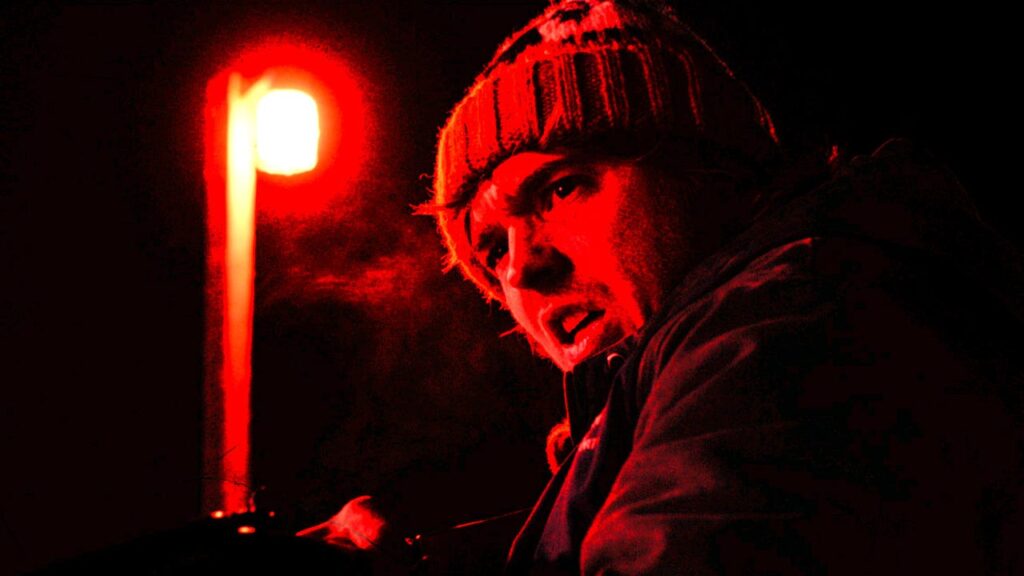
I took away a lot from my visit to Resident Evil’s Prague set – not least being a newly ruined pair of previously white Nike trainers that were now covered in blood from sole to swoosh. The sticky, red-soaked floors of the film’s handcrafted hospital maternity ward are just one of the indications that this latest attempt at adapting survival horror’s most famous series is going to not only be disgusting, but also faithful to the tone of its T-Virus-filled source material, even if it isn’t directly translating any of its individual chapters.
This vision all stems from Zach Cregger, director of recent horror hits Barbarian and Weapons, but also, crucially, a long-time lover of the Capcom games. So much so that he remembers his first steps into its world fondly and has carried on that connection ever since.
“That first American release of 2, I played that a lot, I loved it, but when 4 came out, that was such a big deal for me,” says Cregger. “Then, when the remaster of 4 came out a couple of years ago, I fell in love with it all over again. I’ll get the infinite rocket launcher, do a couple of laps. It’s like a soothing thing for me.”
That reverence for the Shinji Mikami-era of Resident Evil games is reflected in the journey that Austin Abrams’ character, Brian, takes in this new movie. It begins in a more rural, Resident Evil 4-coded area, before closing in towards the centre of Raccoon City and the streets, sewers, and science facilities we’d expect to see there, just as we did in Resident Evil 2 and 3. In opposition to the ambitious narrative structures on display in Cregger’s previous two movies, Barbarian and Weapons, which infuse vignetted scenes from different perspectives while zipping back and forth along timelines, Resident Evil’s plot will be rooted in a more traditional, chronological approach to storytelling, taking us from the mysterious end of an ominous blood trail all the way to its horrific origin point, with some gruesome sidesteps taken along the way.
“What’s important to me, that I’m honouring from the games, is the narrative structure and following one character from point A to point B, and the concern with resource management, ammunition conservation,” reveals Cregger. “We start with a pistol, we graduate to a shotgun, we graduate to an MP5, and things are just getting progressively more intense, and we’re encountering weirder and weirder monsters.”
Brian doesn’t possess the confident, fringe-flicking action hero qualities of a Leon Kennedy, nor the tough-guy stoicism of a Chris Redfield.“
But taking those monsters on is Brian, a protagonist quite unlike any from the games. He doesn’t possess the confident, fringe-flicking action hero qualities of a Leon Kennedy, nor the tough-guy stoicism of a Chris Redfield. In fact, Cregger describes him as “a total hapless everyman,” — a normal guy, thrown into a world quickly catching fire around him. “It’s like if I were thrust into a Resident Evil video game,” the director quips. “I’d be totally unequipped. I’m not good with guns. I’m totally out of shape. It would just be me panicking from one situation to another.”
From what I’ve seen, the horrors Brian must face will be unrelenting throughout this evening from hell. We’ll see him navigate the city’s sewers in a sequence reminiscent of Resident Evil 3, albeit with something lurking down there that is quite unlike anything seen across the games — think a bloated, fleshy, mound of a man, not too dissimilar from Stellan Skarsgård’s unnerving physique in Dune. This one-ton flesh puppet had to be operated by four people in order to make its movements seem believably unnatural, writhing and pulsating as if something was threatening to burst out. As for what could be causing such convulsions… I wouldn’t dare spoil the surprise.
Resident Evil Movie Trailer Slideshow

There’s no shortage of creatures on show, either, with some taken from the games, and others new, exciting inventions. Cregger’s idea is to root each design in what theoretically could happen to a human if it were to fall victim to the T-Virus, without ever crossing too far into the campier moments the games often lean into. Which is to say no Mr. X or Nemesis, for example, whose tiny hats, oversized trench coats, and skin-grafted missile launchers wouldn’t quite mesh with the ever-so-slightly more grounded nature of the world Cregger is constructing.
That doesn’t mean there won’t be plenty of larger-than-life action, though. The first trailer gives us a glimpse of bodies showering from the top of buildings onto the street below, and one set piece, centred on a tower block elevator shaft that took production designer Tom Hammock and the team over two and a half months to construct, looks set to steal the show.
“Making a pair of working elevators in a five-story-tall concrete set was enormously difficult to do in-camera,” reveals Hammock. “I mean, it would have been so much easier, obviously, to just do a little box surrounded by green screen, but Zach wanted to go full bore for this action sequence.” Having been shown around the disused Czech factory building where it was filmed, I have to say it was incredibly impressive, even if I can’t reveal what horrors take place here yet.
It’s this commitment to practicality and capturing as many of the film’s effects in camera as possible that makes this a more believable world for its actors, and therefore characters, to exist within. No detail has been spared, especially Resident Evil’s “obsession” with doors (something Hammock admitted to being surprised by). Ever since the original game, doors have been eerily zoomed in on, unlocked with ornate keys, and had zombies lurking behind them. That’s not set to change here.
“I’d say there are about twice as many doorways in the Resident Evil games as there should be,” Hammock jokes. “You never know where the scares are coming from. Me and Zach had a great deal of fun working on the doorways and these odd transitions between spaces, so a hospital hallway leads to somewhere you don’t necessarily expect. Literally, we have entire sets built where it’s designed around a single shot for a single scare.”
We have entire sets built where it’s designed around a single shot for a single scare.“
It’s a sensation I briefly got to experience myself. From just one step into the hospital ward, it quickly became clear to me that Resident Evil will definitely be a disgusting movie when it chooses to be. Blood covered every inch of the floor, limbs hung out of glowing red sacs, and tentacles lay strewn across tables in the aftermath of whatever nightmare took place here. Over a whole week of filming, these horrors were captured on camera, with over 400 gallons of fake blood dressing the set per day. If you watched Cregger’s 2025 hit horror, Weapons, you’ll know from its grisly ending just how squelchy his films can get when he decides it’s time for flesh to be parted from bone and organs ripped from torsos. Resident Evil is looking no different in this regard, potentially pushing the director’s eye for violence even further.
Cregger’s project looks to be hitting a really nice balance between paying homage to the games while also creating an original story of its own. It’s something we’ve seen video game adaptations do successfully of late, namely Prime Video’s Fallout TV series, which similarly makes the choices to tell a new tale in a familiar world, rather than regurgitate one back to us from a game beat-for-beat. This seems to be a mindset that Cregger shares, wanting this movie to evoke the feeling that “stepping into Raccoon City for the first time [in the games] once did.”
“I’m going to live in the world of the Raccoon City games,” explains Cregger. “But it’s an alternate storyline that takes place on the periphery of the hero’s storyline, so it’s a story that could be happening without necessarily breaking the universe of the story the games are telling.”
It’s about eliciting a positive emotion connected to those formative memories, without hanging its hat on nostalgia. That being said, that doesn’t mean Easter eggs won’t be sprinkled into the mix either, with recognisable weapons, locations and leafy green herbs all set to show up. Even an iconic use of canines from the game that started it all, way back in 1996, is teased by the director.
Survival horror is inherently cinematic as a genre, with the original Resident Evil inspired by the haunted house in space classic, Alien, and its 1997 sequel taking inspiration from George A. Romero’s zombie hits, such as Dawn of the Dead. Romero is a touchstone Cregger recognises, but places less of an emphasis on what films have come before him, instead using Capcom’s games as the sole text to be focused on. That goes as far as camera angles echoing those seen behind the likes of Leon, Chris, and Claire, as the lens hovers over Brian, peeking around corners as if it were connected to an analogue stick.
“What was really fun for me was to try and shoot this visually the way these games are told,” Cregger reveals. “I shoot in on a wide lens in an over-the-shoulder for most of the movie, so it feels like the way you play a game where we’re kind of perched on his shoulder, and as he turns a corner, we turn a corner with him. So I’m using video game visual language. First of all, it’s very inherently cinematic, but it also makes things scarier.” It’s the little details like this that further emphasise his passion behind this project, and his unwillingness to create something that fans wouldn’t be happy seeing.
The Resident Evil Movies in (Chronological) Order
Crucially, Cregger is a horror director who’s known to add a few laughs alongside the scares, something that can also be expected here. Just don’t expect his love of basements to return in Resident Evil (both Weapons and Barbarian utilise the underside of houses as prominent locations). A sad revelation, I’m sure, for those partial to lurking subterranean suburban horrors. We will, however, get the aforementioned sewers, and of course, Umbrella Corp laboratory facilities. To what extent the sterilised white walls that play host to nefarious science experiments stay pristine is up for debate, though. But if the freshly fallen snow seen decorating Raccoon City’s streets is anything to go by, they may well be painted in splashes of violent crimson.
I left the set of Resident Evil convinced that this latest attempt at a translation to film is in great hands. Not that Cregger’s track record to date hadn’t already achieved that, of course, but my confidence is assured because of that clear love he has for the games. Considering his two wholly original projects that preceded it, it came as a surprise that he’d want to dip his toes into the choppy seas of established IP next — especially one with such a mixed movie history as Resident Evil. But that’s not the way Cregger necessarily sees it, and from what I’ve seen, it looks more than a cut above any previous adaptation of the series. Time will obviously tell, but all signs point to Resident Evil successfully finding a new home for its horrors on the big screen when it arrives on September 18, 2026.
Simon Cardy is a Senior Editor at IGN who can mainly be found skulking around open world games, indulging in Korean cinema, or despairing at the state of Tottenham Hotspur and the New York Jets. Follow him on Bluesky at @cardy.bsky.social.