
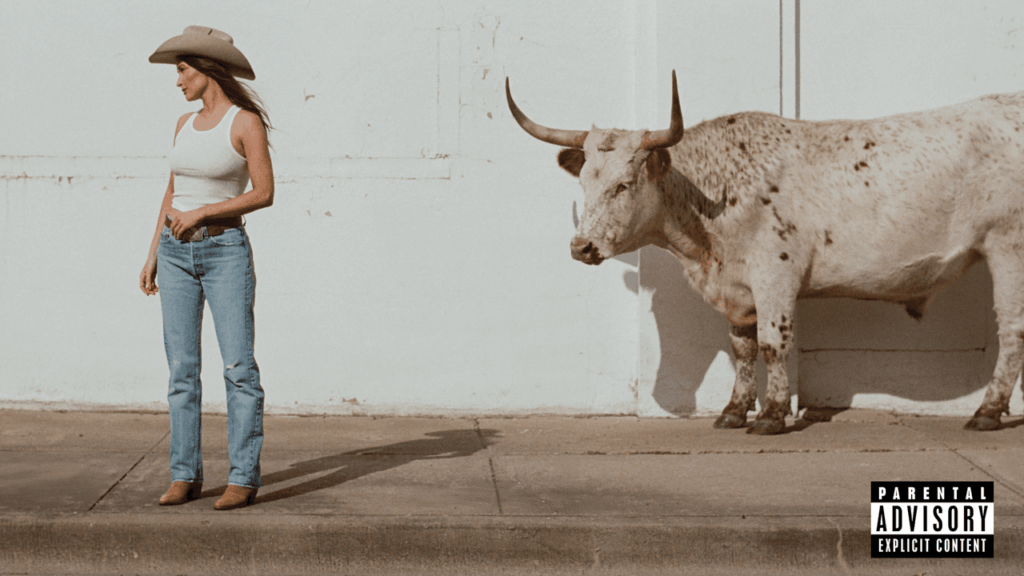
At her mainstage Coachella performance in 2019, Kacey Musgraves led the audience in a chant between songs: “When I say YEE, you say HAW.” When she stayed silent for a beat and the crowd shouted “HAW” anyway, she chided them: “I didn’t say fuckin’ yee.” There’s a lesson here, which is that Kacey Musgraves works on her own time, regardless of our expectations or demands. And with her new album, Middle of Nowhere, she has decided to ride in on her high horse and settle back into some down-the-middle country. Folks, she’s finally said fuckin’ yee.
To describe Middle of Nowhere with a rustic cliché, Musgraves is going back to her roots. Our introduction was the single “Dry Spell,” a sultry, funny, and pristinely constructed song about not having had sex in 335 days. “Lonely with a capital H, if you know what I mean,” Musgraves coos, “I’ve been sitting on the washing machine.” This isn’t the Kacey of 2024’s Deeper Well, omm-ing her way through pain, blaming any errant troubles on the astrological climate. Middle of Nowhere’s Kacey is witty, a bit sarcastic, alternately ecstatic and frustrated but always ready to entertain.
No score yet, be the first to add.
Her 2018 masterpiece, Golden Hour, swerved gracefully between country and pop. Middle of Nowhere, on the other hand, is an expansive but focused survey of the past 50-plus years of country music and its various subgenres, with a particular emphasis on her Texas heritage. Musgraves tapped longtime collaborators like Josh Osborne, Luke Laird, and Shane McAnally (the latter two co-wrote her Grammy-winning song “Space Cowboy”) to write her most classically country tunes since 2015’s Pageant Material: There are four different pedal steel players credited on Middle of Nowhere, and they all get a workout on this album.
Musgraves sounds confident and comfortable. “Back on the Wagon” is a Garth Brooks-style yarn about loving a loser who’s definitely, absolutely getting his shit together this time, whose chorus rhymes “wagon” (he’s back on it) with “drag him” (don’t do it). “Abilene,” about a woman who blows off the titular city for greener pastures, is a spiritual sequel to 2013’s “Blowin’ Smoke,” which depicted a gaggle of small-town waitresses who imagined better lives but never made any changes. And “Everybody Wants to Be a Cowboy” could be read as a dismissal of superficial converts to the agrarian aesthetic (“I bet most of these boots are probably never seeing any dirt/And the ground ain’t any softer if you’re wearing a rhinestone shirt,” Musgraves scoffs), but it ends up being a lament for the kind of people who seek freedom but can’t handle commitment.
It’s a feature-heavy album: “Everybody Wants to Be a Cowboy” gets an assist from bluegrass phenom Billy Strings, and Miranda Lambert joins the party for a ribald, norteño-infused waltz called “Horses and Divorces.” The two Texans appear to be burying the hatchet after years of rumored discord, which apparently began when Lambert poached the Musgraves-written “Mama’s Broken Heart.” On “Horses and Divorces,” the two wave away their feud as “whiskey under the bridge” and find some common ground: They both keep farm animals, they’ve both had marriages end, and, simply, “We both like to drink.” And they both love Willie Nelson, of course—“What asshole doesn’t like Willie?” they warble together like they’re sharing a mic at a Nashville karaoke bar.