


Photo-Illustration: Vulture; Photos: 20th Century Fox, A24, Amazon MGM Studios, Disney, Miramax, Neon, Paramount Pictures, Sony Pictures, Universal Pictures, Warner Bros. Pictures
We’ve been living with Anne Hathaway for 25 years, if you can believe it. After her star-is-born moment in 2001’s The Princess Diaries, the once and forever princess of Genovia has had several career evolutions. She managed the tricky transition from teen roles to more adult fare without shaking off perceptions of an eager theater-kid persona. There were sequels, corsets, and movie romances in an age when the genre was dying. There were Chanel boots and there was Shiva the Destroyer, your harbinger of doom for the evening.
An undeniable pivot point came when she won her Oscar and “it came true,” and the internet wanted you to know exactly how sick it was of her. Some of that critical and online harshness can come down to a simple fact: Anne Hathaway has been in some bad movies. But here’s another: Anne Hathaway has been great in some of them! In some cases, the movie’s quality is irrelevant to the performance, Hathaway giving her all to a movie that is clearly not working. A refrain you could have throughout her weaker films (or her Oscar-hosting duties, even) is “None of this is Annie’s fault!” In the years since, Hathaway has bounced back with interesting high-minded character roles and hits alike — and a few bombs where she still is still the best thing about them. Her career is more interesting and less predictable now than it has ever been, even if some of the haters have lingered. But some of us have always been right about her place among the greats.
Hathaway wants to act without a safety net. Her most consistent trait as an actor is making fearless choices, no matter the material. With no fewer than five planned releases hitting theaters, 2026 feels like a full-circle moment for her. With both the outré Mother Mary and the more familiar The Devil Wears Prada 2 now in theaters, her stardom has settled into a place where she can comfortably Go Big with a creative swing in one project and appeal to the masses in another. Since it’s the Year of Anne Hathaway, let’s take a look back at every role she has played on the big screen (and some brief appearances, because no one loves a bit more than Anne herself). Here’s to Hathaway — from worst to best — and all her gutsy glory.
You’ve heard of “wife on phone” characters, just wait until you get a load of “fiancée in letter”! Here Hathaway plays a young woman left at home while her Mormon fiancé is on a mission in Tonga and is seen almost exclusively through letters. Did you know that one of Hathaway’s first performances was in a Disney live-action quasi-faith-based true story about white religious imperialism? The Other Side of Heaven asks little of the actress except that she be pretty and pensive and do little more than penmanship. Is it cruel or even lazy to put a performer’s first-ever filmed performance as their worst (this shot before The Princess Diaries), or is it offering that performer a kindness? Regardless, you probably had no idea this movie existed!
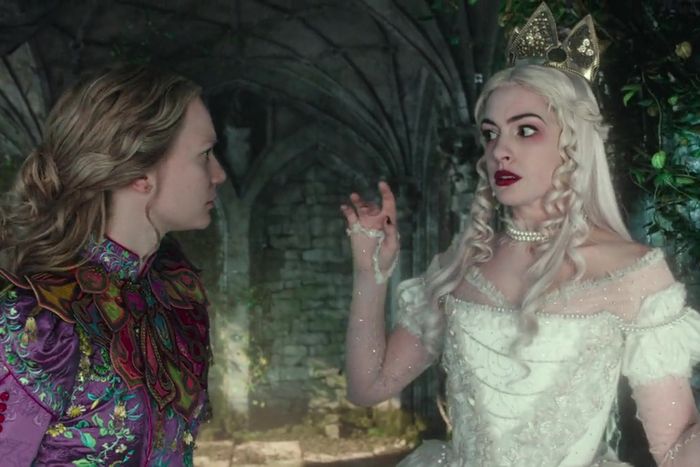
Photo: Walt Disney Pictures
Do you want to see a normally great performer handcuffed to contractually obligated sequels that happen despite public disinterest? A sequel no one asked for, Alice Through the Looking Glass flashes back to the schism between Hathaway’s White Queen and her sister, Helena Bonham Carter’s Red Queen. Hathaway’s story (along with, umm, even the titular heroine’s) is deferential to HBC’s, so there’s next to nothing for her to play besides green-screen reaction shots while drowned in the film’s visual miasma, giving a performance completely divorced from the devilishly sweet characterization she gave in the first film. Mercifully (to her) she is in very little of the film, but there are just better uses of Anne Hathaway’s time than this.
One Day casts Hathaway alongside Jim Sturgess as two British university grads who skip sleeping together in favor of friendship, setting off a decades-long will-they-or-won’t-they romance that ends in inevitable tragedy — and it has no business being as bad as it is! As teacher Emma, Hathaway spoils so much of her creative energies conveying minor age progressions rather than developing a distinguishable character (not to mention her ever-shifting dialect, the effect of which feels like you’re touring the British Isles). While the film grapples with Dexter’s (Sturgess) addictions and patience-testing roguishness toward her, Hathaway and director Lone Scherfig never land on a compelling reason for Emma to put up with it. The movie lacks a pulse, and it’s the rare Hathaway performance that does as well.
A (Partial) Ranking of Hathaway Side Quests
13. Don Peyote (2014)
Did you know that if you ask nicely, Anne Hathaway will cameo in your horrible lo-fi stoner comedy? More than all her career tangents listed below, this one prompts the question: What is she doing here, and what the hell did I just watch?
12. Documentary Now!, “Mr. Runner Up: My Life as an Oscar Bridesmaid, Part 2” (2016)
The actress plays herself as an Oscar presenter. While she’s certainly in on the joke, she doesn’t get to tell any jokes.
11. Hoodwinked! (2005)
Anne Hathaway voices Little Red Riding Hood in this, the worst-looking animated movie you’ll ever see, and she doesn’t even phone that in.
List continues throughout.
Oh boy. This one you might remember as an unrated straight-to-DVD provocation intentionally running counter to Hathaway’s Disney-fied image. She stars as privileged Pacific Palisades teenager Allison, whose friends want to rebel by getting enmeshed with drug dealers. She smokes crack, sings Tupac and Jay-Z songs (racial slurs included!), and at one point spits “I just can’t wait ’til I’m old enough to vote!” In trying to unpack Allison and her friends’ racism and cultural tourism, this off-putting film ends up becoming the thing it’s trying to satirize. Does it sound a lot like Crash? They came out within a year of each other! Havoc is a brazen product of its time that only stirs uncomfortable laughter now — tilt your head slightly and it might look something like Larry Clark sleaze getting the Christopher Guest treatment. But it is also maybe the earliest example of Hathaway committing hard to the material, even when it’s barkingly bad. If it was good, you could call Hathaway’s unabashed, headfirst dive into Allison’s embarrassing behavior a shockingly vanity-free performance for a young star. But, more than any of her daring work in lesser movies, the question begs, for what? Havoc is embarrassing for all involved, and her effort feels misplaced.
Not that Passengers movie, the other Passengers movie. The one you’ve maybe never heard of? This genre-adjacent romance and heavy serving of spiritual hokum stars Hathaway as a (child) therapist to a group of (adult) plane-crash survivors, and she falls in love with the biggest freak among them (Patrick Wilson). It’s a logic vacuum with a groaner of a big twist, asking the actress to give real emotional stakes to increasingly ridiculous behavior and circumstances. Sappier than any romance she has ever starred in, Passengers is movie quicksand that not even a great actress like Hathaway can pull herself out of.
It’s not like Hathaway hasn’t delivered broad, farcical comedy successfully before. But when she has, there’s an air of creative freedom to those performances, where she’s allowed to do her thing. In Bride Wars, however, she squares off against Kate Hudson as two friends who turn on each other over their conflicting nuptials. Both she and Hudson feel trapped by the film’s cruel antics, backing them into a corner of playing the loudest of Jerry Springer behaviors without an ounce of groundedness. Hathaway is best here when winning a dance-off and swinging from a rope while “Tambourine” plays.
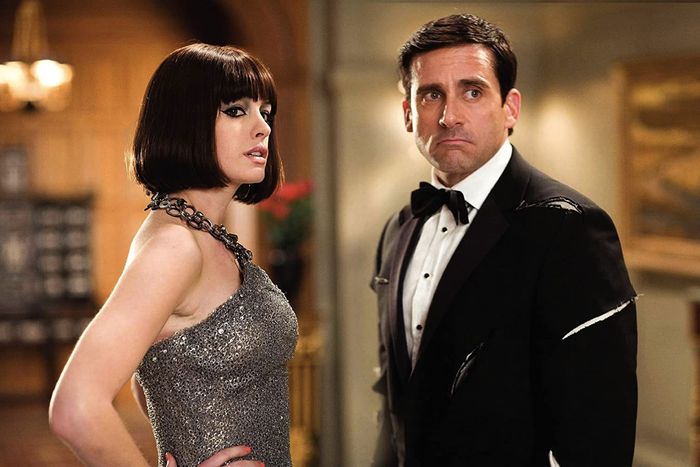
Photo: Warner Bros.
Based on the popular 1960s spy sitcom, this weak adaptation casts Steve Carell as a bumbling secret agent, with Hathaway as his more competent partner and developing love interest. Forced to play the straight man to Carell’s antics, the film saddles her with jokes about [checks notes] plastic surgery, aging, and carbs, and deadpan dialogue like “I’m just a woman with a dusty old uterus.” Worse yet, she and Carell don’t have much chemistry to speak of — it’s a forgotten IP comedy for a reason.
As far as crass-comedy duos go, Hathaway is given more of center stage here than in Get Smart, even if the movie itself is decidedly worse. A remake of Dirty Rotten Scoundrels, Hathaway pulls off cons opposite an ever-unpalatable Rebel Wilson but gets the better bits and jokes throughout, from clowny accents to crying on cue. The film is so clearly beneath her, but she’s still capable of making it a little fun when the spotlight is solely on her. You want to hear Hathaway doing an intentionally bad dialect in a dumb comedy (and it isn’t not a little fun here), but not this dumb comedy.
Imagine a John Carney musical on downers and you can approximate the underbaked mood of the forgotten Song One. Here Hathaway stars as a woman who returns home when her brother falls into a coma and, by chance, enters into a relationship with her brother’s favorite now-washed-up musician (think Da-meh-ien Rice). It’s much more minor key than the juiciest details of the plot might suggest, but it’s so mildly composed that it also doesn’t make for the best fit for Hathaway’s gifts. Plus it’s a music-centric movie that barely asks her to sing?!
Side Quests, Ranked (Cont’d)
10. Modern Love, “Take Me As I Am, Whoever I Am” (2019)
Even Hathaway struggles to make her performance feel like more than a lark in this now-forgotten Amazon show, starring in her episode as a bipolar woman who learns to own her condition rather than hide it.
9. Rio (2011) and Rio 2 (2014)
We shouldn’t discard any Hathaway singing role, but Rio (a kids movie about getting birds to fuck) gives most of its fun bits to co-star Jesse Eisenberg. Ditto to its overstuffed sequel, where she’s outshone by Kristin Chenoweth singing “I Will Survive.”
8. Don Jon (2013)
Hathaway’s cameo as a fictional actress opposite Channing Tatum shows that if you can only give her 30 seconds of screen time, the appropriate thing to do is to let her slap a man.
As the love interest of the titular Dickensian hero, the actress’s work as Madeline Bray is another of her earliest performances where she is tasked with not a whole lot. But unlike The Other Side of Heaven, Hathaway finds a moving emotional core to the character that gives this tepid Dickens adaptation some uplift amid a surprisingly flatlining ensemble (save for a one-eyed Jim Broadbent). Honestly, sometimes we simply must let Anne Hathaway be British!
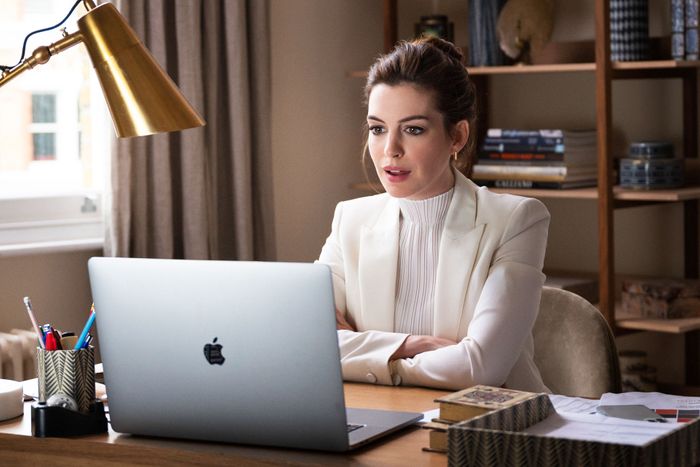
Photo: HBO Max
Doug Liman’s HBO Max original is a cursed object: a lockdown-set quasi-heist movie from hell. Hathaway plays a formerly bicurious executive who drinks constantly, fires staff over Zoom, and pounds cigarettes while her marriage disintegrates, all during early COVID. At one point, she monologues about how sex with her husband will curb her impulse to commit a high-stakes heist, and it should be a lot more fun than that sounds. Because it’s a ridiculous but bland relationship drama told at typical breakneck pace, Hathaway doesn’t ever have the room to find her footing, and Liman lacks the comic finesse to harness his lead actress’s gift for the acerbic.
This fan-fiction-y biopic casts Hathaway as Jane Austen before she publishes her greatest works and during a major romantic heartbreak. But Becoming Jane asks of her a somewhat impossible task: The actor must embody shadows of each of Austen’s beloved heroines while also presenting a take on Austen herself. Her work gets a little lost among all the winks to Austen’s literary world, leaving us wishing we were actually watching one of Austen’s stories instead. Wouldn’t you rather see Anne just play Elizabeth Bennett or one of the Dashwoods? The performance is at its pointedly reserved best in its epilogue, which presents a post-success Austen being generous to a fan: the daughter of the man who broke her heart.
Garry Marshall’s Valentine’s Day is a dire exercise, launching each member of its sprawling ensemble into a void of thinly drawn, ramshackle sketches. Everyone is left to fend for themselves among what feels like Hallmark crossed with Hieronymous Bosch. Hathaway plays a receptionist who side-hustles as a Russian phone-sex operator while dating mailroom clerk Topher Grace, and it’s the plotline in the movie you could most describe as “normal” (for example: While on a flight, Bradley Cooper comforts his seatmate, Army captain Julia Roberts, and then goes home to his boyfriend, Eric Dane). Listen, no one is better than good in Valentine’s Day, and only a few people achieve that low bar — Hathaway, Queen Latifah (duh), and honestly, Taylor Swift. “Good” in this film is “passably charming,” and Hathaway can deliver that even when asked to do something totally ridiculous.
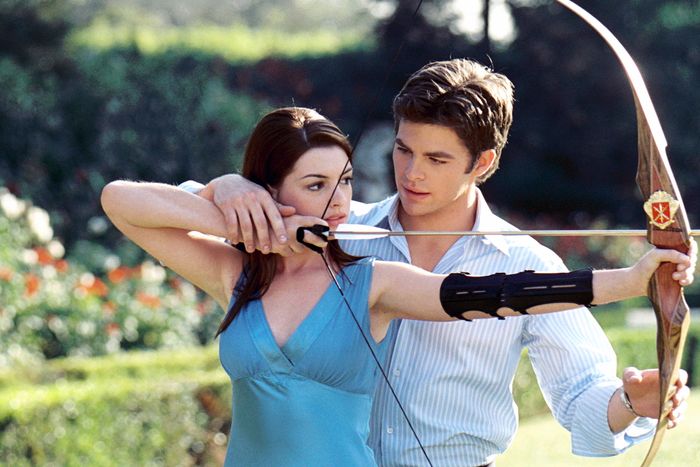
Photo: Buena Vista Pictures/Everett Collection
In a sequel that exists mostly to answer all of your lingering international-diplomacy questions from the first film, The Princess Diaries 2: Royal Engagement is a better delivery system for Kelly Clarkson’s “Breakaway” than it is for giving Hathaway much more than bed-surfing down a staircase. It’s an agreeable but stale romantic comedy in which her princess of Genovia must marry a prince in order to maintain control of the kingdom. Hathaway mostly follows the beats but is given less room for the broader comedy that made the original so infectious. Several bonus points for this perfect bit with a fan, however.
Side Quests, Ranked (Cont’d)
7. “Unexpected Wonders” for Bulgari (2022)
Anne and Zendaya starred in this Paolo Sorrentino–directed “short film” (don’t call it a commercial!), and sometimes untouchable glamour is enough.
6. “At the Ballet” with Barbra Streisand and Daisy Ridley (2016)
Hathaway in A Chorus Line?! Credit that inspired choice to Streisand. Annie gets the best monologue as Maggie but cedes the part’s biggest musical moment to Babs.
5. Host, 83rd Academy Awards (2011)
Direct your complaints to her largely in absentia co-host, James Franco. While he abandoned her effectively the moment they hit the stage, Hathaway bore the brunt of his folly.
Director Robert Zemeckis’s remake was shunted over to streaming and drew both harsh and somewhat rightful ire, but Anne Hathaway nevertheless has a lot of fun! And yes, the questionable CGI choices (separating jaw and all) do often overshadow what she is doing here. But mostly the dismissal of Hathaway’s grand clownery in this was transferred hatred for the objectionable movie itself. The danger of Anne Hathaway taking on the Grand High Witch of Roald Dahl’s The Witches is that she inevitably draws comparison to the previous and quite iconic take on the role from her fellow Best Supporting Actress winner, Anjelica Huston. Hathaway shrewdly chooses to go in a completely different direction. She’s like Count Chocula by way of Bette Davis, making the kind of acting choices that would make RuPaul tell her she was the winner of this week’s challenge (this is all a compliment). It’s not one of her most refined performances, so your mileage may vary, but it’s one to single out for her fearlessness in going big.
If Tim Burton’s Alice in Wonderland monstrosity is a tide so disastrously bad that it sinks all ships, Hathaway is its beacon in the night — or at least the person involved who escapes most unscathed. While some of her co-stars have to carry the weight of Burton’s Hot Topic Tolkienification of the story, she gets to show up late and not be so dully serious as everyone else. Hathaway’s White Queen floats with sweet highs and dark lows, her heavenly air masking a morbid psychosis. You would think her Oscar-winning turn in the Broadway musical adaptation Les Misérables would be Hathaway at her peak theater kid, but no, it’s this.
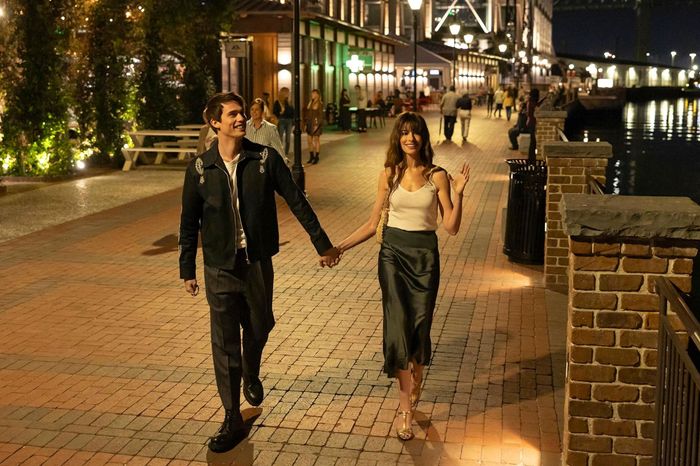
Photo: Prime Video
Ah, yes, the recent streaming hit that cast Annie as a single mom who falls in love with a young Über-famous pop star who is definitely not named Schmarry Schmiles. The actress recently told Harper’s Bazaar that Solène, the lovestruck woman she plays in The Idea of You, was the character closest to her own personality. Here is a very believable, naturalistic performance from the actress that is easy to emotionally invest in, and without even a dash of cynicism, but the mild-mannered nature of the film makes it hard to single out as a standout.
In Mothers’ Instinct, Hathaway and Jessica Chastain play mid-century close friends and neighbors at odds — Hathaway’s son tragically dies, while Chastain suspects she wants to take her son as her own. The movie writes a lot of checks it lacks the nerve to cash — never veering into full camp or heightened actress-versus-actress melodrama, though it still wants you to believe it might at any minute. The result is a deeply sad drama that’s trying on a thriller’s coat for size. Hathaway has the disadvantage of having to play toward a lot of paranoia rather than actually playing with villainy. Though Hathaway’s performance registers the harrowing contradictions of grief responses, the movie around her lacks the confidence to go darker. She’s good in it, but this mother-off is more of a muted-off.
On temperament and fantasy buffoonery, Ella Enchanted is basically a Shrek movie, so it’s surprising people aren’t kinder to it! Given the goofy and chintzy nature of the film — ’70s rock, dreadful CGI, Halloween Express couture — you can’t really argue that it serves Hathaway as a young star as well as The Princess Diaries had three years prior. But she is undeniably gravitational in fantasy-heroine mode, maintaining her charisma and grit in a family-safe package as the maiden forced by a spell into constant complicity. And she performs Queen’s “Somebody to Love” before Glee made it cool to do so.
Edward Zwick’s Love & Other Drugs is a mixed bag, attempting to skewer the pharmaceutical world at the advent of Viagra while also being a heart-tugging romantic comedy. Jake Gyllenhaal stars as a pharma sales rep who falls for Hathaway, a fiercely independent and no-bullshit woman with early onset Parkinson’s. A lot of ink was spilled over the copious frank sex scenes and nudity between the reunited Brokeback Mountain co-stars. Former Tumblr girls will remember the chokehold their tear-soaked climactic scene had over us. But it’s not those headline-grabbing moments that make Hathaway’s performance here special; it is her sheer movie-star magnetism and fiery charisma that sell both the character and the relationship.
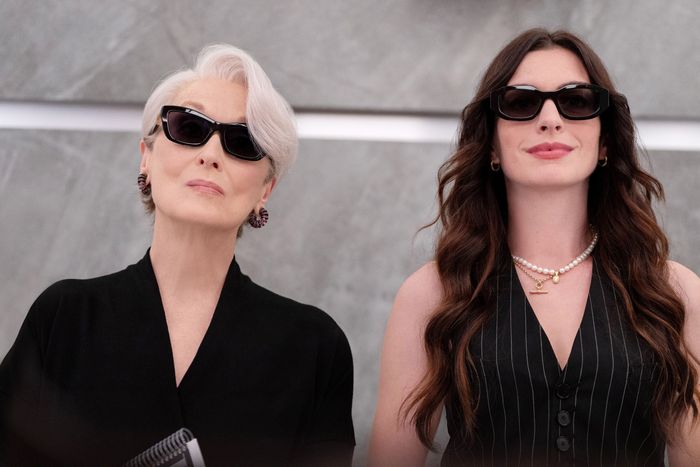
Photo: Walt Disney Co./Everett Collection
Reviving a role after a 20-year absence is no easy task, especially when you’re playing the non-eccentric opposite bigger personalities, as Hathaway does in both Devil Wears Prada films. In the second installment, Hathaway’s characterization of Andy Sachs is more accomplished but just as stricken, and more in line with her original choices than her previous return performances in sequels like Alice and Diaries. And her performance here feels more like an evolution of a beloved character rather than empty fan service. Time hasn’t diminished her flinty chemistry with Meryl Streep or Emily Blunt, thank God, though her moments with Stanley Tucci drift into needlessly sappy terrain.
As a high-functioning alcoholic whose outbursts manifest as a kaiju on the other side of the world, Hathaway delivers one of her most limber performances in the darkly comic Colossal. It’s no Pacific Rim cacophony though, dealing more in themes of codependency and misogyny, giving us an unfettered Hathaway. Here the actress is liberated by something both offbeat and nuanced, selling a performance that is more effective at threading this morphing tone than the film itself is.
Side Quests, Ranked (Cont’d)
4. Duet With Hugh Jackman, 81st Academy Awards (2009)
You can’t argue that their charming moment in the opening number wasn’t instrumental in Anne getting the hosting invite later and both of these stars getting tapped for Les Mis.
3. Lip Sync Battle, “Wrecking Ball” (2015)
Hathaway, along with Tom Holland doing “Umbrella,” gave this deeply heterosexual program some credibility by slaying Miley Cyrus’s power anthem. It was a different time, when the spoof du jour was licking a sledgehammer, but Annie crushed it.
2. The Kelly Clarkson Show, “Since U Been Gone” (2023)
During a round of “Name That Tune,” Hathaway beat the host at her own discography, and Clarkson collapsed to the floor like pop-music roadkill.
To dare greatness, one must also dare flopping. Serenity is a high-concept fiasco, but what if Hathaway eats? The movie is a sexually profane sci-fi noir about domestic violence set in a child’s video game about fishing (not kidding), like Stardew Valley told with Grand Theft Auto’s lexicon. Matthew McConaughey is its hero, with a blonde Hathaway as his former lover who propositions him to kill her husband. In a filmography teeming with eccentric characters, this is Hathaway’s campiest performance — she’s like a hard R-rated Lauren Bacall. The movie regularly veers straight into the ridiculous (Jeremy Strong plays an oddball who refers to himself as “the rules”) and into the icky (Hathaway repeatedly moans “daddy” to her abuser husband, Jason Clarke), but she is unflinching even as it burdens her with poorly scripted abuse tropes. On the path of committing to the bit, Hathaway and her film diverge in terms of quality; the movie is awe-inspiringly ill-begotten, but its leading lady deserves a medal for finding something juicy amid the muck.
A movie like the underseen She Came to Me only works when its performances don’t betray its tricky tone, and Hathaway is exactly the right person to not pull any punches. Her character, like the film, goes to some places. Here she plays the germophobe therapist wife of an opera composer (Peter Dinklage), a woman whose psychological pursuit of “spiritual cleanliness” leads to a mental breakdown and, ultimately, the nunnery. It’s not exactly a movie you’d expect from indie darling writer-director Rebecca Miller; it’s a Charlie Kaufman–adjacent fable with its soul on its sleeve, lyrical, magical, and uncloying in its strangeness. Hathaway plays it all remarkably straight and emotionally authentic — it’s one of the hidden gems of her career and one essential to understanding Hathaway as unabashedly willing to take huge creative risks in the service of unusual material.

Photo: Francois Duhamel/©Warner Bros/Courtesy Everett Collection
Hathaway spends much of Nancy Meyers’s The Intern without exposing much of her upstart CEO character Jules Ostin’s inner life. At first it plays like thinner sitcom portraiture, but it’s also part of the point. It’s the rare time that you wish for Meyers’s sunny sheen to have a few more sharper edges — we keep hearing what a hectic asshole Jules is, but Hathaway barely has an opportunity to show it. Her performance really comes alive once Jules breaks down about her husband’s affair, ultimately revealing her deepest insecurities to her elder confidant, Ben (Robert De Niro). It’s one of her more vulnerable showcases, allowing Jules’s walls to come down in real time. Though there is a stylistic tug-of-war between Meyers’s dialogue (The Intern has its moments, but it’s just not peak Meyers) and the real desperation the actress brings to it.
Christopher Nolan’s intergalactic take on big science and big feelings was a tad misunderstood when it opened. It arrived right when the most common complaint lobbed at the director was that his films lacked emotion; he cast Hathaway in the aftermath of her Oscar win, when she also faced an unfair public perception. You could understand an impulse to overcorrect on those criticisms, but he and Hathaway wisely rein it in. With all of the film’s complicated theoretical physics and flowery musings about the power of love and time, going melodramatic could push the film into eyeroll territory. Hathaway best embodies this balance in a midpoint monologue when the deep-space mission seems doomed. She soberly expounds the film’s most poignant themes with offhand gravitas over hokey sentimentality. It’s one of Nolan’s best and most meaningful films, and Hathaway is its intellectual (but still fiercely human) epicenter.
Hathaway’s only (to date! keep the dream alive!) collaboration with American master director Todd Haynes isn’t exactly the kind of role you would hope for her to have with this specific meeting of the minds. Here she plays the wife — and literally says “Don’t talk to me like I’m the wife!” at one point — of Mark Ruffalo’s real-life lawyer, whom the film follows for decades as he crusades against DuPont poisoning the local community. But what makes this performance interesting is how, in typical Haynes fashion, Hathaway is able to both be the thing and comment on the thing. Her The Wife nods and supports, all knowingly without deceiving the emotional truths of the narrative. If Haynes’s approach to the social-justice movie is to show how the genre works against the rhythms of real-life circumstance, then Hathaway’s performance indicates how this trope works within that genre. In moments where Ruffalo is tasked to explain how the Teflon poison works and the status of the case, she also plays audience surrogate, displaying a doomsday shock we all understand too well. It’s heady but genius.
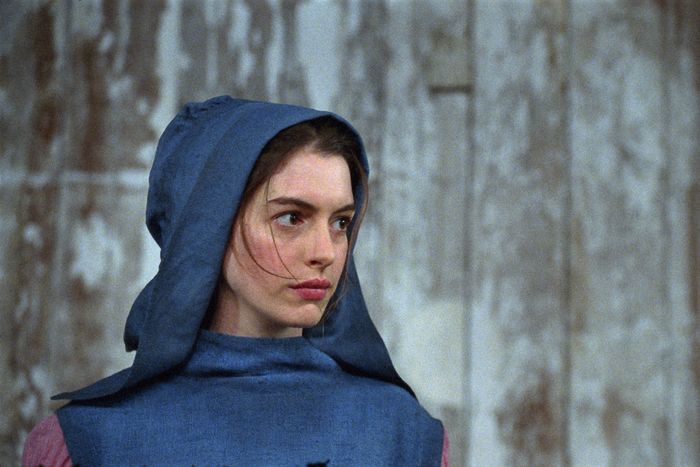
Photo: Universal Pictures
She would take even bigger creative leaps in larger roles, but her short screen time here is fairly undeniable. Ask the average moviegoer for an example of Hathaway’s daring as an actress, and many will offer her turn as Les Misérables’s iconique, tragique Fantine. When it was released, much was made about director Tom Hooper’s live-singing approach to the big, brash musical, and Anne Hathaway deserves a lot of credit for making audiences understand what a lift it was. Her playing of Fantine as she endures endless indignities is more humane and convincing than Hooper’s tastelessly baroque approach to the material. When she offhandedly stumbles into singing for the anthemic “I Dreamed a Dream,” we actually buy what Hooper otherwise fails to sell. Hathaway’s portrayal of the typically opulent song is grounded in reality first, without sacrificing any of its big emotions. It’s somewhat antithetical to the bold theatricality of the song, but if you tell me it left you completely unmoved, I probably don’t believe you. And then Hathaway won an Oscar for it, and everyone was entirely normal about it, flowing with generous takes.
Adapted from Joan Didion by typically brilliant filmmaker Dee Rees, The Last Thing He Wanted struggles to come together. With Hathaway as a hardened journalist who haplessly lands herself into the center of a conflict in El Salvador, the film is somewhat at sea, allowing itself and the audience to get swept away by an unmoored plot. Though Hathaway’s work doesn’t make sense of the film’s confusing political turns, her fraught navigation of the personal and the political plays like a magnetic performance from a better movie. Where her screen persona is often in a fascinating push-pull of charm and prickliness, The Last Thing He Wanted allows her to go full-tilt abrasive without losing the wounded heart at the character’s core. Had the movie worked out better and bolstered Hathaway’s full-bodied approach, it might be more widely acknowledged as some of her best work.
Side Quests, Ranked (Fin)
1. WeCrashed (2022)
I can hear you now: “What’s WeCrashed?” Following the making and unmaking of WeWork, Jared Leto and Hathaway star in this little-discussed Apple TV+ miniseries as the notorious flame-out company’s eccentric figureheads, Adam and Rebekah Neumann. It may be a fairly average show, but Hathaway is phenomenal. With dark humor, she delivers an ungovernable, wild inverse of her performance in The Intern, a self-deluding amalgam of ego, rage, and bone-deep shame. It’s simultaneously her most raw performance and one of her funniest.
If the female-led entry to the Ocean’s heist franchise misses the mark on a few essential elements, it does get two things exactly right: (1) casting Hathaway as the weirdo, and (2) letting her do the PG-13 film’s one allowable F-word. Hathaway gets the most fun part to play in this formidable ensemble, starring as egotistical actress Daphne Kluger, who starts as the mark but ends up enlisting among the thieves. She plays the actress like an overgrown mallrat who lives for the drama, purring over necklaces one minute and firing off an underestimated street-smart intelligence the next. It’s a classic comedic character-actress performance, slaying right comedy choice after right comedy choice after … you get it. We just want to have as much fun watching the whole movie as we do when Hathaway is onscreen. Release the deleted knife scene!
Those of us who love her were able to finally take a breather on this one when the film bros eventually shut up and were able to admit that Hathaway totally whips ass in this franchise closer. Hathaway’s Catwoman is one of her best takes on feminine rage, juggling a sense of righteousness and nihilism that might clang unconvincingly in the hands of a different performer. She’s unshakeable, smooth in her deceptive abilities, and just a little bit horny about getting one over on all these guys. No performance should ever be reduced to a single moment, but The Dark Knight Rises has one that distills the essence of her performance so perfectly: When Bruce Wayne first catches her in a lie about her identity, she wordlessly sheds the mask of her innocent persona in a cascade of expressions from alarm to admission to middle-finger toughness, resting at a “You’ll never catch me” impishness. Christopher Nolan is one of the few directors who really gets Hathaway. The Dark Knight Rises may be an overstuffed and thematically conflicted mess, but her Catwoman rings crystal clear.
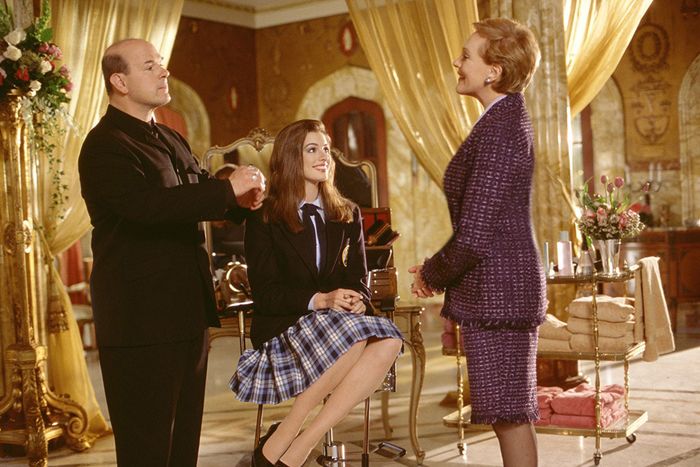
Photo: Walt Disney Pictures
Allow me to Y2K generation out for a moment about Hathaway’s debut as a young woman who discovers that not only is she a descendant of royalty of a real, totally found-on-maps country, but that she must prove sophisticated enough to lead it. There used to be physical-comedy genius; there used to be simple, aspirational concepts; there used to be a passing of batons between past stars onto the next generation of them. If you’re a person of a certain age, you think you might be unable to rewatch something like The Princess Diaries and see it through unbiased eyes. It may be a landmark for a generation of girls and gays, but this Disney-certified debut for Anne Hathaway is the kind of star-making crowd-pleaser that remains timeless, as is Hathaway’s purely charismatic central performance. Asked to match the totemic screen legend Julie Andrews as her queen grandmother, Hathaway takes on a massive challenge that more seasoned performers have biffed, and she aces it. Next, Hathaway must also sell the transition from ugly duckling to global glamour sensation. That we buy the ever-beautiful Hathaway as a frump at all is evidence to her instant physical-comedy prowess, but that she does so opposite the OG Eliza Doolittle is doubly impressive. Sometimes movie stars are built over years, and sometimes they arrive in an instant.
James Gray’s Armageddon Time, about generational divides within a Jewish family in the early 1980s, follows preteen Paul (Banks Repeta) as he befriends Black classmate Johnny (Jaylin Webb) and learns the harsh reality about how the world treats them differently. Hathaway is Paul’s mother, Esther, herself the child of an immigrant parent (Anthony Hopkins) who fled the Holocaust. Gray crafts a nuanced look at the chain of intergenerational expectations, at turns damning and self-reflective about how cultural self-preservation can conflict with the American justice system. The film spotlights Hathaway’s ability to articulate the unsaid and to convey what her character does and does not realize about herself. Two key sequences with Repeta demonstrate the breadth of her performance. In one scene, she violently reprimands him in a school hallway for smoking pot — an act that seems entwined in her harsh maternal instincts and protecting her own precarious standing in the community. Weeks later, she is all tense, bruised tenderness when he arrives home late, and she attempts to contain her grief over her father’s imminent death. It’s one of many truths that she can’t tell him yet. Esther’s complexity comes alive in her contradictions, underlining Gray’s thesis that good intentions can manifest in human ugliness.
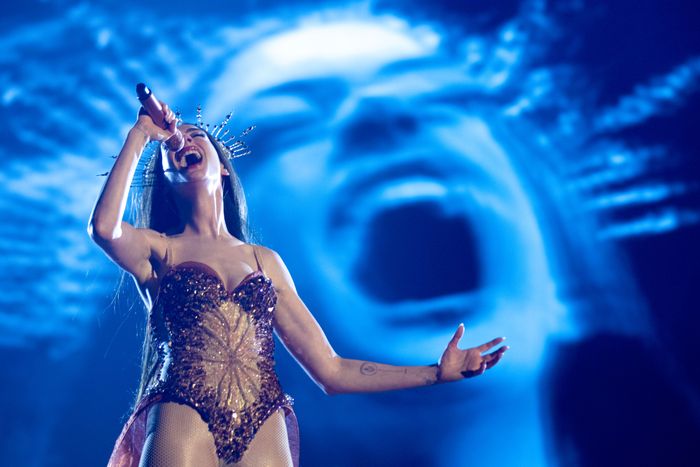
Photo: A24
David Lowery’s sumptuously strange Mother Mary requires some patience for pretension and artifice, but sorry, so does loving any self-serious pop star. With Hathaway as the titular hollowed-out pop goddess and Micaela Coel as the ex-friend who helped shape her image, the film is a musing about adoration, both from the distance of fame and the brutal intimacy of friendship. Hathaway’s turn is unlike anything else she’s ever done, stripped of her usual performance style while playing a siloed Über-celeb lacking the communication tools of a normal person. There’s a physically primal element that feels new to Hathaway here, and not just in the film’s early convulsive silent dance sequence. But it’s also a performance of wildly swinging spiritual highs and lows — she’s conceivably both the onstage persona of deific star wattage and the dejected husk when she leaves the stage. When Hathaway does a weird one, she usually goes big, but here she goes inward in fascinating, unexpected ways.
Famously, Hathaway was far down on the casting wish list for the role of fashion neophyte Andrea Sachs, so this timeless performance is nothing if not a testament to what happens when an eternal theater kid tackles a role with something to prove. While Meryl Streep’s iconic Miranda Priestly got generations of praise for her comic precision and humanizing the boss from hell, Hathaway pulls off something terrific in tandem. It’s Hathaway at her most effortless and believable, crafting with seeming ease someone the audience can see themselves in — it’s one of the reasons the film has endured. Andy “Andrèa” Sachs is the millennial everyhero, alternately unfazed and then racked with people-pleasing anxieties. Like The Princess Diaries, Hathaway makes a slow glow-up believable, here getting to play more in the minutiae of her emerging confidence (thank you for your legacy and service, KT Tunstall). With her co-stars getting most of the jokes, you can easily imagine us losing interest in Andy without the dignity Hathaway gives her. While discourse cycles perpetually call out who is the real villain of the film (for me, personally, it’s those damn twins), we all rest in our love for Hathaway’s unchallenged heroine.
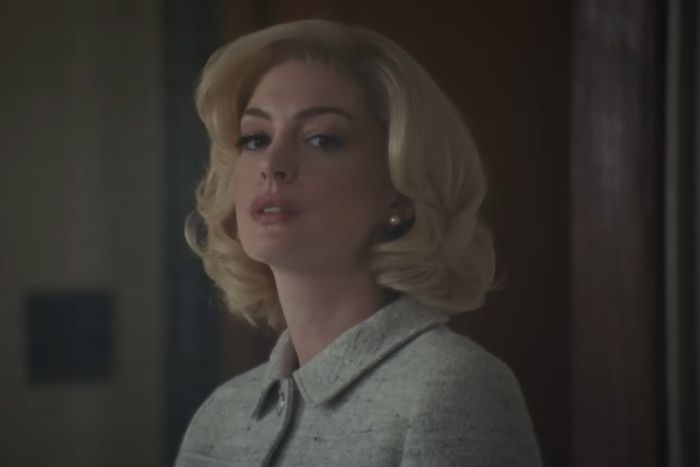
Photo: Neon
Based on Otessa Moshfegh’s novel about women driven to extremes by life in a small town, Thomasin McKenzie stars as the titular gruff clerk at a boys prison, physically and mentally stuck in a reality inextricable from male brutality. “Everyone’s kind of angry here, it’s Massachusetts,” Eileen says. Enter Hathaway as Rebecca, the new, sophisticated head psychologist who relocates from the city and quickly sparks a connection with the young woman that may or may not be flirtatious. And then Rebecca does something very, very bad. Eileen is Hathaway perfectly in the pocket with her obsessions as a performer, melding her gifts for the exquisite and the dark while building a character who is never easy to pin down to a simple motive. Rebecca charms the sheltered Eileen with either lustful seduction or solicitation, whether she sees part of herself in Eileen or that she’s just the least depressing option for friendship around, all depending on how you read Hathaway’s slippery delivery. The performance is also Hathaway’s riff on sapphic tropes of mysterious women in movies — she mugs enigmatically, she purrs mid-Atlantically, she adeptly manages brutish men while drunk, and of course, she comes apart at the seams. Here Hathaway is divine and deceptive in equal measure, offering a kind of thesis statement for her whole deal as an actress.
Every performance in Ang Lee’s cowboy romantic-tragedy masterpiece Brokeback Mountain is a total barnburner, no matter how small. As the rodeo-ropin’ wife to Jake Gyllenhaal’s Jack Twist, Hathaway landed her first blush with a world-class filmmaker but a fraction of the notices that her equally brilliant peers Heath Ledger, Michelle Williams, and Gyllenhaal received. It’s somewhat understandable, given how much Lureen keeps to the background, though Hathaway never plays her as a cipher. But the film weaponizes how little we think about her in one of its final scenes, when Ledger’s Ennis calls her and receives the details of his lover Jack’s death, though he doesn’t get the full story. Hathaway plays the lie as an agreed-upon party line before realizing who Ennis might be and decides not to crumble. She barely moves, yet her clipped delivery and detached middle-distance gaze says it all. It’s not only one of the most impressively performed moments of her career, but it completely reframes the character and how little consideration the camera afforded her up until that moment. It’s a quiet killer of a performance, one whose reputation has rightly grown as the film’s legacy endures.
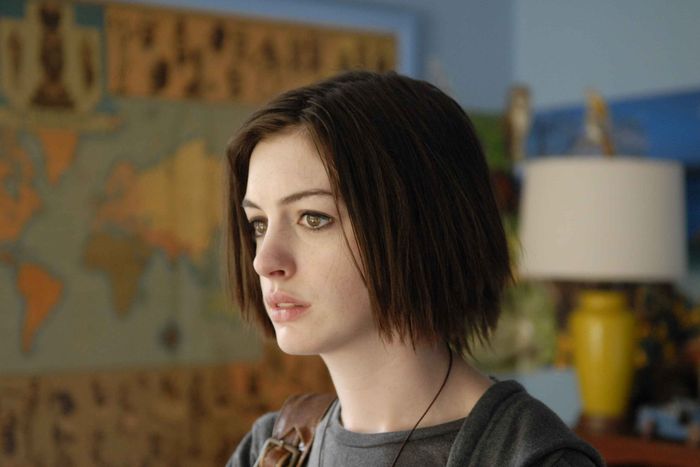
Photo: Sony Pictures Classics
Hathaway’s multitudes are never more visible than in Rachel Getting Married, a late-career Jonathan Demme masterpiece about the unmendable wounds within one sprawling family. The actress earned her first Oscar nomination as Kym, a former model who is permitted a leave from rehab to attend her sister’s wedding (a towering Rosemarie DeWitt). Kym is the family fuckup and a guilty party to its biggest tragedy but also constantly pokes the bear as its selfish verbal assassin. Hathaway unfurls Kym’s grievances (and somehow her humanity) at a rapid-fire clip: She cuts so close to the bone that her delivery takes us from uncomfortable laughter to sudden tears and back again, sometimes in the span of a scene. In one of her acting career coups, Kym delivers a toast to her sister that centers Kym’s own troubles, alienating an entire room of previously blissed-out guests. You hold your breath, desperate for her to stop talking, but Kym just keeps going. And then she keeps going. And by the time she stops, somehow Hathaway has exposed the whole of this abrasive but wounded person. The role unshackles Hathaway from the categories skeptical viewers place her in: the teen star, the try-hard, the ingénue, the vamp, the theater kid. It’s a bold performance of a character who can’t be helped nor help herself, and the most free Hathaway has ever been onscreen.
Sign up for the Vulture Daily
An entertainment newsletter for the pop-culture obsessed.
Vox Media, LLC Terms and Privacy Notice
Related