
Resurrection has been a regular occurrence in Star Wars from the get-go. The veteran Jedi knight Obi-Wan Kenobi gets lightsabered partway through the original 1977 movie, only to return seconds later as a disembodied voice of wisdom. Yoda, the backward-talking green alien who dies of old age in Return of the Jedi, soon reappears as an electric-blue ghost. So do Anakin and Luke Skywalker, the latter of whom sagely reminds us in The Last Jedi, “No one’s ever really gone” (no kidding). In The Rise of Skywalker, Kylo Ren (Adam Driver) cheats death twice, first after getting skewered with his own lightsaber and later by resurrecting Daisy Ridley’s Rey, who temporarily dies battling perennial villain Emperor Palpatine (who also, somehow, returned).
Besides being overdone, resurrection can nullify stakes and come off as a storytelling crutch. Sometimes it just looks goofy. So it’s more than a little surprising that the most compelling Star Wars protagonist in years is yet another character brought back from what looked like certain death. Even more unexpectedly, he’s a villain who croaked out just a few lines of dialogue, got cut in half, and was cast into oblivion in a movie that arrived in theaters several months before Y2K.
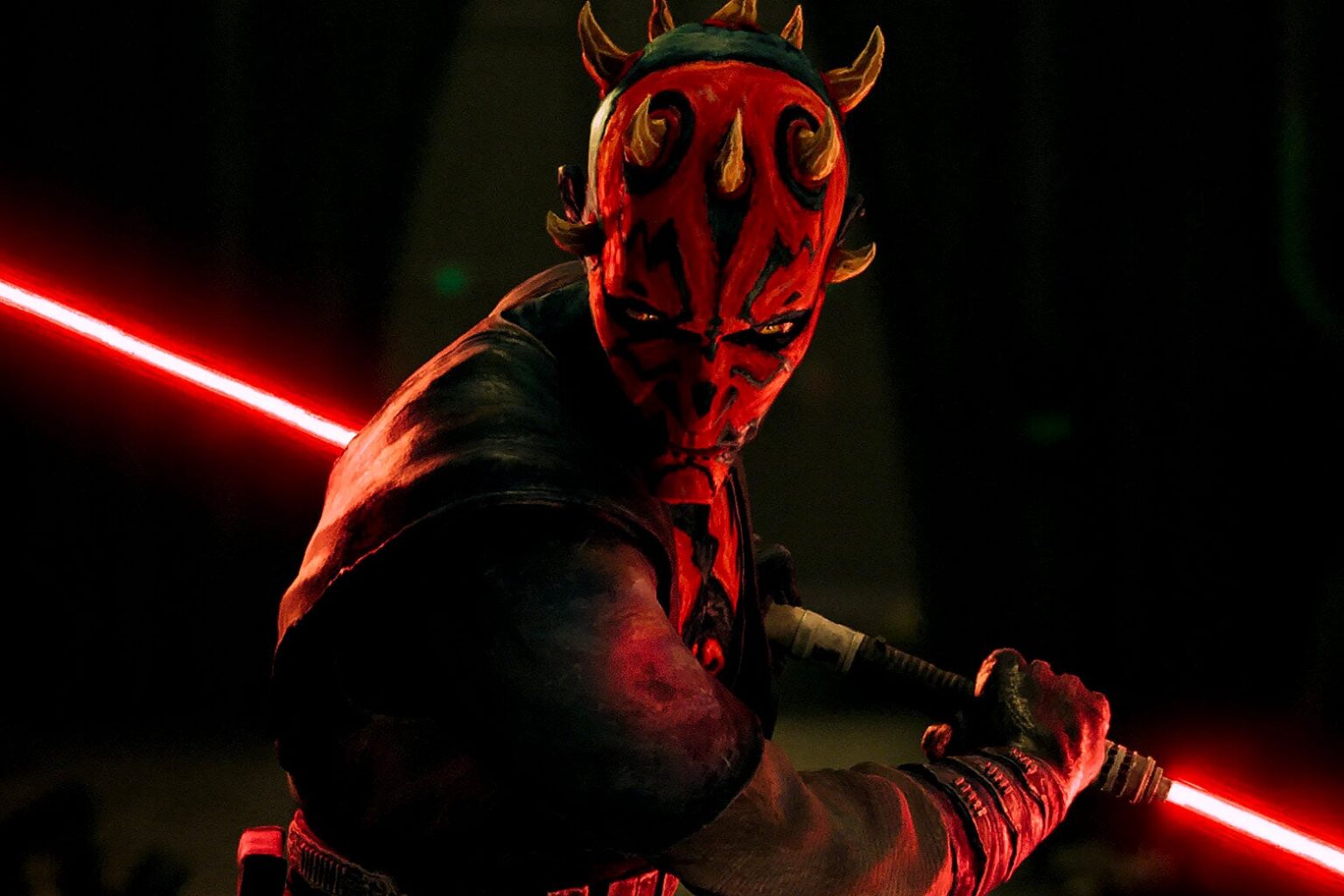
As even casual Star Wars fans might have guessed, I’m talking about Darth Maul. You may remember him as the devil-resembling, double-lightsaber-wielding Sith apprentice introduced 27 years ago in 1999’s Star Wars: Episode I—The Phantom Menace. After stalking a young Kenobi and an even younger Anakin from planet to planet, the aptly named Maul (played by martial artist Ray Park) ruthlessly dispatches Kenobi’s master in a climactic lightsaber fight that remains one of the saga’s best. But as Maul moves to finish off the helpless-seeming Kenobi, the younger Jedi manages to take up his fallen master’s lightsaber, bisect his face-tattooed opponent, and cast his remains down a deep shaft (one of many in Star Wars). The movie ends, and, by all appearances, so does Maul.
But it turns out that time and a thirst for vengeance can heal even the most fatal-seeming wounds. Two films and more than a decade later, fans learned that Maul—now sans his lower half and his “Darth” title—has survived. TV shows, comic books, and a movie have since fleshed out some of his ensuing adventures. Maul, abandoned by his Sith master (the future emperor), goes from eking out a hardscrabble living on a trash-covered planet full of other broken things to commanding the galaxy’s criminal underworld. He gets a set of robotic legs, gains and loses a sidekick, and repeatedly crosses blades with Kenobi.
Bringing Maul back from the dead was reportedly a directive of George Lucas, the grand vizier of Star Wars himself. Until now, though, it didn’t really make much sense. Officially resurrected in a 2012 episode of The Clone Wars, an animated show that began airing when I was a kid, Maul has now been back for longer than he was gone. But through it all, he’s largely remained a side character whose role could’ve been ably filled by some other bad guy.
Maul—Shadow Lord, a new animated series available to stream on Disney+, changes that by finally grabbing the erstwhile Sith by the horns. The show, which finished airing its first season on Monday, is a dark meditation on a former chosen one who got cast aside—a welcome shift for a franchise that normally centers on anointed protagonists fulfilling their destinies. By focusing on the castaway Maul as he and a new band of characters struggle to adapt to a fallen galaxy, Shadow Lord is the rare Star Wars installment that uses resurrection to advance a character rather than to just serve as a deus ex machina for someone else’s storyline.
Set a few years after the ascendance of the evil Galactic Empire, Shadow Lord finds Maul (voiced by Sam Witwer) running a small-ball criminal operation on a new-to-the-franchise planet where the Empire’s iron fist has yet to fully close. But Maul’s ambitions shift after he meets a teenage Jedi apprentice named Devon Izara. Like Maul himself, Devon (Gideon Adlon, daughter of Pamela) and her elderly master have managed to survive the destruction of the Jedi Order and evade imperial detection by subsisting off scraps and living underground as fugitives. The Jedi and the Sith are longtime enemies, but Maul sees kinship in Devon: They’ve both been forced to reevaluate the destinies they’d imagined for themselves, and they’re both angry about it, even if one of them won’t admit it. From there, the season unfolds largely as an extended chase sequence. Maul, with his coterie of mercenaries and henchmen, is running from the Empire. Devon, joined by a father-son duo who served the law until the Empire turned that on its head, is running from both. Yet she also finds herself drawn to Maul, who seems to offer a way to live—not merely survive—under a fascist regime that has hunted her kind to the brink of extinction.

Nitish Pahwa
Trump Is Going After Jimmy Kimmel Again. What’s Likely to Happen Next Isn’t Pretty.
Read More
Shadow Lord benefits immensely from Witwer, a veteran Star Wars voice actor who supplies Maul’s teeth-gnashing growl. It’s also better written than most of the franchise’s previous forays into animation. “I can tell that you are settled on who you believe I am,” Maul hisses to Devon at one point. “Would you like me to be that person? I am capable.” The show is at its best when Maul deals out hard truths over tea and during lulls between fight scenes. It’s also visually stunning, a kaleidoscope of highly stylized computer animation set against more traditional matte-painted backgrounds that recall the old-fashioned visual effects of the early Star Wars movies.
But don’t let its cartoony trappings fool you: Shadow Lord is both bracingly violent and subtler than it first appears. Shifting loyalties, uneasy alliances, and who’s-manipulating-whom intrigues propel the plot, some of it conveyed through fleeting looks and understated expressions that weren’t possible in prior Star Wars animations. (Early seasons of The Clone Wars were infamous for their wooden-looking characters, and Rebels, a successor series that eventually continued Maul’s storyline, had a more juvenile style that matched its target audience.) Shadow Lord dabbles in Star Wars tropes that will keep longtime fans entertained: fizzy lightsaber duels, mid-shoot-out quips, a protocol-obsessed robot. True to the franchise’s penchant for resurrection, there’s even a character who appears to go out in a blaze of glory but who I suspect will return. Yet the show also poses a resonant dilemma: How do you adapt to circumstances that seem to have rendered long-held values obsolete? Maul, who’s just as vulnerable to a changed galaxy as Devon, ends up forcing her into a choice that sets up Season 2, which is already in production.
What makes a Star Wars series about a half man worth watching when there’s literally a show called Half Man you could be streaming instead? The timing is fortuitous in part because of the creative wilderness in which the franchise finds itself. Other than Season 1 of The Mandalorian, which was a cultural phenomenon thanks to “Baby Yoda,” and Andor, a show so befitting our political moment that its catchphrases adorn No Kings protest signs, little of what has come out of the galaxy far, far away of late has been particularly lasting. With Disney at the helm, there’s always more around the corner: The Mandalorian and Grogu, a movie based on the series that features both those characters, will hit theaters this month. But box-office projections already have it tracking below 2018’s Solo: A Star Wars Story, the lowest-grossing live-action Star Wars movie and one in which the revived Maul briefly appeared, teasing a sequel that never got made.
SNL Finally Found Its Kash Patel. It Could Only Have Been One Comedian.
One of Literature’s Darkest Novels Is Now a Netflix Show. It’s Gripping, Heartbreaking—and Unexpected.
It Was the Crime Saga That Captivated Millions. A New Book Provides Some Fresh Insight.
Is an animated show centered on a resurrected villain enough to reanimate the franchise? Probably not, at least not by itself. Despite the critical acclaim and positive fan response, Shadow Lord isn’t perfect. Its action set pieces are too frequent and sometimes involve a dizzying number of lightsabers. Late in the season, a franchise stalwart sticks his black-helmeted head into the fray even though a couple of creepy, less well-worn foes were serving the plot just fine. The reappearance of an antagonist from Solo also seems to be baiting a trap that other Star Wars projects have fallen into: trading story and characterization for the kind of byzantine lore that may thrill hardcore fans but just ends up confusing everyone else.
What the show does with Maul, though, is all the more interesting because we’ve known for years how his story ends: with one final face-off against Kenobi, a showdown as restrained and deadly as their first encounter was flashy and, against all odds, survivable. Shadow Lord suggests there’s still plenty going on in the galaxy’s in-between spaces, plenty of paths left for even its subaltern denizens to walk. “You are operating under the premise that I am somehow the villain here,” Maul tells Devon and the audience, one of several moments in which his guttural snarl softens into seductive sibilance. “But it is not as simple as good and evil.” Devon ultimately gives him a hearing. Hopefully the rest of the franchise does too.
Get the best of movies, TV, books, music, and more.