
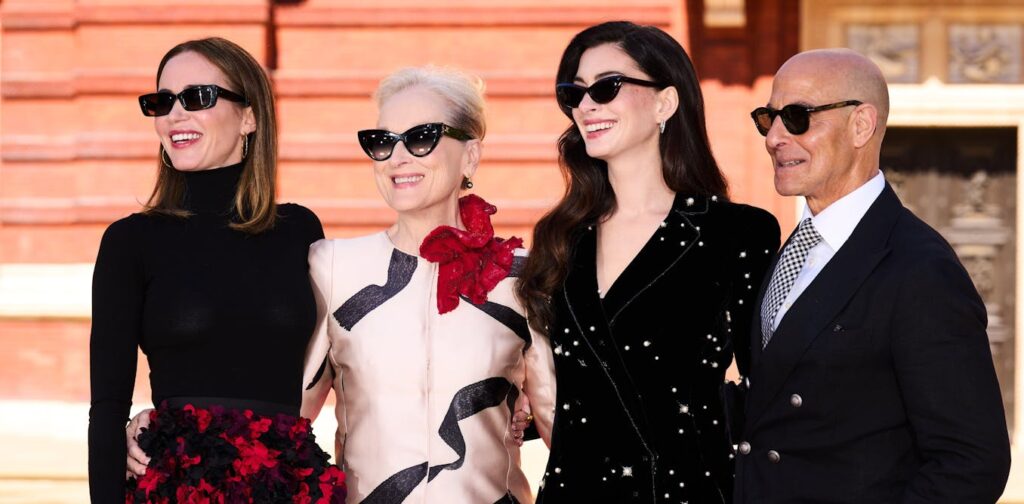
Fashion has always done more than keep us warm. It’s also a social language, quietly organising ideas of status, taste and belonging.
What made the first The Devil Wears Prada (2006) so satisfying was watching main character Andy Sachs (Anne Hathaway) learn, often the hard way, that clothes were never just clothes. At first she could not read what clothes signalled in the room. By the end, she understood their language.
The Devil Wears Prada 2 picks up that idea and runs with it. Here, fashion speaks clearly about who we think we are and who we would like to become. Beneath the sharp one-liners lies something more revealing: clothing as a system of meaning.
Even the soundtrack reinforces this idea. The lyrics “I came to be seen” from the song Runway by Lady Gaga and Doechii, which plays during the film’s credits, underscore how visibility operates as a form of social currency.
Anthropologist Grant McCracken argued that consumer goods carry cultural meaning that moves through society in stages. First, meanings sit in a wider cultural pool, shaped by ideas such as success, taste and aspiration. Second, they are picked up and repackaged by intermediaries such as editors, influencers and tastemakers. Third, they land with consumers, who use them to construct identity.
Read more:
How close reading took over the internet via The Devil Wears Prada’s cerulean monologue
The Devil Wears Prada 2 is a glossy study of change, where identity is constantly renegotiated as the characters grapple with meanings associated with power, roles and friendship. In this world, gatekeepers like Miranda Priestly (Meryl Streep) still decide what counts as “in” before the rest of us have even chosen our socks.
According to McCracken, cultural meaning moves from the cultural world and filters down to consumer goods where individual identity is finally established. Stanley Tucci’s Nigel remarks about Andy: “Look what TJ Maxx dragged in.” This does more than insult. It assigns her a position – misplaced, off-cycle, adjacent to luxury, marking her as uninitiated in a language she no longer speaks.
By contrast, in the archives of Christian Dior, the meaning system is made explicit by Emily (Emily Blunt): “Your bag, your scarf, your umbrella, tells the world who you are.” It suggests that in this world, even the smallest detail signals position, functioning as a micro-indicator of taste, knowledge and class alignment.
Loud signals and quiet codes
The sequel contrasts different strategies of self-presentation. Emily treats fashion as spectacle. Her outfits do not enter a room, but announce themselves to the room. Her black leather harness dress at a funeral is not a misstep, but a bold reminder that even in mourning, style can still speak with conviction.
By contrast, Nigel embodies what has come to be known as “quiet luxury”. His wardrobe is precise, restrained and almost invisible unless you know exactly what to look for. Meaning does not shout. It whispers. This reflects a broader shift in consumer culture.
People have long used possessions to communicate identity, but the codes evolve. In a world saturated with visibility, subtlety has become its own form of distinction. Knowing not to show off is, in itself, a way of showing off. The film captures this tension with a knowing wink. One character dresses to be seen while another dresses to be understood. Both are playing the same game.
At its core, the film is less about fashion than meaning. Clothing becomes a way of signalling trajectory: who is rising, who is stalling, who is quietly consolidating power. This is seen in Andy’s gradual shift from ill-fitting outsider to someone increasingly fluent in the visual language of the industry.
Consumer research suggests that we do not buy things just for what they are, but for what they mean. Clothing bridges the gap between who we are and who we hope to be. Getting dressed, in this sense, is a daily act of storytelling, sometimes optimistic, sometimes aspirational, occasionally delusional. The Devil Wears Prada 2 explains this through humour and self-awareness. The audience laughs at the excess, but not entirely from a distance.
The final trailer for The Devil Wears Prada 2.
From culture to closet and back again
By the time these meanings reach everyday life, the final step in McCracken’s model, they are no longer controlled by Miranda or the fashion elite. They are taken up, adapted and sometimes resisted by individual consumers. This is where meaning becomes personal.
The Devil Wears Prada 2 may be a comedy, but it makes a sharper point. Getting dressed is never just about clothes. It is about navigating a world of symbols and deciding how, or whether, to play along. The real question is not whether fashion matters, but whether we understand the meanings stitched into what we wear, and the quiet ways they shape our sense of who we are and who we might yet become.
In a more tender scene, Andy’s love interest takes in her blue sequin dress and says: “It’s a lot. But I like a lot.” The moment points to a broader insight: when fashion aligns with a sense of self, it shifts from excess to expression, becoming a quiet way of being seen not for what we display, but for who we are.