
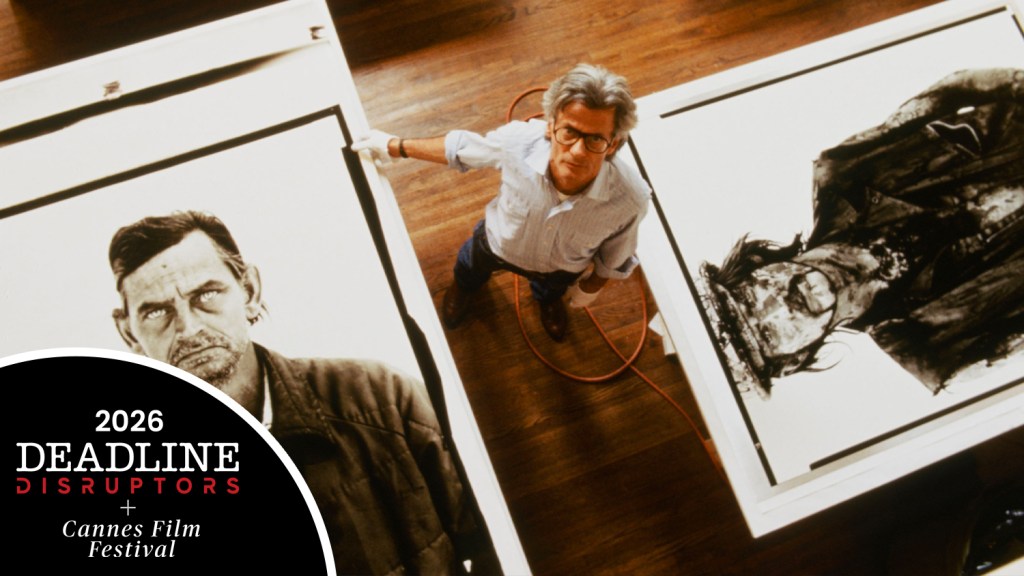
Avedon. The syllables roll fluidly, as elegant as the man. Photographer Richard Avedon possessed movie-star good looks, but he would spend his career not posing for the camera but working behind it, capturing the beauty and often the subtle vulnerability of some of the most glamorous and celebrated people on the planet.
Marilyn Monroe, Sophia Lauren, Audrey Hepburn, Twiggy, Truman Capote, Cyd Charisse, a young Brigitte Bardot, Andy Warhol and his Factory crowd. They and others of equal renown became his subjects, making him, surely, a perfect match for Cannes, a festival synonymous with chic. Twenty-two years after his passing, Avedon’s gift will grace the Croisette through a documentary about him directed by Ron Howard.

Ron Howard
“Avedon is a figure who will really resonate with audiences there in an exciting way,” Howard predicts. “And I’m very, very proud of the film.”
Avedon is the latest nonfiction project from Imagine Documentaries, the unit of Imagine Entertainment headed by Sara Bernstein. Since its founding in 2018, Imagine Documentaries has established itself as perhaps the single most successful production company in the nonfiction space. Its films and series have explored broad subject matter, often training an eye on icons of popular culture.
“We like to think about people who are inspiring to audiences and what is that unique lens, for lack of a better way of describing it, that we can really present them and then how can we do it as authentically as possible?” Bernstein explains. “So, Avedon, and certainly what Ron was able to do with Avedon’s story, I think fits into what we look for here beautifully.”
Sara Bernstein
“We’re interested in individuals who move the needle in often surprising ways,” Howard adds. “And we’re also interested in environments, cultures, whether it’s of our moment or looking back a little bit. And I think Brian [Grazer, Imagine co-founder] and I really share that in common, whether it’s scripted or whether it’s a documentary, is, what’s the world, what do the characters have to say to us? What do they have to offer? And can we transport audiences through the medium? Whether that’s scripted, comedy, drama, fantasy, movies based on real events or now on the documentary side.”
Howard-directed nonfiction projects for Imagine Documentaries include Jim Henson: Idea Man, winner of five Primetime Emmys; Pavarotti, about the ground-breaking, world-famous Italian tenor; We Feed People, a documentary about chef and humanitarian José Andrés, and Rebuilding Paradise, documenting the recovery from the wildfire that devastated the California community in the Sierra Nevada foothills. Howard’s 2016 documentary The Beatles: Eight Days a Week—The Touring Years was released shortly before the official forming of Imagine Documentaries, won two Primetime Emmy Awards.
Imagine Documentaries also collaborates with other major filmmakers, like Lawrence Kasdan, who directed Marty, Life Is Short, a film about actor Martin Short that just premiered on Netflix. Laurent Bouzereau directed the Imagine Documentaries feature Music by John Williams, winner of a Primetime Emmy and the Grammy Award for Best Music Film. Amy Poehler made her nonfiction directorial debut with Lucy and Desi, an Imagine Documentaries production about Lucille Ball and Desi Arnaz that won a pair of Primetime Emmys. Imagine Documentaries have premiered on all the major distribution platforms—Netflix, Apple TV, Prime Video, Disney+, National Geographic, Hulu and more.
Richard Avedon
Bruce Weber
“It’s been interesting over the past few years,” Bernstein observes, “just the level of output of the number of documentaries and the subjects that we’ve been able to tackle, with what is actually happening within our ecosystem and documentaries, or what the streamers are exhibiting, and how Imagine Documentaries has continued to figure out the best way to present these films… I certainly am always thinking what’s next.”
Among upcoming projects for Imagine Documentaries are the “definitive documentary” on Whoopi Goldberg, to be directed by Oscar nominee Geeta Gandbhir (The Perfect Neighbor), and Amelia, a film on aviation pioneer Amelia Earhart directed by Oscar nominees Betsy West and Julie Cohen (RBG, Julia). Joachim Rønning (Tron: Ares) is making a film called Keys of Life for Imagine that centers on the 100-year-old piano that served as the instrument for some astonishing recordings, from the Beatles’ “Hey, Jude” to Carly Simon’s “You’re So Vain” and David Bowie’s “Life on Mars”.
In the investigative realm, Imagine Documentaries is behind Rory Kennedy’s follow up to her film Downfall: The Case Against Boeing about the aerospace company’s troubled production of the 737 MAX aircraft.
Avedon shooting footage for his ‘In the West’ project.
Laura Wilson
The Whoopi Goldberg, Martin Short and Avedon films are ones “Imagine has started financing,” Bernstein says. “That’s been sort of an interesting shift for us. We still have projects that are commissioned with Netflix and Hulu and Apple, Amazon—our usual partners are streamers—but then also taking more risks on documentaries that we can sort of control when we bring them out to the market, so to speak.”
Many Imagine Documentaries involve careful rights negotiations, as with Howard’s Jim Henson film.
“We’ve done so many movies, Brian [Grazer] and I, based on real events, and rights issues can factor into those productions as well, but it’s far more up close and personal when you’re making a documentary,” Howard says. “But I think that our history as a company and the resumes of the individuals, Sara and Justin [Wilkes, president of Imagine Entertainment] and company engaged in the projects does give people confidence and a feeling that if they’re going to take the leap, we’re a good home.
For us, we’ve just always looked at, can you fascinate people with this story? Is there something surprising that’s really worth sharing here?
Ron Howard
“There’s always going to be a risk. They’re not going to agree with all the choices that we make, and we can’t give over those kinds of controls, but we can always be open to conversations and give them that confidence that we’re here to tell the stories with integrity and reach audiences with them.”
The Avedon estate is overseen by the Richard Avedon Foundation, which stewards the legacy of the artist whose work spanned more than half a century.
“He was a director. That’s one of the things I learned in making the documentary is he’s not taking snapshots, he’s creating scenes,” Howard says. “I thought of him as a great fashion photographer, Marilyn Monroe and Twiggy and the later television commercials with Brooke Shields. And he remained that his whole life. That’s kind of how he made his bones and that’s how he sustained his career and he did it with great creativity and commitment. But almost from a decade or so into his career, he began being a risk-taker and using his talent and his platform, his status, to take on really challenging subjects.”
For instance, between 1979 and 1984, Avedon worked on his book In the American West, photographing “miners, herdsmen, showmen, salesmen and transient people, amongst others with rich histories,” as the Fondation Henri Cartier-Bresson notes, “alone or in small groups, before his camera, against a white background that enhanced their features, postures and expressions… a milestone in the history of photographic portraits.”
Howard observes, “[Avedon] maintained this balance between maximizing what his art could mean creatively and commercially in the world and the kind of mirror that he could hold up to society with his work that was more political study, kind of social science.”
Read the digital edition of Deadline’s Disruptors/Cannes magazine here.
That same balance of art, commerciality and intensive exploration of cultural meaning also applies to Imagine Documentaries.
“Part of the Imagine DNA, it starts with the curiosity of subjects. And I think for us, it’s really about how can we eventize these subjects or these personalities and how can we find a commercial audience for them,” Bernstein says. “At the end of the day, it’s really about what is the narrative we want to tell… What I think we really try to do, frankly, with the documentaries is entertain people… They’re going to be exposed to a person or a subject they haven’t maybe thought about before, but I think we really want them to feel like they had a riveting viewing experience throughout that process.”
“With characters, whether it’s a scripted fiction or nonfiction or doc, engagement is spurred by connection and surprise and revelation,” adds Howard. “And so, when you say, ‘What is the story? Will it be commercial?’ I think for us, we’ve just always looked at, can you fascinate people with this story? Is there something surprising that’s really worth sharing here? And then yeah, we’re a group of experienced, passionate storytellers who want to shape these stories in as engaging and enthralling a way as we possibly can, that leads to commerciality. So, it’s not necessarily about a tone that we understand and it’s not some kind of a cookie cutter. It’s more about digging out what’s really intriguing, what’s emotional, what can connect with an audience in ways that might surprise them.”