
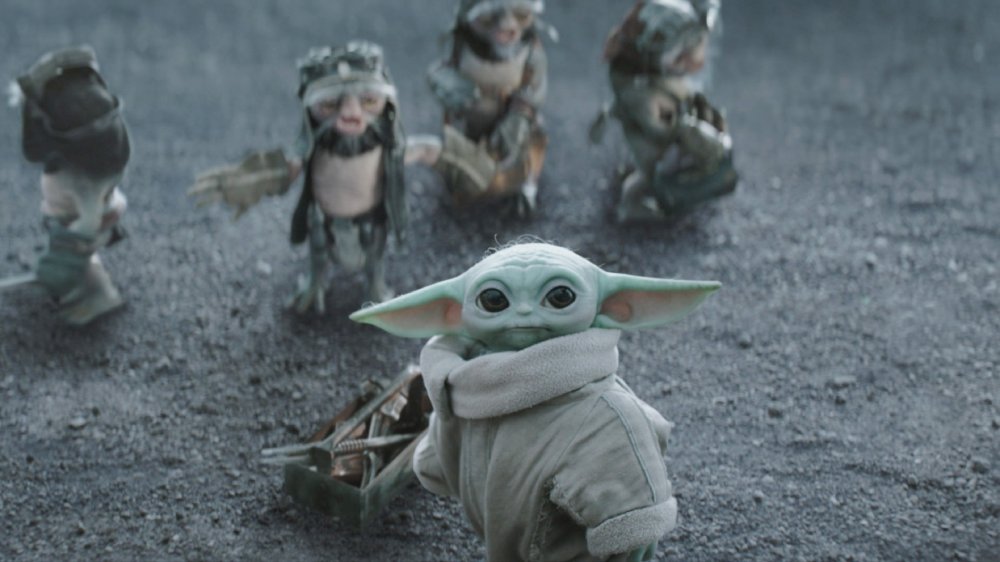
In 2019, Baby Yoda was ubiquitous. The adorable green sidekick to Pedro Pascal’s masked bounty hunter made his debut on the Disney+ series “The Mandalorian,” becoming a pop culture sensation and fueling enough memes and merchandise to fill the galaxy.
Seven years and one pandemic later, is the force strong enough to turn the creature formally known as Grogu into a big-screen star? His box office bankability will be tested in this summer’s “Star Wars: The Mandalorian and Grogu,” a continuation of the hit television show. As the first “Star Wars” movie in (what feels like) eons — the last was 2019’s “The Rise of Skywalker” — there’s mounting pressure to prove the space opera series is still a viable cinematic property.
“The Mandalorian and Grogu” is estimated to earn $80 million to $100 million domestically over the four-day Memorial Day weekend. Those ticket sales would be decent were this not a “Star Wars” film. Sure, the box office hasn’t returned to full strength since COVID, and major franchises — Marvel too — haven’t been immune to the changing tastes of audiences.
Yet “Star Wars” is one of Hollywood’s preeminent film properties. It’s a beloved franchise with few equals, so there’s an expectation of a certain level of box office. Case in point: Disney-owned Lucasfilm plunged into crisis mode after 2018 spinoff “Solo: A Star Wars Story” opened to $103 million (not adjusted for inflation) over the same holiday frame. With lackluster reviews and distracting behind-the-scenes turmoil, “Solo” became the first “Star Wars” movie ever to lose money in its theatrical run — it tapped out with $392 million globally against a massive nearly $300 million budget. That said, “The Mandalorian and Grogu” carries a leaner $165 million price tag, not including the mega marketing spend.
“There’s clearly interest in the brand,” says Eric Handler, senior media analyst at Roth Capital Partners. “But revenues for each film have gotten progressively lower. ‘Star Wars’ isn’t resonating with younger moviegoers like it did for [older] generations.”
“The Mandalorian and Grogu” was directed by Jon Favreau, who helmed big-screen hits like “Elf,” “Iron Man” and the “Lion King” remake before creating “The Mandalorian.” Favreau co-wrote the film with Dave Filoni, who was promoted to president of Lucasfilm following Kathleen Kennedy’s departure in January. With the company’s first theatrical endeavor since Kennedy’s exit, Favreau and Filoni have a major obstacle: convincing fans that “The Mandalorian and Grogu” is worth getting off the couch for, while assuring newcomers they can watch the film without having seen the series. Not to mention, ratings and reviews had declined by the third season of “The Mandalorian.” Set after the events of the show, “The Mandalorian and Grogu” revolves around Pascal’s Din Djarin (aka Mando) and Grogu (né the Child né Baby Yoda) as they navigate a galaxy that’s recovering from the fall of the evil Empire.
“The biggest challenge is whether the streaming audience converts into a theatrical audience,” says Shawn Robbins, Fandango’s director of movie analytics and founder of Box Office Theory. “If word of mouth is good, that’ll be the big X factor.”
Even Disney’s Marvel Cinematic Universe, the most commercially successful film franchise in history, has struggled with crossover between streaming and theatrical. Last year’s “Captain America: Brave New World” and “Thunderbolts,” both of which were preceded by Disney+ streaming series, met with tepid box office grosses. However, the MCU has a vaster output than “Star Wars,” with 37 movies and more than 15 television shows since 2010. “The Mandalorian and Grogu,” on the other hand, could benefit from scarcity and pent-up demand.
The franchise’s yearslong absence from multiplexes wasn’t for lack of trying. Lucasfilm failed to launch new films as projects from Patty Jenkins, Marvel producer Kevin Feige and “Game of Thrones” creators David Benioff and D.B. Weiss never came to fruition. Meanwhile the company turned its attention to the small screen with series in the “Mando”-verse like “The Book of Boba Fett” and “Ahsoka” as well as “Andor” and “Skeleton Crew.”
There’s a more pressing reality: “Star Wars” has seen diminishing box office returns since Disney acquired Lucasfilm for $4 billion in 2012 and revived the property with 2015’s “The Force Awakens.” A critical and commercial smash, that entry raked in more than $2 billion globally and remains the highest-grossing domestic release of all time with $936 million. Follow-ups, including 2017’s “The Last Jedi” and “Rise of Skywalker,” were billion-dollar hits that nonetheless earned half as much as their predecessor. “Rogue One” has been the company’s one triumphant spinoff, earning $1.05 billion in 2016.
Analysts point out the 50-year-old brand is much more than movies. It’s part of a lucrative ecosystem that spans theme park attractions in California and Florida, to say nothing of all the action figures and plush dolls that’ll be flying off the shelves long after summer is over.
“Box office dollars are incredibly important, but this is a broader pop culture phenom,” Robbins says. “Grogu is going to be a merchandising monster.”
Insiders at the studio, as well as box office watchers, believe next summer’s tentpole “Star Wars: Starfighter” has a better chance of reenergizing the series. The oceanic adventure, directed by Shawn Levy (“Deadpool & Wolverine”) and starring Ryan Gosling, doesn’t have the baggage of continuing a TV show and could serve as a fresh start. It helps that Gosling scored with another recent space adventure, “Project Hail Mary.”
“Disney needs something new and exciting to bring energy to the franchise,” Handler says. “Ryan Gosling is as hot as can be right now. ‘Starfighter’ could be the way to go.”