
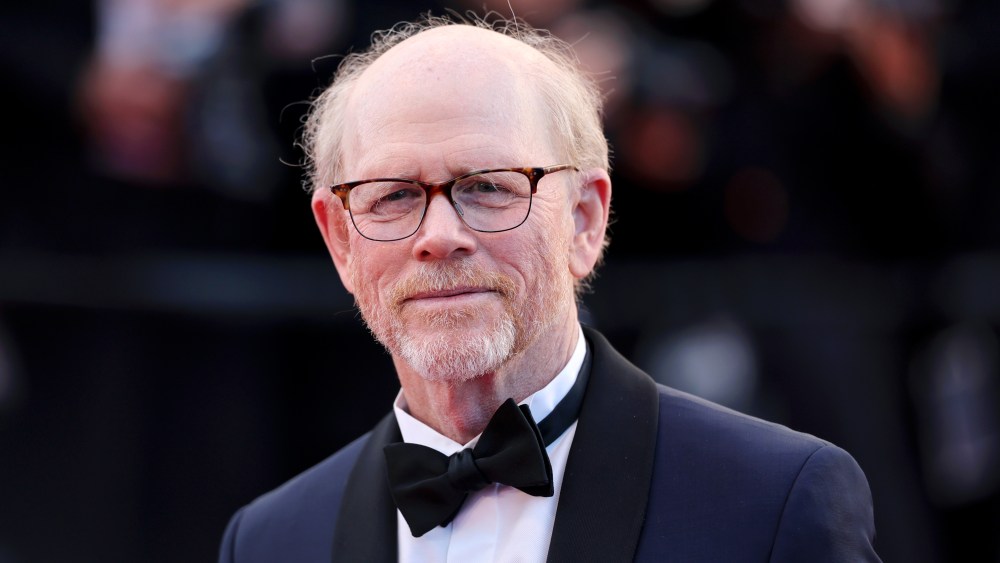
Over the weekend, Ron Howard made his ninth trip to the Cannes Film Festival to debut his latest documentary, “Avedon,” about the legendary photographer Richard Avedon. But, en route to the French Riviera, the Oscar-winning director made a pit stop at the University of Oklahoma to receive an honorary degree. The recognition was more profound than your average salute: it’s the culmination of his family’s history with the university, where Howard’s parents met as students and fell in love.
“Neither one graduated from OU because they ran away together to be in show business,” Howard says of his late mother, Jean, and father, Rance. “But lo and behold, they made it work.”
Thus, the commencement ceremony was one of those rare opportunities to “pause and take a look at the cause and effect of life,” he says. “I believe in the philosophy of the movie ‘It’s a Wonderful Life.’ That ripple effect you have on other people, or other people had on you, is something that rarely goes recognized, unless it’s obvious. So, here’s a chance to go back and remind people how much an institution like the University of Oklahoma can mean. It makes us wonder how many stories like [my parents’] are being launched today.”
What does all this have to do with “Avedon”? Well, Howard’s documentary similarly aims to capture the cause and effect of the famed photographer’s life and how his singular artistic vision reshaped the visual language of the 20th century.
“Avedon” is the latest doc from Imagine Documentaries, the nonfiction arm of Howard and Brian Grazer’s prolific production company, with subjects ranging from Hollywood legends like Martin Short (Netflix’s “Marty, Life is Short”) and Whoopi Goldberg, to the American soccer team that won the 1994 World Cup (the upcoming “Summer of ’94”).
Howard had long been a fan of Avedon’s work — who hasn’t seen his portraits of Marilyn Monroe, Charlie Chaplin, James Baldwin and Lew Alcindor (before he was known as Kareem Abdul-Jabbar) or Brooke Shields’ Calvin Klein ads? But Howard didn’t know the full breadth of the photographer’s portfolio — like Avedon’s civil rights-focused work — until he started crafting the documentary.
One fun discovery in Avedon’s extensive and dazzling archive was a portrait of director John Ford, whom Howard grew up idolizing. “That’s my favorite photo of him, and I had no idea Richard Avedon had taken it.”

Richard Avedon with his portraits
Avedon’s diverse array of subjects was compelling enough. But the thread that hooked Howard was how Avedon parlayed his success and status in the world of pop culture to create stirring and thought-provoking images about the wider world. That tension, or rather the lack thereof, became a key theme in the film.
“He knew how to be commercial and in-demand in the magazine and advertising world, and yet simultaneously push boundaries, take chances and create,” Howard says. “He’s just a fantastic case study that you can be commercial and not a sellout.”
The film features interviews from dozens of bold-faced names in fashion and art, including Isabella Rossellini, Twiggy, Lauren Hutton, Calvin Klein, Tina Brown and Beverly Johnson, as well as Richard’s son, John Avedon. The doc also featured archival interviews with Richard, affording the late artist — who died in 2004 at age 81 — the chance to tell his story in his own words.
A tricky endeavor was capturing Avedon’s rich life in less than two hours. “It was so hard to edit this down into a playable length,” Howard says. “There were so many more photographs and anecdotes.”
Among Howard’s favorite interviewees was dancer and choreographer Twyla Tharp, who’d been both a subject and a close friend of Avedon’s. “She offered a lot of insight, and I just love her droll delivery,” Howard says. “She really understood how Avedon could find that balance between images that would provoke or be sexy, funny, sell a product — whatever it was trying to be — and his own sensibility and the spirit that surrounds all of that.”
Howard found he could relate to much of Avedon’s creative process, like the photographer’s drive and the joy he took in collaboration. Howard, too, enjoys “ferreting out the essence” of his subjects and realizing a project’s potential. (“For him, every photo sitting was like creating a scene,” Howard says.)
Where the two artists differ is how Avedon imprinted his specific style on his art, while Howard is more reticent to do so. (“He wanted people to recognize an ‘Avedon’ photo,” the filmmaker adds. “Every sitting, every subject, every shot was a reflection of him. He wanted that authorship.”)
Richard Avedon during a portrait session
Howard also tends to work on multiple projects at once. While in post-production on this documentary, he simultaneously worked on the war drama “Alone at Dawn,” starring Adam Driver and Anne Hathaway, for Amazon MGM Studios.
“I love working on the documentaries at this point in my life because the goals are the same as a narrative feature: share an idea with audiences and engross them,” Howard says. “I like moving back and forth between the two imperatives and find it creatively stimulating. I can borrow things that I learn from one medium and use it in the other.”
Despite the fact that Howard was certainly well-known enough to be one of Avedon’s subjects in the photographer’s heyday, the actor-turned-filmmaker jokes he never ran in those types of fashion circles — meaning he only admired Avedon’s work from afar. Howard appreciates the symbolism of getting to turn the camera around on the man behind the lens.
“I hope he would appreciate the portrait that I’ve created of him,” Howard says. “It’s nice to see that people are learning about Avedon and getting something out of it. It’s exciting for me to share what I feel like I’ve come to understand about him. I really wish I could have known him. I would have really liked him.”