
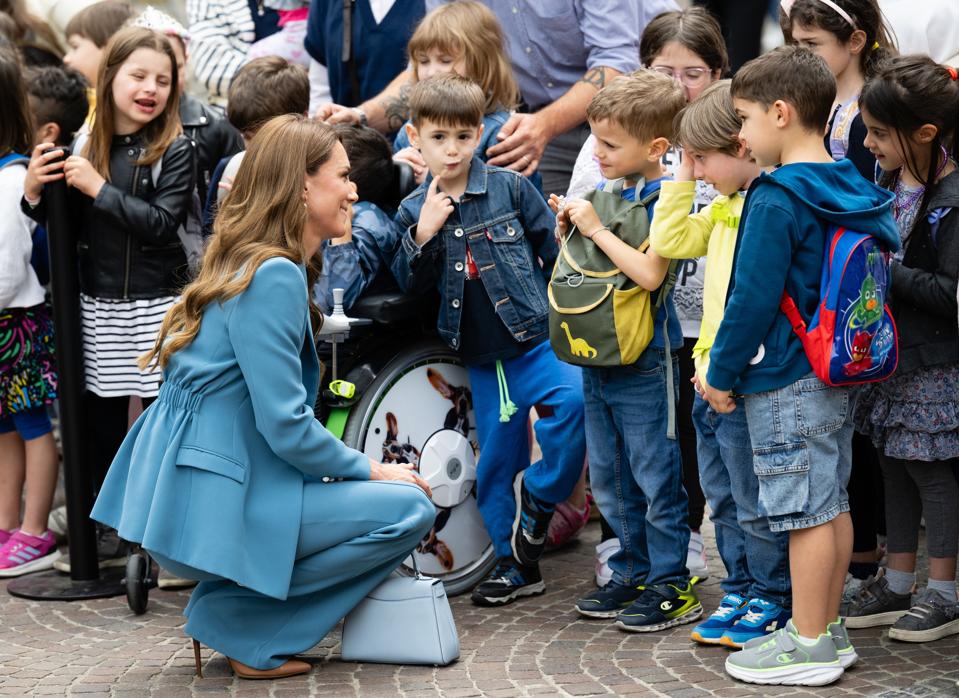
Her visit to Reggio Emilia reflects a growing global debate over AI-driven schooling, human flourishing, and what children actually need to learn.
Princess Katherine’s recent visit to Reggio Emilia was more than a royal appearance or cultural excursion. It was a signal.
The future Queen of England traveled to the northern Italian city long associated with one of the world’s most influential early childhood education philosophies, a model built around inquiry, creativity, relationships, movement, and hands-on learning. The visit, part of her continuing work through the Royal Foundation Centre for Early Childhood, comes as parents worldwide are increasingly questioning what children actually need to flourish in an era dominated by screens, artificial intelligence, and declining student engagement.
For decades, the Reggio Emilia approach has quietly influenced educators around the world. Emerging in Italy after World War II under educator Loris Malaguzzi, the philosophy was developed with strong involvement from parents and local communities determined to rebuild society through the education of children. The model emphasizes what Reggio educators famously call the “100 languages of children” — the idea that children learn and express understanding through art, movement, conversation, construction, storytelling, nature, and collaboration, not simply through memorization or standardized instruction.
That broader vision appears to resonate with Catherine, whose own children reportedly attended Montessori-inspired programs in their early years. During a recent discussion, Mimosa Jones Tunney described the princess’s visit as evidence that even one of the world’s oldest institutions is reconsidering traditional assumptions about schooling. Tunney, a pedagogical scientist, educator and thought leader is founder of The School House on Long Island.
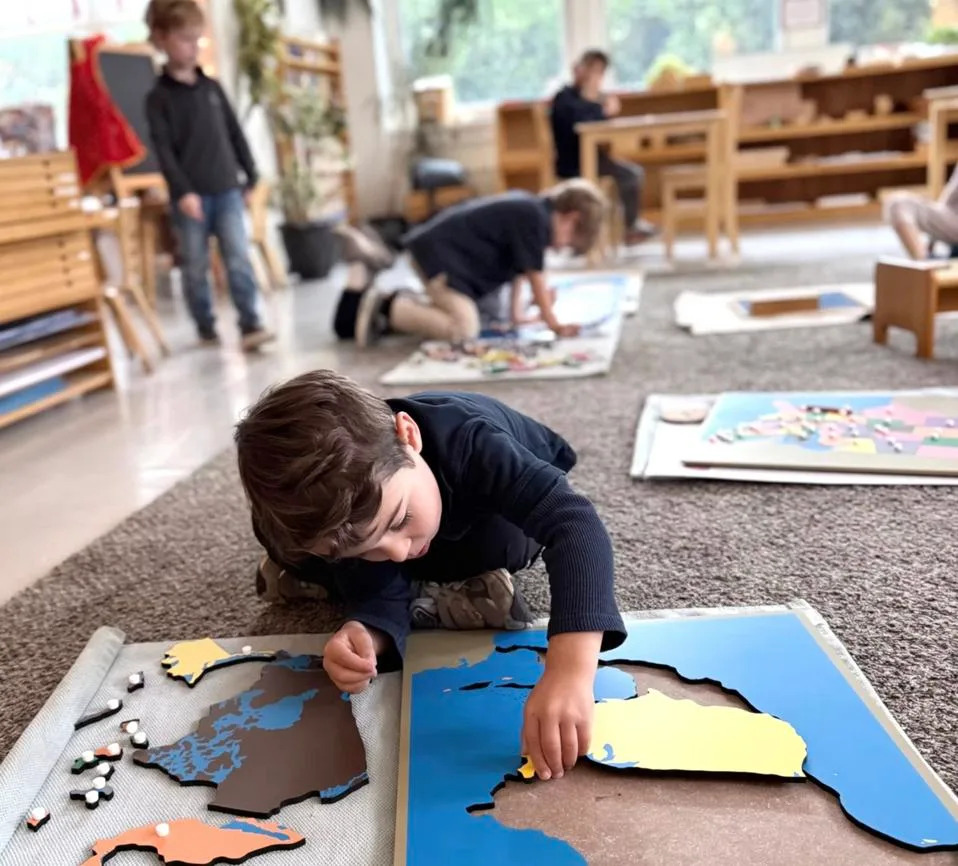
Children learning at The School House, Long Island, NY, USA.
The School House
“Coming from the Royals, where they’re doing everything by the book for the last 800 years, she is stepping out and saying, ‘Wait a minute, this isn’t good enough for our future royals,’” Tunney told me. “We need to think about project-based learning, manipulatives early in children’s lives, and freedom within structure in creating personal responsibility and critical thinking.”
What makes the moment particularly noteworthy is its timing.
Across the United States and internationally, education is entering another cycle of technological disruption. AI-powered schools and screen-centered instruction models promise efficiency, acceleration, and personalization. At the same time, parents are increasingly worried about children’s mental health, attention spans, social development, and isolation. A growing body of research continues to associate excessive screen exposure with negative impacts on cognitive, emotional, language, and social-emotional development among children.
That tension — between technological acceleration and human-centered education — sits at the center of today’s educational debate.
Emily de Rotstein, Executive Director of the Chesterton Schools Network, sees the renewed interest in classical and content-rich education as part of a broader search by families for something deeper than academic performance metrics alone.
“Parents are searching for the best for their children,” she said. “They want an education that will help their kids find happiness, true joy, friendships, and well-being. They’re willing to revisit what has worked in the past.”
Classical education, she argues, is often misunderstood as elitist or outdated, when in reality it is rooted in an integrated, content-rich curriculum designed to form students intellectually and morally.
“It’s a broad-based curriculum that helps young people encounter truth, beauty, and goodness,” de Rotstein said. “This kind of education was never meant to be reserved for the elite.”
What is emerging now is not necessarily a return to one single philosophy, but a broader rediscovery of pedagogical science — the accumulated understanding of how children actually learn and develop. Increasingly, educators are borrowing from multiple traditions: Montessori, Reggio Emilia, Socratic instruction, project-based learning, liberal arts education, and experiential models grounded in movement, conversation, nature, and direct human interaction.
That is particularly relevant as schools race to incorporate AI into classrooms.
Tunney, whose own schools integrate Montessori and Reggio principles, believes technology can support education but should never replace the fundamentally human dimensions of childhood learning.
“You cannot substitute the human operating system from zero to twelve years old,” she said. “The best things children are learning during those years — mathematics, science, language, collaboration, kindness — cannot fully happen through a screen.”
De Rotstein echoed that concern.
“The richest education has at the center of it the virtuous teacher,” she said. “Young people need to be seen, known, and loved. They need thoughtful conversation, debate, and real human community.”
Both education leaders pointed to the importance of the Socratic method and active listening — skills increasingly absent not only in classrooms, but across civic life itself.
“What employers want are thoughtful problem-solvers who can engage in conversation, listen, and work through ideas together,” de Rotstein said. “That does not come from a screen.”
Princess Catherine’s visit to Reggio Emilia may ultimately matter less because of the school itself than because of what it reflects culturally. Around the world, parents are beginning to ask harder questions about childhood, technology, learning, and human flourishing. They are searching for schools that produce not only academically capable students, but grounded, curious, empathetic, resilient human beings.
In many cases, the answers families are discovering are not entirely new.
They are rediscoveries of ideas that educators, philosophers, and communities have spent generations refining — long before the arrival of Chromebooks, algorithms, and artificial intelligence.
And increasingly, even royalty appears to be paying attention.
This article was originally published on Forbes.com