
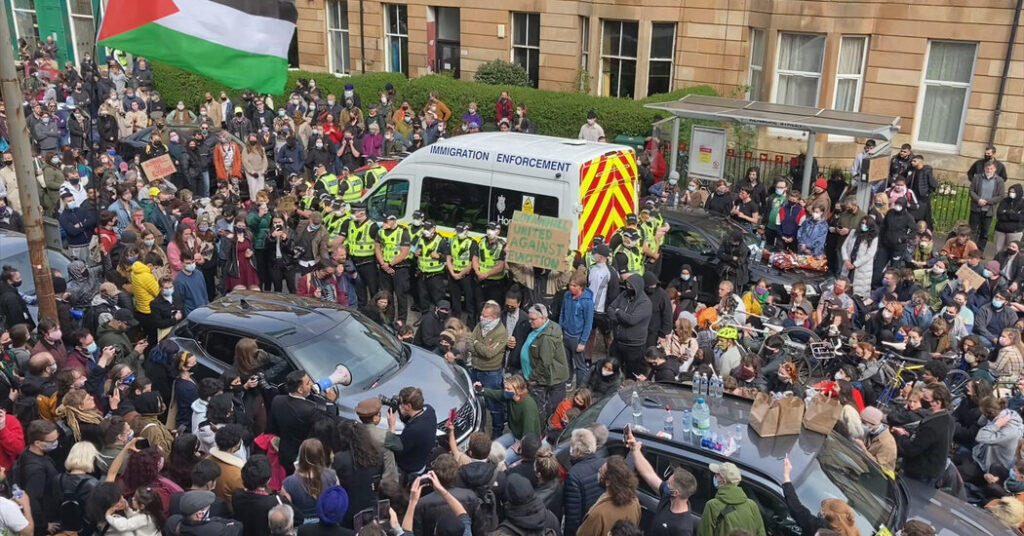
It is early morning in a quiet neighborhood. Residents are just rising, having coffee, getting ready for school. Then they notice a commotion: Two men are being marched out of their home by police officers to a van parked on the street. They look: The van is marked Immigration Enforcement. Quickly, the neighbors start spreading the word via group chats and social media platforms that two men are being detained for deportation. In a very short time, hundreds of people from the community have gathered, demanding that law enforcement let the men go.
The scene took place on May 13, 2021, on Kenmure Street, located in Glasgow’s Pollokshields neighborhood, one of the most ethnically diverse neighborhoods in Scotland. The two men were Indian nationals, Sikhs who had lived in the community for a decade, and their neighbors were determined that they would be able to stay. Directed by Felipe Bustos Sierra, “Everybody to Kenmure Street” is an exceptional documentary, both in the story it tells and in the way it tells it, about what happened that day.
To set the scene, the film begins with a montage of images and video depicting Glasgow’s history as a city with two prongs to its proud heritage: It is a city of industry and a city of protest. We see people building ships and observe blast furnaces. We watch suffragists demand the right to vote, trade unionist protests against then-Prime Minister Margaret Thatcher and Black Lives Matter demonstrations against police brutality. We see children supporting a refugee family whose asylum request was turned down. Glaswegians, this prelude says, fight back and look out for one another.
Then the film transitions to its main story, and Bustos Sierra makes the bold choice to interview residents of Pollokshields, and eventually others who showed up to the protest, without the usual documentary fanfare — no clapperboard or onscreen text. They just start telling the story of what they saw: neighbors being marched down the stairs, two figures being put into a van, people beginning to gather on the street. Each talks about deciding to abandon their plans for the day. “I could go,” one says. “I can do this.”
Many of the residents note that this raid was not just unwelcome but a provocation. It was happening at dawn, and it was happening on Eid al-Fitr — the feast day that marks the end of Ramadan — in an area of the city where many Muslims live. (What the residents don’t note, but is important, is that the raid was approved by the U.K. government without the Scottish government’s knowledge or approval, which would only ratchet up tensions; the protests led to a broader political debate over whether Scotland ought to be subject to immigration and asylum policies directed by London.)
It’s unlikely anyone expected what happened next. Bustos Sierra makes extensive use of cellphone footage shot by protesters and residents in their homes, sometimes arranging it in split-screen so that we see the events from two angles at once. Slowly, then quickly, the crowd grows. People talk about hearing from a friend or even a stranger that immigration had shown up on Kenmure Street and simply dropping everything and heading there. “I didn’t know what I was going to do,” says one young person. “I just knew that I had to do something.”
One of the most significant figures in the documentary is someone known only as “Van Man,” who arrived on the scene early and immediately crawled underneath the van where the men were being held, wedging himself in so the police could not drive away. Van Man wishes to remain anonymous, so Emma Thompson, who was also an executive producer on the film, serves as his proxy, and is seen wedged beneath a van. “This isn’t my face, but these are my words,” she says, and throughout the film speaks the words that Van Man provided in interviews. Similarly, a nurse who tended to him is “played” by Kate Dickie, and a protester by Keira Lucchesi.
As the film goes on, the group of interviewees expands, just as the protest did, eventually numbering around 2,000. The group began to form their own community. Following their celebration of Eid, those who had been at the local mosque joined the protest, bringing along food and even a cake — it became “a wee Eid celebration,” one man says, smiling at the memory. The group turned a bus stop into a water and snack station and handed out blankets to whoever needed one. It was moving, one person said, to see the “act of care around the broader act of care.”
The interviews have a friendly, easy quality to them that is often lacking in documentaries — nothing feels rehearsed. There’s probably a good reason for that: Bustos Sierra is a resident of the area, though he wasn’t at the protest; he’s interviewing his neighbors. That also lends a cleareyed lens to his approach. Halfway through the film, he breaks away from the story of the protest to recount Glasgow’s history with the slave trade. Even a city with a radical heritage has to grapple with its own checkered past.
But “Everybody to Kenmure Street” is much bigger than what happened in Glasgow that day. The people of Pollokshields tell the story as one of ordinary heroism: They just showed up and cared for their neighbors, even if they didn’t know them, and that was enough to effect change. And as the film subtly suggests, that is a tradition that can always be handed over generations. One man explains that they often tell the story of that day to their children and have put an illustration of it in their bedroom, where it occupies a “mythic place.” When you believe you can be part of the solution, then you are willing to try.
Everybody to Kenmure Street
Not rated. Running time: 1 hour 35 minutes. In theaters.