
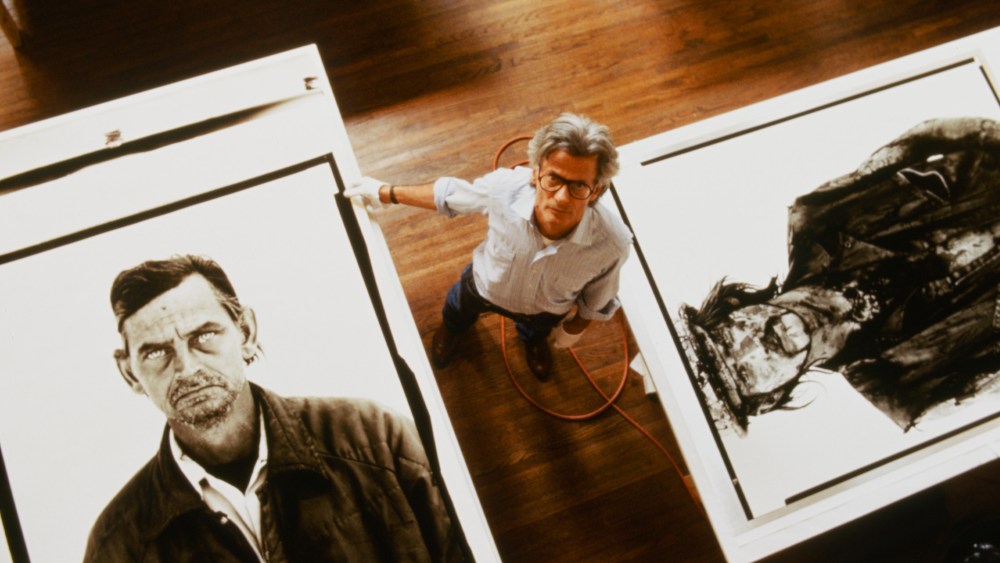
Ron Howard’s new documentary on Richard Avedon reveals a photographer whose images helped define modern fashion, while simultaneously expanding into politics, portraiture and cultural critique.
The film premiered in Cannes to its very first audience. “No one had seen the final cut yet,” Howard told WWD after the screening. “It was nice to see how well the movie seemed to hold people’s attention, and the response at the end was very, very warm.”
That reception, however, came after years in the making.
Howard admitted that when he began the project, Avedon existed more as a cultural reference point than a fully understood person. It was only when he first entered the archives that the scale of the work became clear.
“I’d known about Avedon, knew that name,” he said. “But I started to understand him as soon as I had access to the vault and started seeing these photographs.”
What struck him was not only the familiarity of the images, but the realization that they were all created by a single, highly intentional vision.
“I had no idea Avedon was the creator,” he said of the way images from fashion iconography to actors to politicians he had seen over the decades suddenly became understood as one body of work.
That discovery, Howard said, reframed Avedon less as a historical figure than as an artist defined by construction, control and creative risk. “His own creative journey I thought was fascinating and inspiring,” he said. “It demonstrated a kind of commitment, a kind of creative courage, a bit of audacity, along with the humility of recognizing that not everything was going to work.”

Veruschka von Lehndorf, dress by Robert David Morton, New York, January 1967 (contacts)
Richard Avedon © The Richard Avedon Foundation / Imagine Entertainment
If Avedon’s reputation was built in fashion, it was never simply about documenting clothes, Howard said. Instead, it was about constructing images that functioned more like authored scenes than lucky captures. It was a deep methodology that presaged fashion’s own shift from photos to image-making.
“These were all directed scenes, basically,” Howard said. “These weren’t snapshots. This wasn’t somebody wandering around with a camera taking advantage of nice light.”
That distinction is central to Avedon’s influence. In fashion history, his work marked a break from static editorial photography toward something more choreographed.
It is a legacy still visible today in luxury campaigns that are focused on storytelling and creating narrative and movement.
One of the film’s early scenes explains how Avedon’s 1947 assignment in Paris, photographing Dior’s early postwar collections, signaled that shift. The resulting images, with their exaggerated silhouettes and sweeping fabric, captured a fashion moment that was itself charged with cultural reconstruction — an emblem of a Europe attempting to reassert beauty as cultural confidence.
Within that system, Avedon’s innovation was not only aesthetic. He understood that fashion imagery was not simply about clothing, but about treating models and environments as actors and sets.
“The ability to draw people to your lens, into your world, to gain trust, that does take personality,” Howard said, referencing Avedon’s early mentor Alexey Brodovitch. “Technical expertise, taste, these are values, but there’s this other one — the ability to draw people to your lens.”
That performative energy extended beyond the camera. Avedon was widely described as physically active on set, “moving around and dancing,” Howard said. “We couldn’t find archival footage that really showed it, but there’s a little snippet where you could see him moving, and he sure moved well.”
Avedon’s influence also extended beyond aesthetics. At “Harper’s Bazaar,” Avedon reportedly threatened to leave the magazine unless his photographs of non-white models, including China Machado, were published — using his growing authority within fashion to challenge the industry’s racial exclusions.
China Machado, suit by Ben Zuckerman, hair by Kenneth, New York, November 1958.
Richard Avedon © The Richard Avedon Foundation / Imagine Entertainment
Behind the scenes, Howard’s film was assembled over several years through what he described as a constantly evolving archival process.
“It was a couple years of a team that worked constantly,” he said. “You build a documentary with buckets — childhood, fashion, political work — and start to build sequences.”
As new material surfaced, the structure shifted. A turning point came with the participation of Avedon’s son, whose involvement added an emotional counterweight to the artist’s public persona.
“When he finally saw our treatment of the film, he understood that there was a void there that really only he could fill,” Howard said. His involvement, he added, helped reframe Avedon not only as a cultural figure, but as a father negotiating distance between creative ambition and personal life.
While fashion is the door to Avedon’s legacy, the film also traces how he extended his work into politics and sociological documentation with charged portraits of the Chicago Seven, and his Vietnam War era imagery of soldiers, citizens and generals were raw and carried a weight that translated into awareness.
Through all of this comes a consistency of method, control and discipline that Howard was particularly keen to put on display. “He was very demanding of himself and others,” Howard said. “He kept holding to those standards even when it would be uncomfortable or exhausting.”
That discipline, Howard said, is what allowed Avedon’s images to endure across decades of shifting fashion systems and cultural aesthetics. In an era increasingly defined by an onslaught of images and algorithms, his approach is that much more important.
“It was about his connection with the subjects, not just the camera,” Howard said.
James Baldwin and Richard Avedon, Finland, June 1964.
Richard Avedon © The Richard Avedon Foundation / Imagine Entertainment
“He had this restless creative energy,” Howard said. “An extrovert’s desire to meet as many people as possible, look them in the eye, connect, and be a magnet for people and feelings and ideas.
“His energy was exciting to be around, and for everybody I interviewed there was just love in their eyes when they were talking about him, it’s undeniable, and it’s because of what he gave them through his lens.”
For Howard, who is already deep into post-production on his next project “Alone at Dawn” starring Anne Hathaway and Adam Driver, the experience has reinforced his understanding of creative work itself.
The end of the film shares a prophetic quote from an Avedon interview, in which he stated that in the future, photography would be fundamentally changed.
Lauren Hutton, New York, March 13, 1973.
Richard Avedon © The Richard Avedon Foundation / Imagine Entertainment
“I don’t even think there’ll be photographers in the future,” Avedon said. “You’ll just dial up an image from the information place,” a prediction that sounds eerily like the cloud-based and AI-generated images of today.
Howard counters that Avedon’s photography was about more than just images.
“He used his talent not just for commercial means, but politically, socially, personally,” he said. “He used it to understand the world better and share what it was he was observing and learning.”
And for Howard, that remains irreplaceable.
“It’s not about technique,” he said. “It’s about the photographer.”