
Credit: Far Out / Tony Barnard / Los Angeles Times / UCLA Library
Sat 23 May 2026 16:45, UK
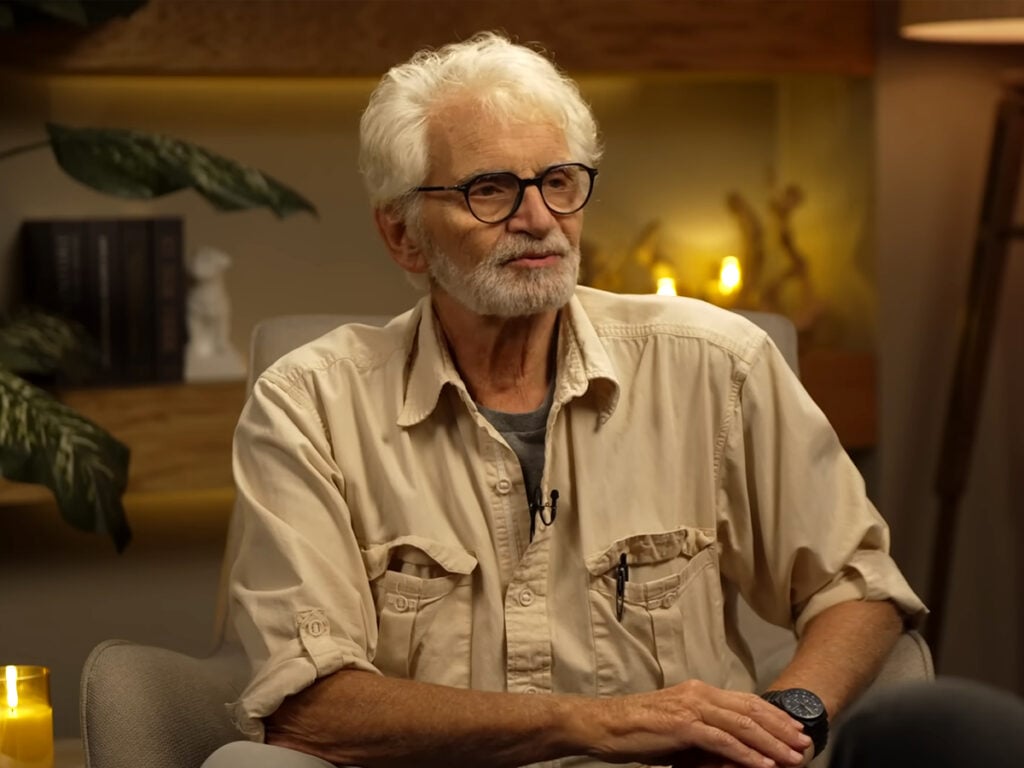
“I had years of regret, and that final take running through my mind over and over again. The only way to put that to sleep was to do some heroin,” Jack Douglas told me back in 2024.
The producer, who passed away earlier this month at 80, was with John Lennon in the studio a few fateful hours before the former Beatle was shot and killed. “The thing that made it really hard on me is that we were neighbours,” Douglas explained. “We lived two blocks apart. I usually rode the limo home with John.”
However, on that particular night, he didn’t. “I had a young band that wanted to come in and work late that night,“ he recalled. “I always think that if I would have ridden home with him maybe I would have seen the guy, jumped on him or jumped in the way.” Years later, these ifs and buts subsided, and Douglas was able to reflect on their beautiful friendship.
What he saw was a collaboration borne from a similar spiritual outlook. “He was very open to suggestion and very easy to work with,” Douglas explained. “He took direction without any problem. He would let me comp his vocals [the process of cutting pieces of vocal takes together] without being in the room saying this one or that one. He left it totally up to me.”
That was the crux of Lennon’s creative view: leave people to their own devices. He was so focused on his own self-expression, once quipping, “I like to write about me, ‘cuz I know me”, that he didn’t want to get in the way of anyone else’s. “A lot of trust early on, he let me do arrangements on the songs from cassettes that he gave me,” Douglas reflected.
“I arranged Double Fantasy with the rhythm section without him even being there,” he added. This was the boho vibe that Lennon always tried to foster in the studio. It was far from lazy, though. As Douglas mused, it was like “making four records” at once because various interplaying factors had to be neatly tessellated after the fact rather than adhering to one autocratic vision from the start.
 Credit: YouTube Still
You’d imagine that this was a very artist-friendly approach, but not everyone liked Lennon’s way of working, and in those instances, the feeling was usually mutual. Eric Clapton, for instance, once said, “Given the choice between accomplishing something and just lying around, I’d rather lie around. No contest.”
Needless to say, that meant that despite his supreme talents, when he was working with others, he craved some degree of framework. He wasn’t the type to muscle in with an array of confident ideas regardless of his skill. So, when Lennon called him in to work on ‘Cold Turkey’, the clash seemed inevitable, and neither party could stand the unpleasant experience.
Of course, they had previously worked together when Clapton came into the studio to record the ‘While My Guitar Gently Weeps’ solo for The Beatles. But on that occasion, George Harrison had already worked the whole song out. By and large, the recruitment of Clapton was just a ruse to ensure that the song wasn’t cut from the record by the harsh Lennon-McCartney partnership at the helm of the band’s songwriting.
In this environment, Clapton thrived, and his performance was stunning. But when it came to ‘Cold Turkey, he “choked”. The track was set to be Lennon’s second solo single, and he was brimming with enthusiasm. But things weren’t going to plan. There was an evident conflict between the way the bespectacled Beatle and the former Cream man were working.
Lennon’s frustrations with the so-called virtuoso would become public record years later when Cheap Trick’s very own Rick Nielsen was brought in for Double Fantasy.
“I was in the studio, playing, and John looked at Jack Douglas and said, ‘God, I wish I’d had Rick on ‘Cold Turkey.’ Clapton choked up.’”
It was high praise indeed for Nielsen, but it came at Clapton’s expense in a way that Douglas might have envisioned with enough hindsight. “In the studio with John, you had to really stay ahead of him; if you got bogged down and he was waiting to record something, he would become very impatient,” Douglas remembered. “So, I had to stay a few steps ahead of him.” Clapton didn’t. He hummed and hawed with more of a jazzy consideration.
Lennon loathed this laboured approach, sensing time away from his family slipping by, not to mention the irksome loss of rock ‘n’ roll’s zipping momentum. “As long as I was doing that and the rhythm section was attentive,” Douglas says, “it all went really smooth.” By all accounts, the ‘Cold Turkey’ sessions weren’t as cogent as that. Lennon was calling Paul McCartney a c**t while Clapton was contemplatively wondering what he wanted from him on guitar. That wasn’t going to work.
In short, the ridiculous work ethic of The Beatles is often noted as their secret weapon. However, it was a notably bohemian work ethic, built upon creative freedom, curated collaboration and playing to your peers’ strengths. Clapton didn’t neatly fold into that way of thinking. Thus, a collaboration for the ages ended up straining a friendship and maybe even precluding the early potential of Lennon’s solo career in the process.
ADD AS A PREFERRED SOURCE ON GOOGLE 