
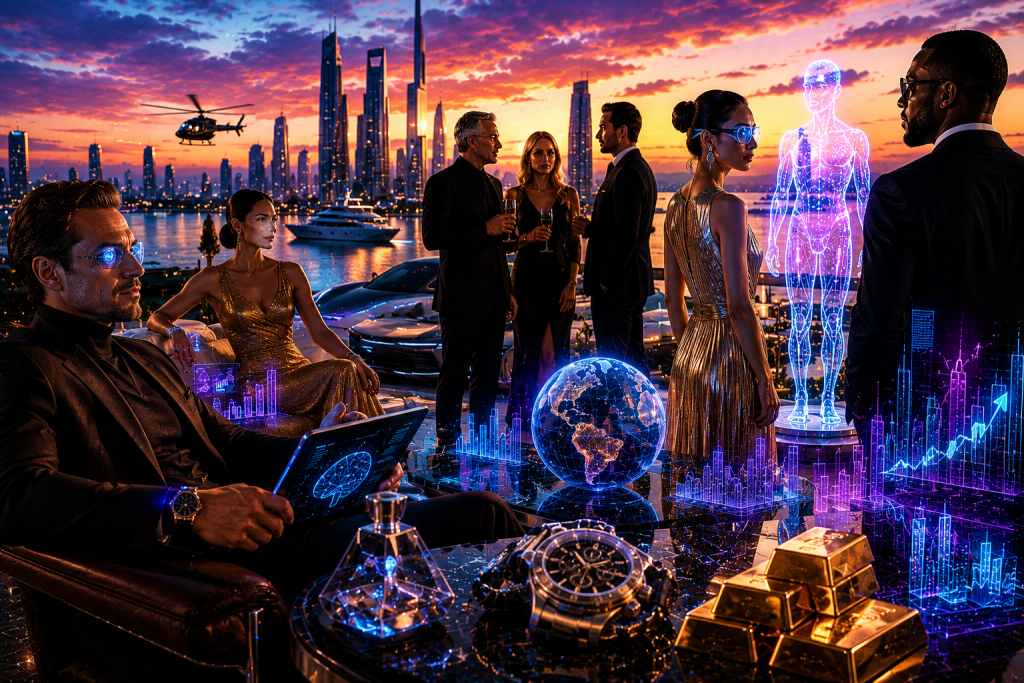
The New Status Codes: How AI Money Is Rewriting the Rules of Wealth
The old AI billionaires status markers, the yacht, the vineyard, the charity wing with your name on it with your name on it, still exist. They have not gone away. But the AI wealth class of 2026 has introduced a parallel status system that runs on different signals entirely. A $9,000 leather jacket that says “I am not finance.” A $10 Shein outfit that says “I do not need your approval.” A $76,001 salary that says “I built this for reasons you cannot price.” A LinkedIn bio with six words and $18 billion behind it. The new status codes are being written in real time by people whose relationship to wealth is fundamentally different from anything the Hamptons social architecture has encountered before.
The Wardrobe as Position Statement
The AI billionaire wardrobe rejects the traditional luxury signaling that East End culture has historically required. Jensen Huang’s leather jacket is deliberate. Lucy Guo’s Shein is constitutional. Sam Altman’s normcore is philosophical. Edwin Chen’s invisibility is structural. Each wardrobe choice communicates something specific about the wearer’s relationship to status, and none of those communications follow the existing playbook. On the South Fork, you can no longer read net worth from an outfit. The person in Shein might be worth more than the person in Brunello Cucinelli.
Real Estate Without the Social Infrastructure
AI money is reshaping Hamptons real estate with record prices, vanishing inventory, and a buyer profile that does not require the charity circuit to validate its presence. Median prices hit $2.34 million, up 34%. Luxury sales above $10 million jumped 75%. The buyers are younger, more liquid from stock vesting events, and less interested in the social performance that traditional wealth requires. They want the house and the beach. The benefit gala is optional.
Longevity as the New Philanthropy
The $20,000 longevity weekend has replaced the charity donation as the preferred status investment for the AI wealth class. The logic is consistent: if you believe technology can solve previously unsolvable problems, spending $2 million a year on anti-aging protocols is not vanity. It is R&D on the most important asset you own. The medspa-to-longevity-clinic pipeline is the commercial expression of this belief, and it is accelerating on the East End.
Celebrity Capital Enters the Chat
Celebrity AI investments are bridging the gap between technology wealth and cultural influence. When Shaquille O’Neal joins a creator platform funded by an AI billionaire, or when Ashton Kutcher’s fund backs AI infrastructure, the traditional boundary between Silicon Valley and Hollywood dissolves. On the East End, where both industries summer, the dissolution is visible in the guest lists, the restaurant tables, and the real estate transactions.
See also: Jensen Huang’s real estate choices.
The Convergence on the South Fork
What makes the East End uniquely positioned to witness this convergence is its historical function as the geographic space where different wealth categories share physical proximity without sharing social infrastructure. Finance summered in Southampton. Media summered in East Hampton. Old money summered in Quogue and Westhampton Beach. Each community occupied distinct real estate, attended distinct events, and patronized distinct restaurants. AI wealth arrives without a designated village, which means it distributes itself across the entire South Fork based on individual preference rather than tribal affiliation, and that distribution disrupts the geographic sorting that decades of social convention had established.
A thirty-year-old Nvidia engineer might buy in Sag Harbor because the village reminds them of San Francisco’s Mission District. An Anthropic researcher might choose Amagansett for the beach access and the relative anonymity. A Scale AI executive might settle in Bridgehampton because the proximity to Polo Hamptons on July 18 and 25 at 900 Lumber Lane aligns with their interest in the events where technology and finance leadership actually interact. None of these choices follow the traditional village hierarchy. All of them are driven by personal preference rather than social obligation, which is itself a status code: the freedom to choose without reference to where your peers expect you to be.
The Invisible Billionaire as Status Archetype
Edwin Chen’s $18 billion invisible fortune represents the most extreme version of the new status code. Zero public profile, no wardrobe to analyze, no real estate to map. Six words on LinkedIn and enough equity to buy a small country. Chen is the archetype of what wealth looks like when it arrives without any of the traditional packaging. In the old status economy, wealth required visibility to function. In the new one, invisibility might be the ultimate luxury.
Visibility as Vulnerability
Chen’s invisibility raises a question that the traditional status economy never had to confront: what happens when the wealthiest person in the room is invisible by choice? In the old system, wealth required visibility to function socially. The mansion, the car, the wardrobe, the charity donation, each was a visibility investment that converted financial capital into social capital. Visibility was the mechanism by which wealth entered the social system. Without visibility, wealth existed but did not circulate. Chen’s $18 billion exists but does not circulate in any social system that the Hamptons, or any traditional luxury economy, has built infrastructure to serve. His fortune is structurally invisible. Whether that invisibility is a choice, a temperament, or a strategic calculation, the effect is the same: $18 billion that the luxury economy cannot reach, cannot serve, and cannot convert into the transactions that sustain the boutiques, galleries, restaurants, and benefit galas that constitute the commercial infrastructure of the East End summer season.
What This Means for the East End
Social Life Magazine has covered the intersection of wealth, culture, and the East End for twenty-three years. The AI wealth arriving in 2026 does not replace the existing social infrastructure. It runs parallel to it, operating on different signals, different timelines, and different definitions of what status means. Understanding those signals, reading the new codes, decoding the vesting schedule references and the deliberate wardrobe choices and the longevity metrics exchanged like business cards, is how brands, brokers, and cultural institutions stay relevant to a buyer class that does not need their validation but might choose to engage with it anyway.
At Polo Hamptons on July 18 and 25 at 900 Lumber Lane in Bridgehampton, both economies converge on the field. Finance meets technology. Old codes meet new ones. The event is where the translation happens in real time.
The Translation Problem
Here is the fundamental challenge the AI wealth class presents to the existing social infrastructure of the East End, and it is a challenge that no amount of charity gala programming or benefit committee restructuring can resolve because the challenge is not organizational. It is linguistic. The old wealth spoke a language of signifiers that everyone in the room could read: the car, the club, the charity, the children’s school, the summer house address. Each signifier placed the speaker on a social map that decades of precedent had drawn with extraordinary precision. When a person said “Meadow Lane,” every other person in the room knew what that meant, not merely geographically but socially, financially, and temporally. The address was a sentence in a language everyone had agreed to speak.
AI wealth does not speak this language. AI wealth speaks a language of stock tickers, vesting schedules, GPU clusters, and model architectures that is completely opaque to the traditional social infrastructure. When a thirty-year-old Nvidia employee says “my RSUs vested at 280,” the information content of that sentence is as socially significant as “Meadow Lane” but the social infrastructure has no mechanism for translating it. The vesting price encodes a net worth, a timeline, a corporate affiliation, and a set of cultural values (tech over finance, equity over salary, West Coast over East Coast) that the existing Hamptons taxonomy cannot parse. That translation problem is real, it is growing, and it will define the next decade of social dynamics on the South Fork.
The Deeper Read
Social Life Magazine’s twenty-three-year editorial history positions it uniquely to perform this translation. The publication knows the old codes because it has covered them for two decades. It is learning the new codes because the new codes are arriving on the same beaches, at the same restaurants, and at the same events, including Polo Hamptons, where the translation happens in real time across a polo field. The brand that can speak both languages, old money and new code, finance and technology, charity circuit and cap table, becomes the essential intermediary in a social economy that desperately needs one. That is what this empire is. That is what this content does. It translates.
The Bilingual Advantage
The brand, the publication, the event that can speak both languages fluently becomes the essential intermediary. Social Life Magazine’s twenty-three years of editorial coverage on the East End provides fluency in the old codes. This AI Billionaires content empire provides fluency in the new ones. Bilingual institutions do not merely survive the translation. They profit from it, because every introduction between old money and new code, every dinner where the hedge fund partner meets the Nvidia engineer, every event where the charity chairman encounters the bootstrap billionaire requires someone who understands both sides of the conversation and can facilitate the exchange.
Where the Conversation Continues
If your brand, property, event, or company belongs in this conversation, reach us through our contact page. For premium editorial visibility, explore our paid feature submission process. Subscribe at sociallifemagazine.com/enflyer. Polo Hamptons returns July 18 and 25. BMW is title sponsor. Details at polohamptons.com. Subscribe at sociallifemagazine.com/subscription.