
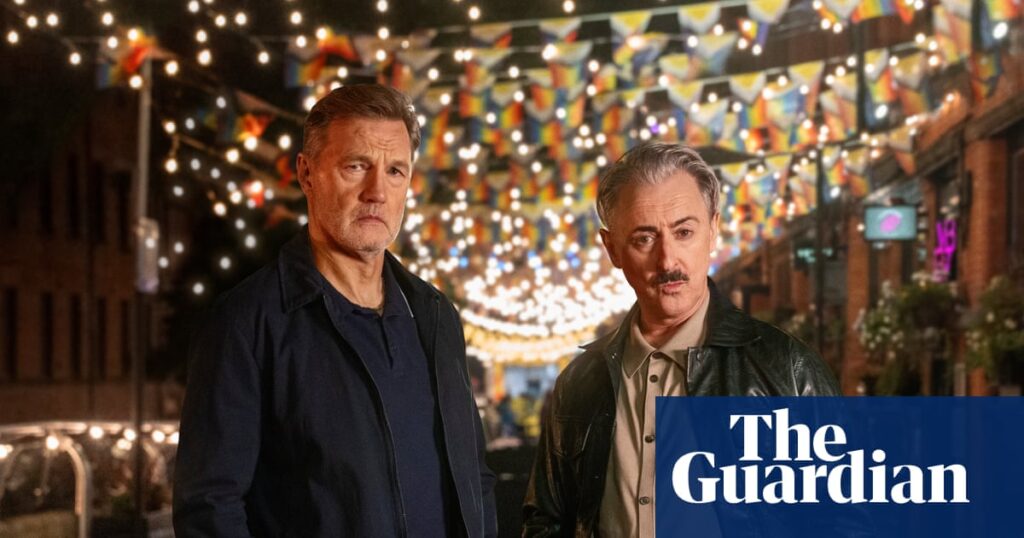
Late at night on Manchester’s Canal Street, the heart of the city’s famous queer scene, two neighbours are at war. An escalating feud between gay bar manager Leo (Alan Cumming) and reserved, judgmental neighbour Clive (David Morrissey) shows no sign of abating. Yells from Leo are so loud they echo down the canal. The street is not closed to the public as their altercation plays out, so you can’t tell who in the background is an employee at Leo’s bar, Spit & Polish, who is a regular, and who is a member of the public out for their midweek pint. In the background, an ambulance’s lights flash while unflappable drag queens continue to flyer for their neighbouring bars.
Russell T Davies’s Tip Toe, a new Channel 4 drama, looks at how political rhetoric, toxic online bullying and misinformation can add jet fuel to a feud between neighbours. The location of the series won’t be lost on viewers of Queer As Folk. The 1999 classic, which regularly featured scenes shot in Canal Street, followed the lives of three gay men, in a way that not only made being gay seem cool, it also reflected a new era of tolerance. Viewers took from it that the future could only be bright.
‘I wanted all sorts of voices in there’… Russell T Davies. Photograph: Fabio De Paola/The Observer
Now? “We’ve got this slide back into something as bad as I can remember, if not worse, because now people know what they’re doing,” Davies tells me. “In the old days when we used to preach about visibility, if someone punched you in the face, or excluded you … you had the excuse of saying they were ignorant. They were in the dark and we must be visible. And now they’ve seen us, and now I think that anger and that violence is on the rise. So what the fuck does that say?”
Davies says he has never written so furiously in his life; the central question running through all five episodes being that if inclusion and representation is now a given, what if other people don’t like what they see? The feud starts with Leo asking Clive for help after he gets locked out of his house, but Clive’s reluctance, reticent character and problematic views make Leo, and the viewer, feel wary about where it ends – and how deep his resentment for Leo lies. The series is a powerful exploration into hate, and how LGBTQ+ people can find themselves in the firing line, with the election of Trump now giving permission for anyone who is angry to say what they want without consequences.
“This isn’t exclusively a gay problem,” says Davies, “but nonetheless we’re an easy focus for it. Whatever this anger is, we’re a target. The amount of times online I’m called a groomer and a paedophile [for his support of trans rights] is shocking and maybe actionable, except I think if I took action, I’d make it even worse.” It’s this fear of being able to express yourself that the show is named after. “I used to walk into a room and go: ‘Ta-da!’” says Melba (Paul Rhys), a close friend and longtime frequent drinker at Leo’s bar, in episode one. “Now I tip toe. Just in case.”
Hate watch … Alan Cumming and David Morrissey in Tip Toe. Photograph: Ben Blackall/Channel 4
“We’ve all seen the changes, we’ve all felt them,” says Cumming. He’s just filmed a scene in his bar in the middle of a pretend busy service, though everyone is dancing to silence to not drown out the dialogue, so the only thing you can hear is the squeak of the floorboards.
Cumming says that Davies has the knack of not only reminding us about things from our past – such as in It’s a Sin, his critically acclaimed 2021 drama about the Aids crisis – but also for writing about our present and future. There’s a death in Tip Toe that might at first appear far-fetched, but the power of the drama is how within reach it increasingly feels. “It seems crazy what this is about, but he makes it all absolutely plausible – and so nuanced. It’s not black and white.”
To some, including members of the LGBTQ+ community, it might feel like a surprise that a drama has to remind people of the challenges that threaten them. He disagrees.
“No, because I think that’s what dramas are for,” says Cumming. “Why do we do the Greeks? Why do we read Shakespeare? They have things to say, and we need to keep hearing the same stories and allegories, because they’re important for us as a culture, to hear and to understand and to reinterpret.”
double quotation markWe’re very, very fair to Clive in this. He’s not just the monster next doorRussell T Davies
If scenes are not set on Canal Street, they are at Clive and Leo’s homes. The domesticity of two neighbours at war and themes of Leo’s private life being intruded on were inspired by recent events where Davies felt unsafe in his own home. Three years ago, the BBC’s Imagine documentary series featured Alan Yentob profiling Davies’s career and his return to Doctor Who. A fan who recognised his house turned up outside and he started receiving letters from viewers. When a kind neighbour who had a key once let themselves into the property without knocking at the front door first, it gave Davies a fright.
“I was fascinated by how startling that was, how porous your house feels,” he says. He then started contemplating how it must be for other people in less privileged positions. “If it’s reaching me, what the fuck is it like on levels where you have less defence and less ability to move and less money, frankly?”
From the opening scene outside their front door, you can tell that Clive already does not think highly of Leo. An electrician with two sons, Clive’s opaque character means that there are times where you’re unsure how sinister his views really are. The third episode flips the perspective from mostly Leo and his friends to Clive. He’s unhappy in his marriage, he’s unable to get enough income and he’s ostracised from his colleagues. He feels trapped and alone, but not able to confide in his male friends. The show explores why at every junction, Clive has taken the darker path.
“Instead of having friends and reaching out, he finds validation online,” Morrissey says. “They go: it’s those people. They’re taking your job. It’s reinforcing something that he had all the time. So he just becomes angrier and angrier and angrier.”
Paul Rhys and Alan Cumming in Tip Toe. Photograph: Ben Blackall/Channel 4
“We’re very, very fair to Clive in this,” says Davies. “He’s not just the monster next door. Even if you don’t necessarily feel sympathy for Clive, the knack of the series is that you get a full understanding of the circumstances that led him to end up with these views.
“It’s a very nuanced piece,” says Morrissey. “I felt as if there were a lot of opportunities inside the story where characters, particularly my character, could have taken a different road, made a different decision. Russell gives him that fork in the road to play with and that was really interesting for me; about why this man takes the decision to go one way rather than the other. That’s a gift for an actor.”
Trying to get in as well rounded a view of the issues at stake here is a deliberate choice by Davies. Spit & Polish’s employees are mostly a younger generation of LGBTQ+ people. He sought advice from the writer Juno Dawson, with whom he worked on Doctor Who, about how to portray the trans characters in the show, including the charming and endearing employee Zee (Iz Hesketh). Stephanie (Elizabeth Berrington), Leo’s close friend whom we see throughout the series, is gender-critical – believing that biological sex cannot be changed from birth.
“I wanted all sorts of voices in there,” says Davies. “I’ve got friends who are gender-critical. It’s only online you end up screaming and shouting and being attacked by them. In real life, you have a chat, and we all kind of sigh and put up with each other. That’s how the world works. It’s actually how the world is ceasing to work.” As terrifying violence looms towards the end of the series, Stephanie and Zee end up on the same side.
Cumming says that the filming has been an intense experience because of the subject matter. “I have this sort of, I don’t know what it is, soreness in my heart, in my chest, when I think about it,” he says. But it’s left him feeling hopeful for the future after working alongside so many young people.
“They were so gorgeous and supportive and kind,” he says. “It’s very emotional.”
Despite the theme, the show also features a lot of uplifting solidarity and camaraderie, expressed through the younger workers who work at his bar. “Joy, queer joy, trans joy, Black joy is a form of protest”, says Cumming. “It infuriates people who don’t have joy or don’t understand why you can have joy when the world, everything seems to be against you.”
“There’s great joy [in Tip Toe].” What follows is a short pause: “Some of it.”
Tip Toe starts on Sunday 31 May at 9pm on Channel 4.