
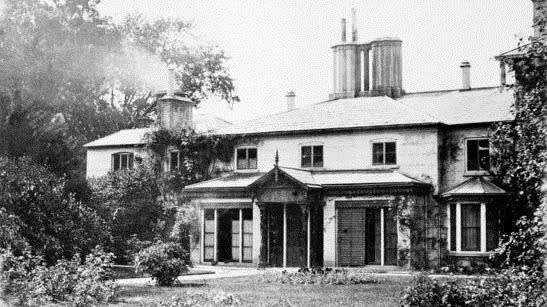
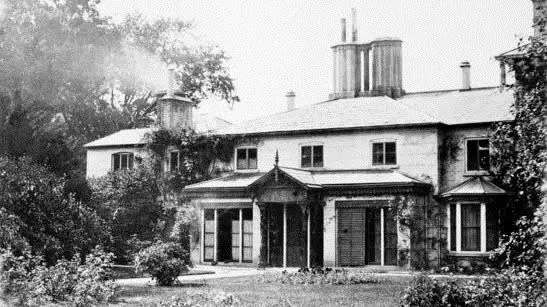
An image of Frogmore Cottage from 1872.
To most Americans, Frogmore Cottage is known as the home Prince Harry and Meghan Markle renovated, lived in briefly, and ultimately left behind when they moved to California. However, the modest yet beautiful house on the Windsor estate has a history stretching back more than 200 years. That history includes frogs, royal favorites, exiled aristocrats, and a queen who found the whole place rather revolting. Here are 10 things you might not know about it.
It was built for a queen who wanted to escape — for around $65,000 in today’s money
Royal Central reports that the cottage was built in 1801 at the direction of Queen Charlotte, wife of King George III, originally under the name Double Garden Cottage. According to royal records, it was constructed for just £450 by a builder named Mr Bowen — the equivalent of roughly £50,000 today (around $65,000 in US dollars), as Country & Town House notes. Queen Charlotte and her unmarried daughters used it as a serene retreat; it was a short walk from Windsor Castle and all its formality.
Even Queen Victoria wasn’t a fan of the frogs
When Queen Victoria stopped at the cottage for breakfast on June 28, 1875, she was distinctly unimpressed by the local wildlife. As she recorded in her journal that day, published in The Letters of Queen Victoria (Volume 5, Cambridge University Press), she found the frogs around the property “quite dreadful,” noting there were so many that the grass itself seemed to come alive with them. The damp, low-lying ground had long given the wider Frogmore estate its amphibian name. According to the Royal Collection Trust, the estate was named Frogmore due to the large number of frogs originally found there, on land bought by King Henry VIII in the 16th century. The royal verdict did nothing to soften its reputation.
It was home to one of the most extraordinary friendships in royal history
Perhaps the most remarkable chapter in Frogmore’s history involves Abdul Karim, a young man from Agra who became one of Queen Victoria’s closest confidants. According to the Royal Collection Trust, Karim entered the Queen’s service in 1887. Then he became her official Indian Secretary in 1888 and gave her lessons in Hindustani. Victoria, who felt great affection for him, provided him with Frogmore Cottage as his home. Their bond, which was deeply resented by the royal court, was later dramatized in the 2017 film Victoria & Abdul starring Judi Dench.
After Victoria died, her son had her favorite servant sent home
After Queen Victoria’s death in 1901, the court soon sent Abdul Karim away from Frogmore Cottage. People reported that, within just hours of the monarch’s burial, a group of senior royals and courtiers invaded Karim’s home and had all his letters from Queen Victoria destroyed. He died in Agra in 1909.
A Russian Grand Duchess fleeing revolution once took refuge there
The cottage has long served as a place of shelter, and never more dramatically than in the years following the Russian Revolution. The Independent shared that Grand Duchess Xenia Alexandrovna, who was the sister of the last Tsar of Russia, Nicholas II, took refuge at Frogmore Cottage in the 1920s following her exile.
Before Harry and Meghan, it was five separate apartments for palace staff
For much of the 20th and early 21st centuries, the cottage was not a grand single home. According to MSN, Frogmore Cottage was divided into five separate housing units and occupied by Windsor estate workers. It would take a royal wedding gift to transform it into a single residence once more.
The late Queen gave it to Harry and Meghan as a wedding gift
When Prince Harry married Meghan Markle in May 2018, the couple received a very significant gift. Queen Elizabeth II gave Frogmore Cottage to the couple following their wedding, and the five-unit property was converted back into a single-family home. The couple moved in during early 2019 after an extensive renovation.
The renovation cost $3.2 million — and Harry paid every penny back
The refurbishment became the subject of intense public scrutiny. The BBC reported that the renovation cost £2.4 million (around $3.2 million in US dollars) and was initially funded through the Sovereign Grant, the public money allocated to the royal family. After stepping back from royal duties, Prince Harry repaid the full amount, with a spokesman confirming the contribution fully covered the necessary renovation costs. The work had included rewiring, structural repairs, new flooring, and reportedly a yoga studio.
It sits next door to the royal family’s private burial ground
For all its domestic charm, the cottage sits within one of the most solemn corners of the royal estate. The surrounding Frogmore Estate is home to the Royal Burial Ground, where numerous members of the royal family are laid to rest, as the Royal Windsor visitor guide described. The same estate also contains Frogmore House, the grand 17th-century mansion where Harry and Meghan held their wedding reception.
Today it sits empty — and its future is uncertain
After stepping back from royal duties in 2020 and moving to California, Harry and Meghan were asked to give up Frogmore Cottage in 2023, just weeks after the release of the Duke’s memoir Spare.
The couple removed their remaining belongings, leaving them without a UK base. At the palace’s annual Sovereign Grant briefing, an official confirmed that “during the year, Frogmore Cottage has remained empty,” declining to speculate on who its future occupants might be, as reported by Hello! magazine. More than two centuries after a queen first built it as a serene escape, Frogmore Cottage stands empty for now.
For a house so often dismissed as a footnote in the Sussex story, Frogmore Cottage holds one of the richest and strangest histories in the royal portfolio. There is far more to this charming Windsor home than its recent headlines suggest.
For more about historical homes and the royal family, follow me on Yahoo.