
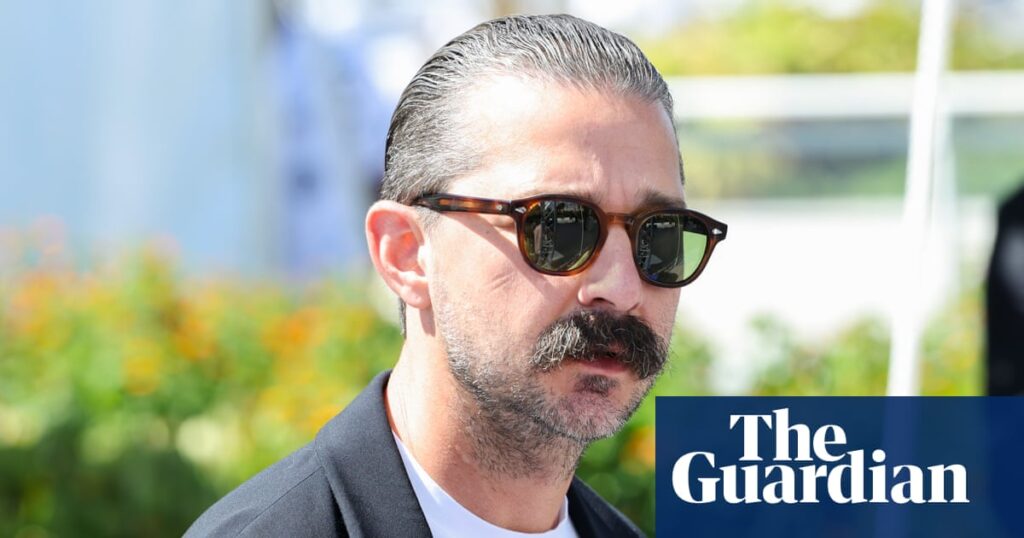
Shia LaBeouf on Wednesday pleaded guilty to misdemeanor battery charges filed against the actor after his arrest over allegations that he struck three men at a New Orleans bar in February.
After his plea in the city’s criminal district courthouse, the Transformers film franchise star received a sentence of two years’ probation, rehabilitation for alcohol abuse, sensitivity training and anger management classes.
LaBeouf’s attorney for the case, Sarah Chervinsky, said her client was now “looking forward to focusing on family, work and new creative projects”. She said the authorities’ investigation into the matter established that the actor’s arrest stemmed from “nothing more than a minor … bar tussle” on the morning of the Mardi Gras holiday in New Orleans.
Chervinsky denied her client’s actions that day were driven out of “bias”, despite claims supported by video that LaBeouf aimed anti-gay slurs at the victims.
Police arrested LaBeouf, 39, after he punched two men and head-butted a third at the R Bar in the New Orleans’s Marigny neighborhood at about 12.45am on 17 February.
Bar staff had told him to leave the premises after he became increasingly aggressive and insulted the men he battered with homophobic slurs, police said in sworn statements filed in court. LaBeouf was briefly jailed after being discharged from a hospital where he was taken at the time of his arrest. But he was soon released, required to put up a $105,000 bond and ordered by a judge to enroll in substance abuse treatment.
The Guardian has previously reported that one of the alleged victims, Nathan Thomas Reed, identifies as queer and another dresses in drag. The latter of those men, named Jeffrey Damnit, recorded a cellphone video of LaBeouf directing the homophobic insult “faggot” at him outside the bar.
Damnit, whose legal last name is Klein, initially spoke to news media of his hope that prosecutors would charge LaBeouf under a state law which allows for enhanced penalties against those who victimize others based on the “actual or perceived” basis of sex or gender, among other categories.
Damnit’s video was one of several that recorded aspects of circumstances surrounding LaBeouf’s arrest.
The formal charges to which LaBeouf pleaded guilty were filed by New Orleans district attorney Jason Williams’ office on 21 May. They were contained in a charging document known as a bill of information.
Chervinsky said LaBeouf – who bought a home in New Orleans in December – went to court on Wednesday “wanting to take accountability for his part in what happened, and he has done so”.
Damnit’s attorney, Michael Kennedy, said the outcome of LaBeouf’s case was a reminder that everyone in New Orleans is “equal, and we don’t treat people differently based upon relative fame”.
“The defendant in this matter has been given an opportunity to do better – to be better,” Kennedy said. “It is the hope of Mr Klein, and our entire team, that the substance abuse treatment, sensitivity training, and anger management will be taken seriously and that the defendant will make use of the skills he learns in the future.”
The New Orleans case to which LaBeouf pleaded guilty is not his first experience with the US’s criminal court system.
He was arrested in 2014 over allegations that he disrupted a Broadway show in New York City, in the process purportedly insulting a police officer with the homophobic slur “fag”.
LaBeouf was separately recorded saying police were racist – and that a Black officer on the scene would go to hell – during a 2017 disorderly conduct arrest in Savannah, Georgia. That led to another, earlier court-mandated stint in rehab.
In an interview published less than two weeks after his New Orleans arrest, LaBeouf told the YouTube outlet Channel 5 that “big gay people are scary” to him given his “traditional Catholic” faith.
He also alleged to Channel 5 that “three gay dudes [were] next to me, touching my leg”, before the violence preceding his arrest.
“I [got] scared,” LaBeouf added. “I’m sorry – if that’s homophobic, then I’m that.”