
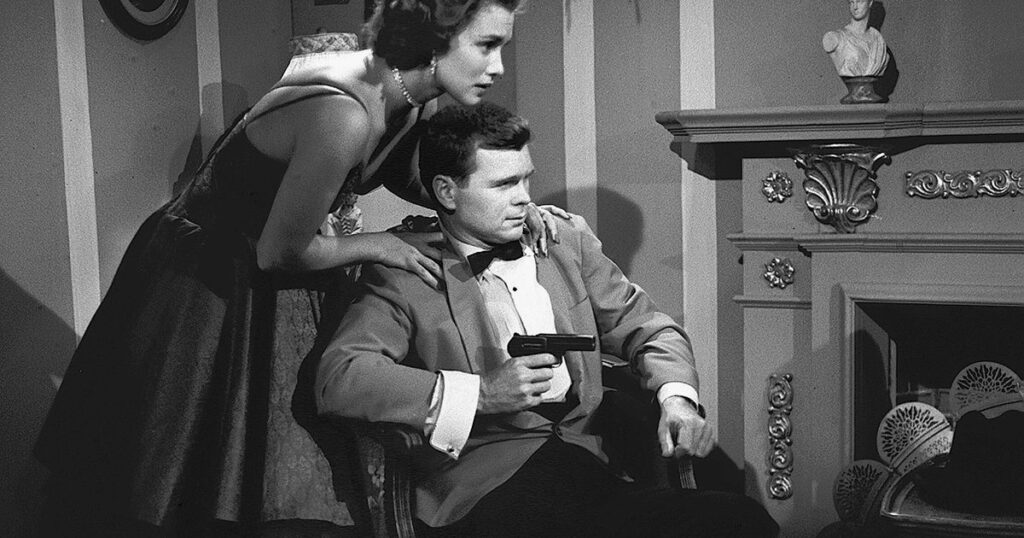
Before Sean Connery ordered his first vodka martini, before Ursula Andress emerged from the sea, before Monty Norman’s theme became shorthand for cinematic cool, James Bond had already made it to screen.
Not the James Bond most viewers would recognise, admittedly. Not quite.
In 1954, eight years before Dr. No launched the 007 film franchise as we know it, Ian Fleming’s Casino Royale was adapted for US television as part of the anthology drama series Climax! – it was broadcast live, ran for around 50 minutes, and starred Barry Nelson as Bond opposite Peter Lorre as Le Chiffre.
Except this Bond was not the suave British secret agent of legend. He was “Jimmy” Bond, an American operative working for “Combined Intelligence”, assisted by a British contact named “Clarence” Leiter.
For anyone raised on the familiar rhythms of the film series – the gun barrel, the theme tune, the pre-title stunt, the briefing with M, the banter with Q, the elaborate villain’s lair – the 1954 Casino Royale is initially a jolt. It is Bond before he had fully become Bond. No gadgets, no Aston Martin, no outrageous death traps, no mythology straining under the weight of six decades of expectation.
Instead, this is a lean, studio-bound piece of live television, closer to a stage play than the globe-trotting cinema spectacle the franchise would become. It is also, for that very reason, fascinating.
The plot is broadly recognisable to anyone familiar with Fleming’s first Bond novel, or indeed the 2006 Daniel Craig film. Bond is sent to Casino Royale to beat Le Chiffre at baccarat, bankrupting him and leaving him exposed to his Soviet paymasters. There is a dangerous woman with divided loyalties – here named Valerie Mathis, effectively a combination of Vesper Lynd and 007’s French intelligence ally René Mathis – and a brutal confrontation after the card game, with Le Chiffre attempting to torture the whereabouts of Bond’s winnings out of him.
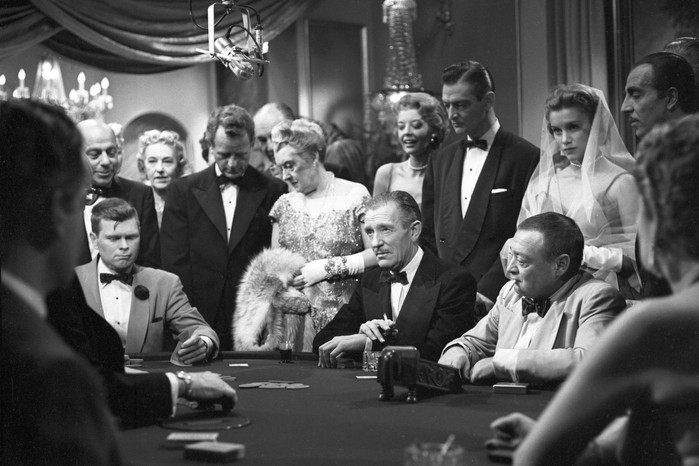
CLIMAX! production of ‘Casino Royale’ featuring (seated at far left) Barry Nelson as James Bond and Peter Lorre (seated at right, wearing white suit) as Le Chiffre.. CBS via Getty Images
But the texture is entirely different. This is not the heightened, hyper-stylised Bond world that EON Productions would establish from 1962 onwards. It is smaller, stranger and rougher around the edges. At points, it feels like watching a rehearsal for a franchise that has not yet realised what it is going to become.
That might sound like faint praise, but it is precisely what makes Casino Royale essential viewing for Bond fans. It is not essential because it is secretly the best screen Bond, or because Barry Nelson has been unfairly overlooked as one of the great 007s. He has not. Nelson is perfectly watchable, but his Bond is a very different proposition: more hardboiled American TV hero than Fleming’s “blunt instrument” of British intelligence.
Yet Nelson’s more vulnerable, less mythic version of the character is not without interest. Seen from this side of Daniel Craig’s bruised, human Bond, there is something oddly intriguing about a 007 who feels less invincible. This Bond sweats. He looks trapped. He has not yet become a brand.
The real draw, though, is Peter Lorre. As Le Chiffre, screen icon Lorre brings a queasy charisma to the production, his presence gifting the episode much of its electricity. He is oily, desperate and faintly grotesque, suggesting a man whose danger comes not from physical dominance but from panic, appetite and intelligence curdled into menace.
Le Chiffre would later become one of the great Bond villains on-screen thanks to Mads Mikkelsen’s icy, wounded performance in the 2006 film, but Lorre’s take has its own peculiar power. He belongs to an earlier mode of screen villainy – theatrical, expressive, just slightly unreal – and that makes him a perfect fit for this odd little television experiment.
There is also real novelty in seeing how much of Casino Royale survives the compression into a one-hour broadcast. The card game is there. The basic mission is there. The torture sequence, though inevitably altered for 1950s television, is there too. Given how many of the flourishes we now associate with Bond had not yet been invented, what remains is the raw Fleming set-up: a spy, a casino, a woman, a villain and a game of chance with geopolitical consequences.
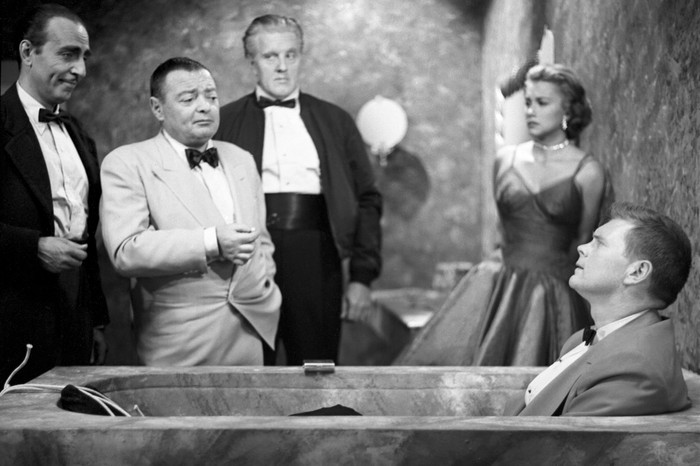
CLIMAX! production of ‘Casino Royale’ featuring Peter Lorre (in white suite) as Le Chiffre, Barry Nelson (in tub) as James Bond and in background, Linda Christian as Valerie Mathis. CBS via Getty Images
That simplicity is refreshing. Casino Royale is a reminder that Bond did not begin as a superhero in evening wear. He began as a Cold War operative in a relatively contained thriller, one where tension came from cards on a table as much as bullets in a gun. The 1954 adaptation, for all its compromises and quirks, captures some of that stripped-back quality.
Of course, part of its appeal is pure curio value. This is the kind of Bond artefact that feels almost impossible: a first screen outing that sits outside the official film sequence, predates the familiar iconography, and imagines a version of the character who might have taken an entirely different route through pop culture. Had CBS’s later plans for a Bond television series come to fruition, perhaps 007 would have become a small-screen American hero before he ever became Britain’s most famous cinematic export.
That did not happen. Instead, Dr. No arrived in 1962, Connery gave Bond his lethal elegance, and the template was set. The 1954 Casino Royale slipped into the margins, lost for years after its original broadcast before eventually resurfacing in the form of a black-and-white film recording. Its obscurity has only added to its mystique.
Watched now, it is not a rival to the great Bond films. It is too modest, too creaky and too much a product of early live television for that. But as an alternate beginning, it is irresistible. It offers a glimpse of Bond before the machinery of Bond-ness took over – before the catchphrases, before the iconography, before the formula became both the series’ greatest strength and its most familiar constraint.
For 007 fans, that makes it more than a footnote. Casino Royale is a fascinating “what if?” preserved in flickering monochrome: Bond without the myth, Bond before the movies, Bond as he might have been.
And while “Jimmy” Bond was never going to replace James, his one-and-only outing remains a strangely compelling reminder that even the most enduring screen legends had to start somewhere.
Read more:
Check out more of our Film coverage or visit our TV Guide and Streaming Guide to find out what’s on. For more recommendations and reviews, listen to The Radio Times Podcast.