
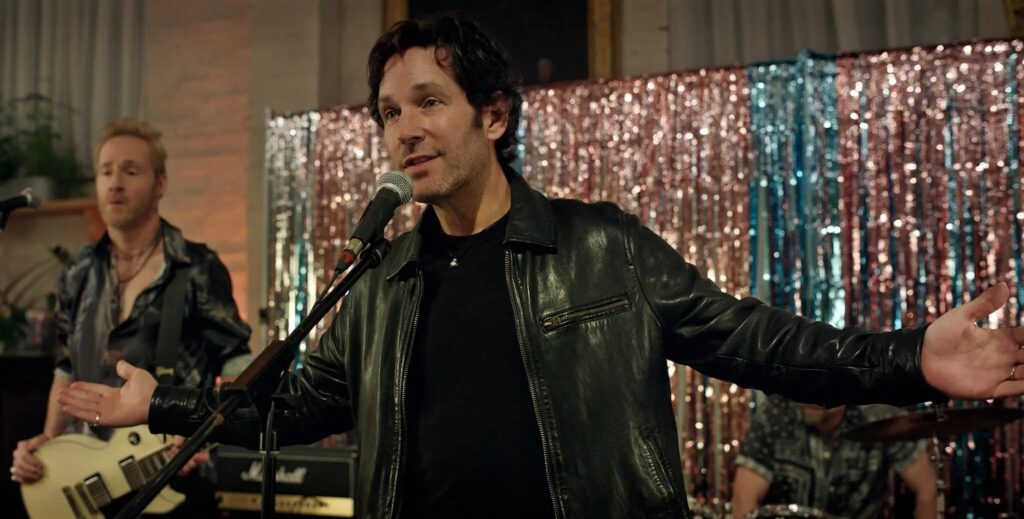
Somebody already made a movie about a charming-fuckup wedding singer who longs to perform his own songs instead of the obligatory covers of ’80s hits. It’s called The Wedding Singer, and it fucking rules. You might think that one wedding-singer comedy would be enough, especially since that one wedding-singer movie was a huge hit that became a cable staple. You might think that nobody would need another wedding singer comedy, especially since wedding bands are relative rarities these days. (Someone must hire them, but I haven’t been to a wedding reception with a band since my aunt got married in the late ’90s.) Nevertheless, the Irish writer and director John Carney’s new film Power Ballad dares to revisit that territory and to ask a pressing question: What if a wedding singer wrote a song and somebody stole it?
In Power Ballad, the wedding singer is a gentleman with the unfortunate name Rick Power, portrayed by the unrelentingly amiable Paul Rudd. Our hero used to be in a ’90s touring band, but a Dublin gig led to a hookup, a pregnancy, and a whole new life in Ireland. We know that Power Ballad takes place in a fantasy world because this musician’s shotgun wedding leads to a loving and lasting marriage. In real life, that couple wouldn’t make it to their first Christmas.
Rick still dreams of the stardom that he never found, but he loves his wife and daughter, and he gets along just fine smoking weed and singing “The Boys Are Back In Town” at Dublin-area receptions. (Rick’s otherwise-Irish group is called the Bride And Groove, which is about the level of comedy on offer in Power Ballad.) On occasion, Rick will reach into his bag and perform one of his own songs, clearing out the dancefloor and pissing off his bandmates. It’s the first of many, many party fouls that Rick commits over the course of the picture.
One night, Rick and his band are playing at a wedding, and the couple has a special request. One of their guests is an old musician friend, and they want him to sit in with the band. That guest is Danny Wilson, former member of a hugely popular boy band. His ex-bandmates have all gone on to solo success, but he’s struggling. He wants to play his expensive acoustic guitars and write his own songs, but his label doesn’t hear a single yet. Basically, Danny is a fictional version of Niall Horan from One Direction, but he’s played by Nick Jonas, another millennial heartthrob type with his boy-band past.
Rick doesn’t really want to let anyone else onstage, but he’s talked into it. Danny sings Stevie Wonder’s “I Wish” with the band and immediately impresses Rick. A little while later, Danny spies Rick smoking a joint and invites him to hang out. He’s got a room full of expensive instruments, and he’s trying to write the songs that’ll establish him as something other than a washed-up boy-band guy. He and Rick play each other a bunch of songs that they’ve written, suggesting little tweaks and finding a collaborative flow. Six months later, Rick hears one of his songs over mall speakers. There it is. There’s your movie.
The song is good. That’s really the most important test for the entire film. If the song were bad, or if it were just OK, nothing would work. In a movie about fictional songwriters, that’s always the test. The beautiful thing about That Thing You Do! is the way it passes that test. The late Adam Schlesinger’s titular number sounds like a plausible hit from the period. More importantly, it plays multiple times throughout the picture, and you get excited every time it starts again. Few other movies can pull off that magic trick.
“How To Write A Song Without You,” the power ballad from Power Ballad, does what it needs to do. It sounds good when Paul Rudd sings it and when Nick Jonas sings it. It sounds good when Rick Power’s daughter hears it on the radio and sings along. It sounds good in montage form. “How To Write A Song” is a drippily sincere, slow-building number. It’s a song about writing songs, a meta-construction that should be played out but that still works sometimes, and it’s got a chorus that pleasantly lodges itself into your brain. Last night, I walked out of the theater with “How To Write A Song” stuck in my head. But when I put the song on in the car, it didn’t sound half as good. Unlike “That Thing You Do!,” it doesn’t stand on its own. That’s just movie magic, baby. Power Ballad gives its power ballad a context, a reason for being. The song and the picture serve one another. The other originals in Power Ballad are pretty rough, and nobody should ever ask Paul Rudd to do a Lou Reed-style speak-sing ramble, but “How To Write A Song” does its job.
Power Ballad writer-director John Carney has already done this. Before he started making movies, Carney spent a few years as the bassist for the Frames, the Dublin rock band. In 2007, Carney wrote and directed Once, and he cast his former Frames bandmate Glen Hansard in the lead role. It told the tale of two Dublin street musicians who fall in love and write songs together, and it worked mainly on the strength of “Falling Slowly,” the all-timer that the two leads, Hansard and Markéta Irglová, wrote and performed together. That song won an Oscar. Once became a minor hit and then a Broadway musical. Hansard and Irglová fell in love and then broke up, and they still make music together as the Swell Season.
That’s the kind of story that John Carney loves to tell. He’s all-in on the magic moment when a song appears out of nowhere. That song might not change the world, but it might change the lives of the people who wrote it. Whenever Carney shows that happening onscreen, he takes sheer delight in the romance of it. Carney didn’t have anything to do with writing “Falling Slowly.” Often, though, the songs in Carney’s movies are written by Carney and composer Gary Clark (not the Texan blues guy). Therein lies the problem. Carney’s songs are big, gleaming middle-of-the-road pop-rockers, and they always sound like Keane. I was absolutely charmed by Sing Street, Carney’s 2016 film about Irish teenagers who get together to start a band in the ’80s, except for the moments when that band would play their Keane-ass songs.
“How To Write A Song About You” has the advantage of being a good Keane song, especially when it plays in the Power Ballad context. The scene of Rick and Danny playing each other songs is where Power Ballad is at its best. Carney lingers, teasing out the alchemical thing that can happen when two musicians really click with each other. It’s so interesting that he could have a complete understanding of that dynamic despite evidently possessing zero knowledge of the music business.
Everything about Power Ballad is implausible. Entire frameworks are in place to prevent exactly this situation from happening. If anything, it works the other way today. Artists, labels, and publishers don’t want to get sued, so they hand out credits and percentages to people who wrote songs that sound even a little bit like their new ones. There are Beyoncé tracks with dozens of credited writers. Even if Rick is a small-timer with no manager and no knowledge of how things are done, he’d keep at least some documentation of all the songs he’d written. The movie tells us that he’s a total fucking idiot, a naïve bumpkin without the slightest respect for his own creations, but that we should root for him anyway.
Paul Rudd can do that, right? He’s charming. He’s always been charming. We love this guy, whose face has barely changed since he was Alicia Silverstone’s Clueless ex-stepbrother/love interest three decades ago. He’s Ant-Man! He’s lead field reporter Brian Fantana! He’s the guy who Judd Apatow cast as Judd Apatow in This Is 40, another comedy with an absurd understanding of the music business! Power Ballad is one more showcase for that Rudd screen persona. He sings solid, capable covers of a recognizable songs. He dresses the way that Jeremy Renner and Kiefer Sutherland do when they’re playing at rock stardom in real life. He underplays everything enough that he manages not to evoke too many Adam Sandler memories, except in the regrettable scenes where he has to get belligerently depressed in the middle of a wedding performance. He soulfully crinkles his eyes a lot.
But Paul Rudd is a lot more charming when he’s around Americans. When you put him around actual Irish people, his whole thing doesn’t hit the same. Carney’s pictures are attuned to uniquely Irish quirks and rhythms. Tonally Power Ballad might as well be a gentle Mirimax comedy from the ’90s, and Rudd isn’t the right fit even though he was in actual ’90s indie comedies. The actual Irish characters in Power Ballad are mostly one-dimensional cut-outs, but they still outshine Rudd way too often. Peter McDonald plays Max’s comic-relief stoner-guitarist sidekick Sandy. At one point, he gives a whole speech about how he’s not just a sidekick, how he has his own internal life. Max is like, “Wow, you’re right, sorry.” Sandy tells him that it’s fine and then goes right back to being his sidekick. And I still would probably rather watch a movie about Sandy.
Paul Rudd, however, is still Paul Rudd. Unfortunately, Nick Jonas is not Paul Rudd. I thought Jonas was pretty good in that one Jumanji movie, but I don’t buy him as a lead. Power Ballad needs an actual pop star in that role, and Jonas comes alive in the moments where he and Rick play songs for each other. The rest of it depends on our knowledge of Jonas as an actual grown-up boy-band kid. But the movie’s fictional boy band seems to have nothing to do with the real Jonas Brothers, and Jonas simply can’t come across as a desperate, flailing, fast-fading star who needs to steal someone else’s song to save his career. He’s too blandly likable to go full mercenary. I could believe that Joe Jonas would steal someone’s song, not Nick.
Paul Rudd and Nick Jonas are basically the only Americans in Power Ballad. Havana Rose Liu is barely in it, though she’s great, especially in this crucial scene. Jack Reynor plays Danny’s slimy American manager, but he was the stoner older brother in Sing Street, and the Irishness sneaks through. Power Ballad has a few broadly comedic American-style setpieces, and those things do not work. It’s better when it stays small and grounded. I’d prefer to see a version with an all-Irish cast, maybe with actual Irishman Niall Horan in the Niall Horan role.
The goofy plot machinations of Power Ballad require Rudd to play an obsessive stalker type, and he does a lot of dumb bullshit over the course of the movie. Maybe those things would make for big laughs in a packed theater, but there were only two other people in my screening last night, and I never heard either of them laugh. The two movies couldn’t be more tonally different, but Rick’s arc reminded me a bit of the main character in Alex Russell’s 2025 indie psychological thriller Lurker, another story about a clueless outsider who’s desperate to attach himself to a pop star. Lurker has a much more accurate, lifelike image of the circa-now music business than Power Ballad does. It’s also funnier.
Still, Power Ballad got me a couple of times. John Carney’s overarching career thesis is that it’s beautiful and sacred when people get together to make music. Power Ballad aims lower than Once or Sing Street, and it doesn’t have the same glow as those movies, but a few scenes really bring that sparkle. You don’t need to run out to see Power Ballad in a theater. A few months from now, though, you might wake up on a Sunday morning next to someone you love, and you might want to watch a movie together before going out and starting your day. When that moment arrives, you could do a lot worse than Power Ballad. You could also just rewatch The Wedding Singer. Up to you.