
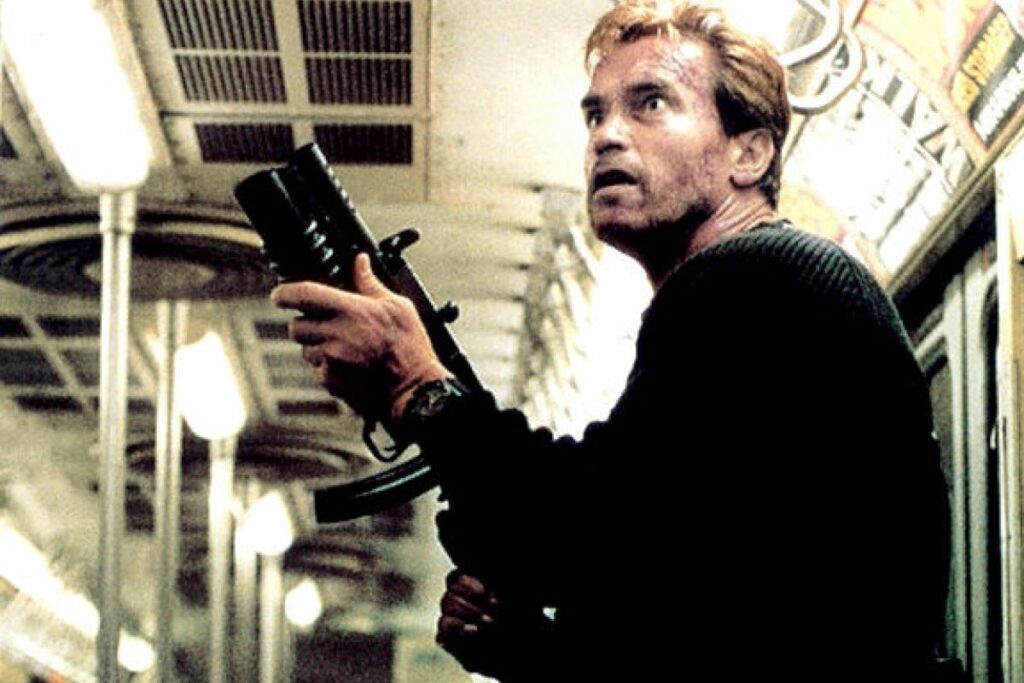
On the 1999 set of End of Days, directed by Peter Hyams, Miriam Margolyes recalls an offensive on-set incident with co-star Arnold Schwarzenegger while she was playing the sister of Satan. In a 2022 appearance on the podcast I’ve Got News For You, she called him rude and full of himself, as the film disappointed despite roughly $211 million on a $100 million budget.
On the apocalyptic set of End of Days in 1999, the real fireworks, Miriam Margolyes says, erupted off camera. In a 2022 podcast interview, she recalls an offensive moment with Arnold Schwarzenegger that left her embarrassed and unimpressed. Her account lands like a time capsule from the height of his blockbuster reign, just as the musclebound archetype was giving way to slicker, quippier action leads. What lingers is a sharp portrait of on-set power and the uneasy aftertaste of a genre in transition.
An uncomfortable memory from the 90s
Some stories stick because they complicate the myths we grew up with. That is the case with Miriam Margolyes, who recently revisited a sour memory from the set of End of Days. On the podcast I’ve Got News For You in 2022, she recalled a moment with Arnold Schwarzenegger that left her unimpressed, and, by her account, disrespected. The anecdote resurfaced an old tension about star power and set behavior.
Arnold Schwarzenegger and the action star era
By the late 90s, Schwarzenegger’s reign was well established, built on touchstones like Predator, The Terminator, and True Lies. But End of Days, released in the US on November 24, 1999 by Universal Pictures, landed in a shifting moment for the genre. Directed by Peter Hyams, the supernatural thriller paired him with Gabriel Byrne and Robin Tunney in a New York-set battle against impending apocalypse.
Miriam Margolyes’ revealing account
Margolyes, who played a satanic figure in a pivotal sequence, described what she considered rude and self-centered behavior from Schwarzenegger during a break on set. She has said he deliberately passed gas in her face while she was pinned for a stunt, an action she found degrading and unprofessional. Her blunt retelling, which she has repeated in interviews, sparked fresh debate about boundaries on set and how they are enforced.
The late-90s pivot in action
Audiences were already gravitating toward a different kind of action hero. For example, Keanu Reeves in Speed and The Matrix, Tom Cruise in Mission: Impossible, and Will Smith in Men in Black brought agility, irony, and a lighter physical profile. End of Days earned around $211 million worldwide on a reported $100 million budget, a result that looked decent on paper yet felt muted for a star of Schwarzenegger’s stature. According to this shift, bulk and bluster were giving way to versatility and wit.
A complex legacy in Hollywood
Margolyes’ story endures because it adds a human wrinkle to a blockbuster era defined by spectacle. Indeed, the film sits at a crossroads: a throwback vehicle for a titanic star, and a marker of where the genre would soon head. Schwarzenegger remains a pop-culture fixture, but her account invites a closer look at how respect, power, and craft coexist when the cameras stop rolling.