
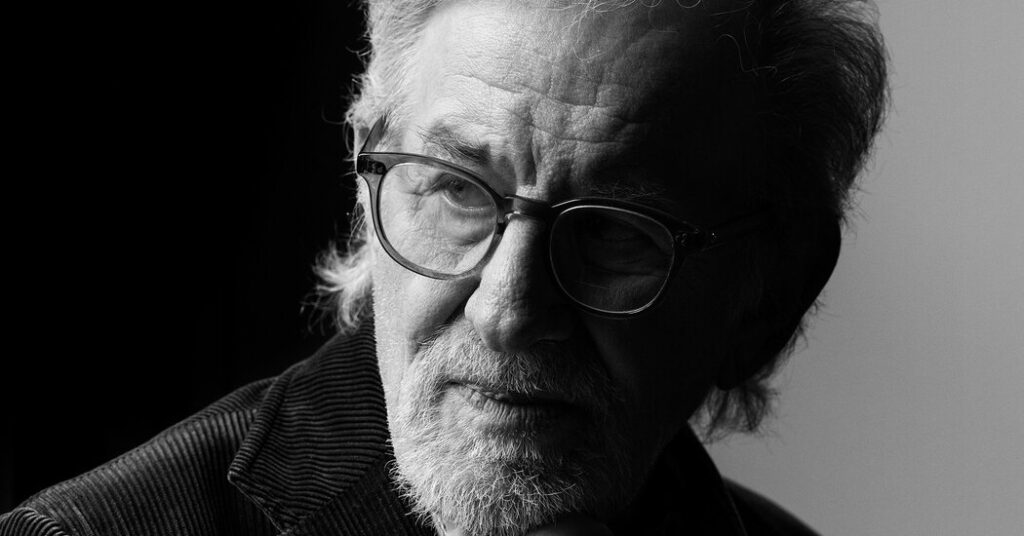
Spielberg’s stardom arose from the collision of capitalism, audacity and creative vision. His movies emerged alongside the arrival of cable television and proliferating advances in personal computing and home entertainment. I watched “E.T.” at the movies, devoured it on cable, played it on my Atari and let Michael Jackson sing me a lullaby the movie inspired him to write. (Spielberg: so titanic that the other king of pop worshiped his thrillers.)
But a kind of cultural malnourishment has set in. While you once needed a pair of hands to count the major studios, we’re on the verge of barely needing one. And the best, most lucrative ideas entail microwaved nostalgia that we all know by its legal nickname: I.P. The takeovers and reheating, the obscure metrics that ensure we never quite know exactly how popular anything is, it’s dispiriting: Pac-Man eating ghosts, algorithms keeping secrets.
When movies play in only a handful of theaters to qualify for awards, and increasingly millions of us watch them on our phones, “that is not my definition of a motion-picture experience,” Spielberg told me. For that, he said, you need “an audience to be the accelerant of that experience, to be the contagion of making the experience even more profound for the individual in that crowded theater — or what we hope is a crowded theater.” Obviously, streaming changes that experience, denying us the companionship of hundreds of strangers either confirming or causing us to question our humor, our tastes, our responses.
This is to say that what Steven Spielberg symbolizes, what he built in Hollywood and in our hearts, could be reaching its twilight. He is touched by our appreciation for all that he has come to mean to us. At that “Oh, Mary!” cast party, a stocky, ebullient woman approached and asked if she could show Spielberg the “Jaws” tattoo beautifying her calf. Of course she could. And even though Spielberg estimates that he has seen 30 of these since “Jaws” came out in 1975 (plus dozens of other tattoos inspired by his movies), he listened and marveled as though hers was his very first. Earlier, on the corner of 45th Street and Eighth Avenue, a young, fit guy with a blond ponytail sitting on a construction barrier looked up and said, with biblical concision, “Thank you.”
It was a “thank you” that contained so much. As I interpreted it, thank you for your vision, your imagination, your ingenuity, acuity, spirit and nerve. Thank you for “All my life I had to fight” and “You’re gonna need a bigger boat,” for every single caftan you let wear Meryl Streep in “The Post.” Thank you for more than 50 years of unflagging energy and unshakable belief that we human beings are worth the trouble. But the gratitude was tinged with sorrow. “Thank you” for daring and caring and trying to show us the light, to keep the lights on, as the artistic system you worshiped and symbolized and helped redefine renounces itself.