
As the ex-Yorks made preparations to leave their home in Windsor Great Park, in December 2025, Voosh, the company of Sarah Ferguson’s former boyfriend Manuel Fernandez, for which she had acted as a brand ambassador, went into administration; records showed Fernandez owed the company £324,609. Despite raising £9 million from investors, including £1 million from British taxpayers through research and development tax credits, the company had never launched a long-promised app that Fernandez said would offer customers the ‘power to find, plan, share, live and remember the things you love to do’.

Its linked charity, on whose board Sarah sat, and which purported to help ‘relieve poverty’ and ‘promote good health and education in disadvantaged areas throughout the world’, had spent nothing. The Charity Commission now closed it, concluding that it had never conducted any charitable work.
Further stories emerged about how Sarah Ferguson had used charity work not only to launder her reputation and promote her social life but to subsidise her lifestyle. Homayra Sellier, long involved in child protection, had invited Sarah to be a patron of a dinner raising money for sexually abused children two hours from the ski resort where Sarah part-owned a chalet. Sarah’s requirements to attend included ‘two luxurious suites in a fivestar hotel, a chauff eur to whisk her back and forth from Verbier, and a business-class ticket from Boston to a location I can’t quite recall’.
The total bill came to 10,000 Swiss francs, a large sum for a non-profit organisation and one Sellier felt obliged to pay herself: ‘What stung the most was [Sarah’s] insistence on the plane ticket, despite being two hours away, and having a driver sent to pick her up, especially knowing that we were fundraising for a noble cause.’
In February 2026, Sarah would close her charity Sarah’s Trust ‘for the foreseeable future’ because of the embarrassment of the Epstein releases. In a statement a spokesman for the charity said it remained proud of the work the trust had done over recent years, having partnered with over sixty other charities in over twenty countries, providing education, healthcare, crisis response and environmental projects. It said it had delivered over 150,000 aid parcels during the Covid pandemic, provided medical aid and training for those affected by the war in Ukraine and delivered education for over two hundred children in Ghana.
In reality there had been complaints to the Charity Commission. In November 2020, after Ferguson had launched her ‘Brew for the Crew’ tea collection – teabags and ‘Duchess’branded biscuits – she’d committed to giving all profits to Sarah’s Trust to help protect the wellbeing of frontline workers in their fight against the spread of Covid. But each packet was branded with corporate entity logos for the charity and also for her commercial enterprises Duchess Collection, Little Red and Ginger & Moss.
The charity’s financial statements were unaudited, the transactions behind it unclear – Sarah Ferguson has a history of inter-company loans that do not include formal documentation, repayment terms or arm’s-length interest rates, notably seen with Gate Ventures.
The accounts to 31 May 2020 showed a loan of £50,000 without saying where it came from. Did Sarah’s Trust purchase Brew for the Crew tea collections at cost from her company Ginger & Moss and retain the profit? Did Ginger & Moss sell the tea collection at charitable events and donate the profits to Sarah’s Trust? Were any gifts that were expensed in 2023, 2024 and 2025 purchased from a related party entity? Are these questions, perhaps, for the Charity Commission?
In November 2025 it emerged that Andrew had arranged a private tour of Buckingham Palace in June 2019 for Jay Bloom and Michael Evers, who ran a crypto-currency mining firm called Pegasus. It had promised Sarah Ferguson £1.4 million as a brand ambassador to use thousands of solar power generators to mine Bitcoin at a remote site in the Arizona desert. Her contract stipulated she required first-class travel, five-star hotels and the services of a professional hairdresser and make-up artist for the maximum of four ‘networking events’ she would attend on the company’s behalf; she had, indeed, appeared at Pegasus’s energy project launch in the Arizona desert, arriving in a blackand-gold helicopter and posing with a gold-coloured spade and construction hat alongside armed guards holding AR-15 rifles and pistols.
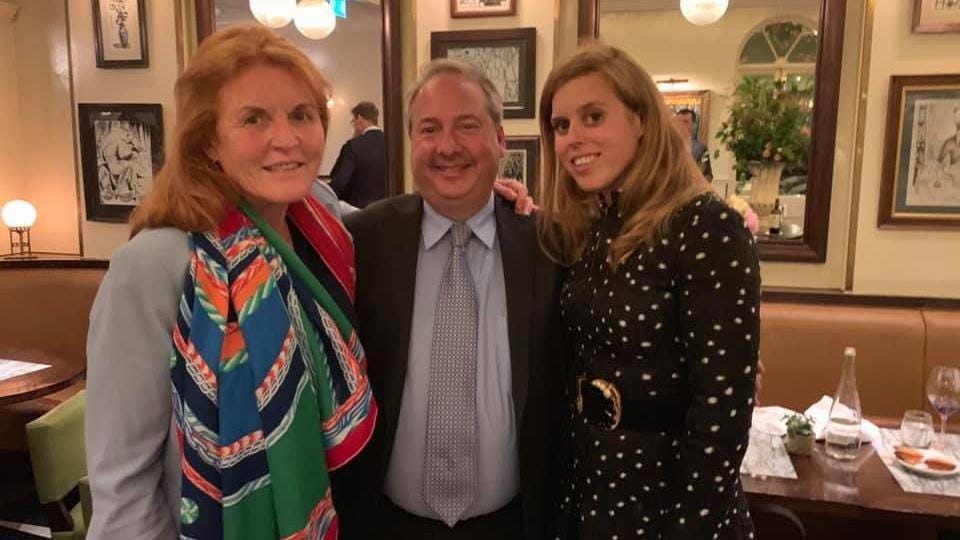
Bloom was later entertained at Buckingham Palace, St James’s Palace and Royal Lodge, joined by Beatrice as well as her parents, visits he promoted on his social media. Of the planned 16,000 generators, only 615 were acquired and only $33,779 in cryptocurrency was mined; some investors took legal action in April 2021, claiming millions of dollars of investor funds were unaccounted for. A tribunal later awarded them $4.1 million.
 Jay Bloom had several dinners with Sarah Ferguson and Princess Beatrice
For reasons that remain unexplained, the contract itself was with Alphabet Capital, a British company whose owner, Adrian Gleave, had paid Andrew, Sarah and Eugenie over £1 million in December 2019. These payments came to light during the Selman Turk High Court case, months after Gleave had resigned as a director of SVS Securities, a company that had been ordered to cease trading by the financial regulator over pension mis-selling allegations. Gleave had also run a series of caravan parks, ten of which have gone into administration.
Mr Bloom claimed never to have heard of Alphabet or Adrian Gleave; he said there was no connection with Pegasus. Neither Andrew nor Sarah Ferguson responded to a detailed list of questions from the BBC about their involvement with Mr Bloom, including whether Sarah planned to repay money received for her Pegasus work to the company’s investors.
In 2009, Sarah had also tried to go into business with Epstein, with the financier taking a 51 per cent stake in Mothers’ Army, a company and personal brand that aimed to ‘help amplify the voices of mothers all over the world to tackle some of the tougher issues facing young people and families’. It was a brand, Epstein said, that stood for ‘integrity, consciousness, morals, etc’. Under the plan she was to receive a $250,000 salary but the arrangement collapsed after he requested she sign a letter of support for him.
Among the fourth tranche of Epstein material made public in December 2025 were images of Jeffrey Epstein looking dishevelled after a ‘possible suicide attempt’ in 2019 – eighteen days before his death. One of the harrowing pictures showed him tired, looking straight at the camera while wearing what appears to be a blue prison vest. Another captured him lying on his back with his eyes closed – he looked as if he had been crying.
Increasingly the verdict of suicide for Epstein’s death has been challenged. A man once held in a similar cell at the Metropolitan Correctional Center, former mob boss Michael Franzese, has argued: ‘There’s no way to hang yourself. There’s nothing from the ceiling, there’s nothing from the bed. You’d have to be a midget and work really hard to try to hang yourself, and I don’t think you can accomplish it at that point.’