
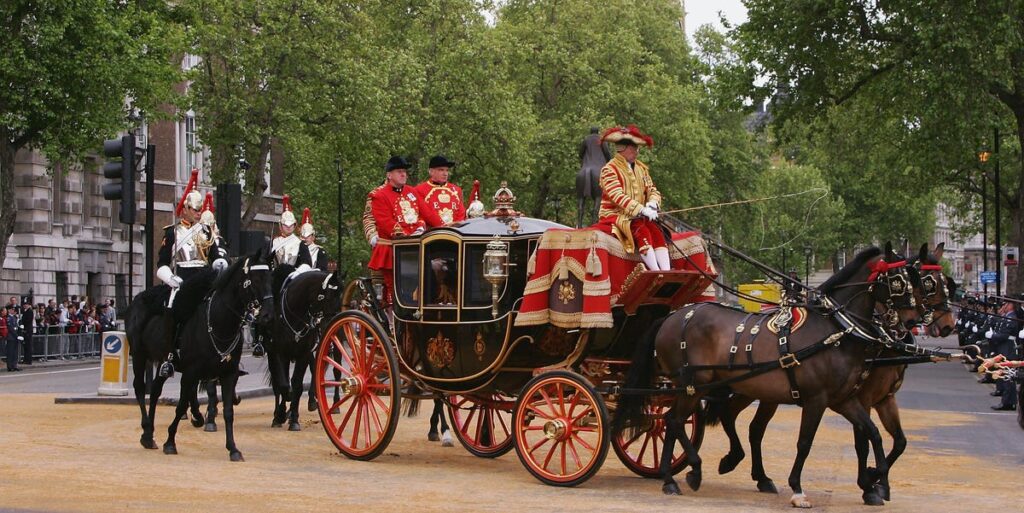
King Charles III will once again eschew tradition at this year’s Trooping the Colour by riding in a carriage rather than on horseback—as he has done in the past. This marks the third time Charles has not ridden on horseback for the annual event, which dates to 1748 and is meant to celebrate the official birthday of the British sovereign. (King Charles’s actual birthday is November 14.) The 2026 Trooping the Colour will take place on Saturday, June 13.
Traditionally, the reigning monarch leads the procession from Buckingham Palace to Horse Guards Parade on horseback. In fact, according to a June 2025 report from The Times, it’s likely the public won’t see Charles ride horseback during the ceremonial procession again.
Although the 76-year-old monarch is an accomplished equestrian and rode for years in the parade (for his mother’s celebrations and then his own), his ongoing cancer treatment prompted a return to the carriage alongside Queen Camilla last year—an adjustment to protocol that will continue this year. It’s a decision made with the King’s comfort and safety in mind as he continues weekly treatments following a cancer diagnosis in early 2024. (Charles’s mother similarly stopped riding horseback during the parade in 1986, after her horse Burmere retired.) The couple will instead be riding in the Scottish State Coach, which has a long and storied history within the British royal household.
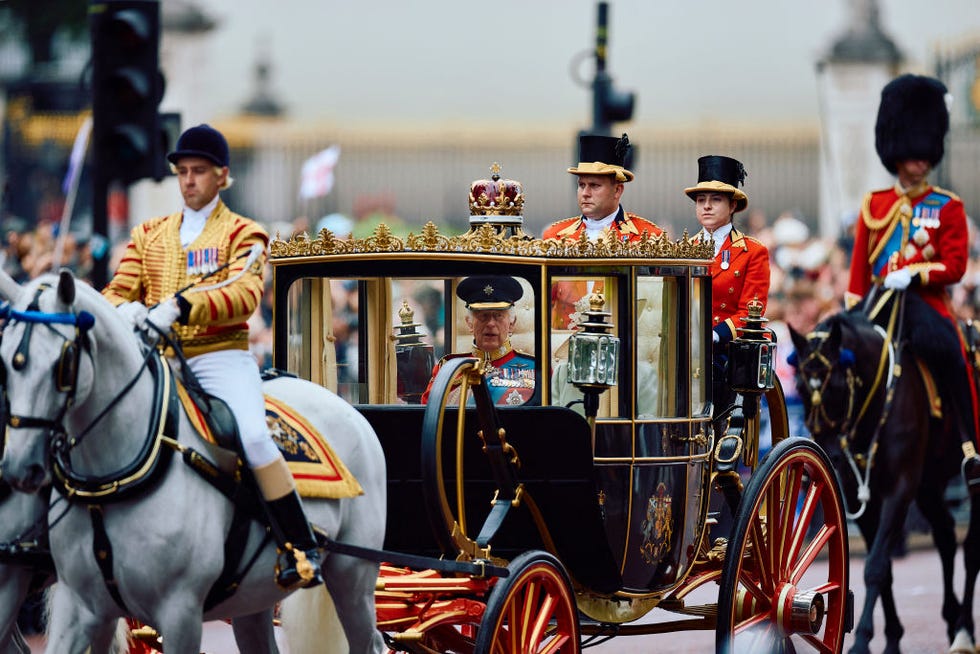 Benjamin Cremel//Getty Images
King Charles III inside the Scottish State Coach for last year’s Trooping the Colour.
Originally commissioned in 1830 by Prince Adolphus, the Duke of Cambridge—brother to King William IV and grandfather to the future Queen Mary—the coach was first designed as an enclosed glass ‘town’ coach, according to the Royal Household. At the time, it was known as the Cambridge Coach. It remained in the Duke’s family for several years before being sold to William Keppel, 7th Earl of Albemarle, who converted it into a semi-state landau, a roofless carriage with front and rear seats facing each other. In 1920, the coach was given to the Royal Family for Queen Mary.
Nearly five decades later, in 1968–69, the Scottish State Coach underwent another extensive restoration to return it to its original enclosed form. The new design includes large glass windows and a unique transparent roof, allowing onlookers an unusually clear view inside and flooding the interior with natural light.
Unlike other royal carriages, which bear the Royal Arms of England and the insignia of the Order of the Garter, the Scottish State Coach is emblazoned with the Royal Arms of Scotland and the insignia of the Order of the Thistle—a nod to its heritage.
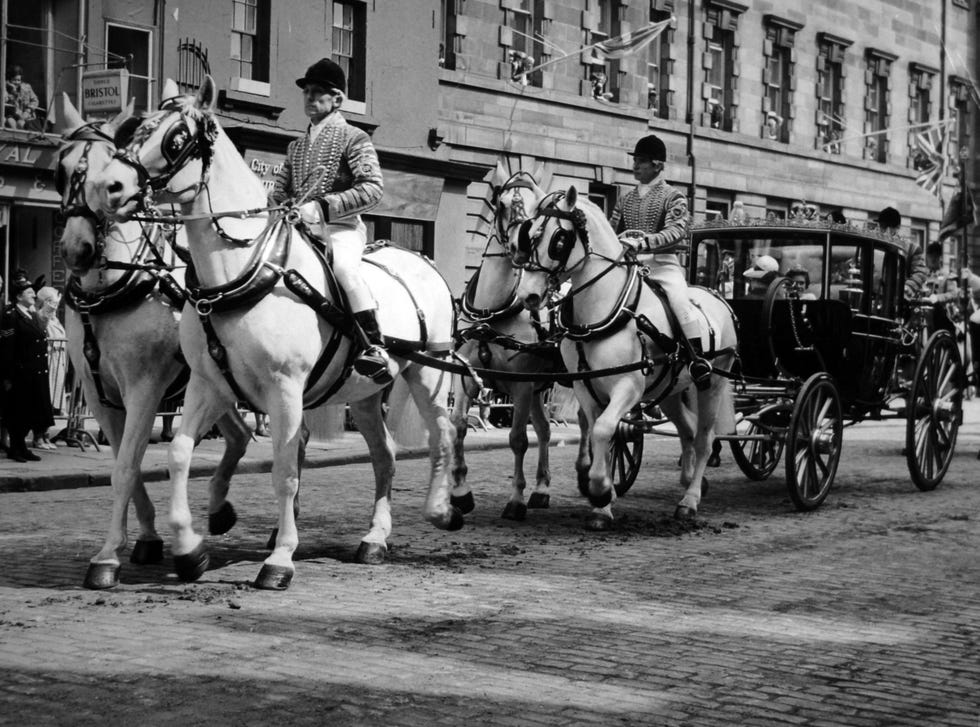
PA Images//Getty Images
Queen Elizabeth II debuted the updated carriage during the opening of the General Assembly of the Church of Scotland in Edinburgh on May 20, 1969. More recently, the coach appeared in 2016 during the Queen’s 90th birthday celebrations at the Windsor Horse Show. Coachman Natalie Ozanne called it “a big favourite,” the royal website reported, noting that “it has a glass ceiling, so crowds higher up, people positioned higher up—which there will be a lot of in Windsor—can see in.”
It’s also distinct from the open-top Ascot Landau carriages that you can expect to see other members of the royal family riding in on Saturday. Most notably, it was used by Prince William and Kate Middleton when the newly married couple rode through the streets of London to Buckingham Palace following their 2011 wedding.
During its Windsor appearance, the carriage was pulled by four Windsor Grey horses, with two additional horses serving as outriders. The Windsor Greys have long played a ceremonial role in royal events, dating back to the reign of Queen Victoria.

Rachel Silva is a freelance writer and editor covering design, architecture, and culture. She previously served as an editor at ELLE Decor, and her work has appeared in Harper’s Bazaar, TIME, and Veranda, among others. A graduate of Columbia Journalism School, she is based in New York City.