
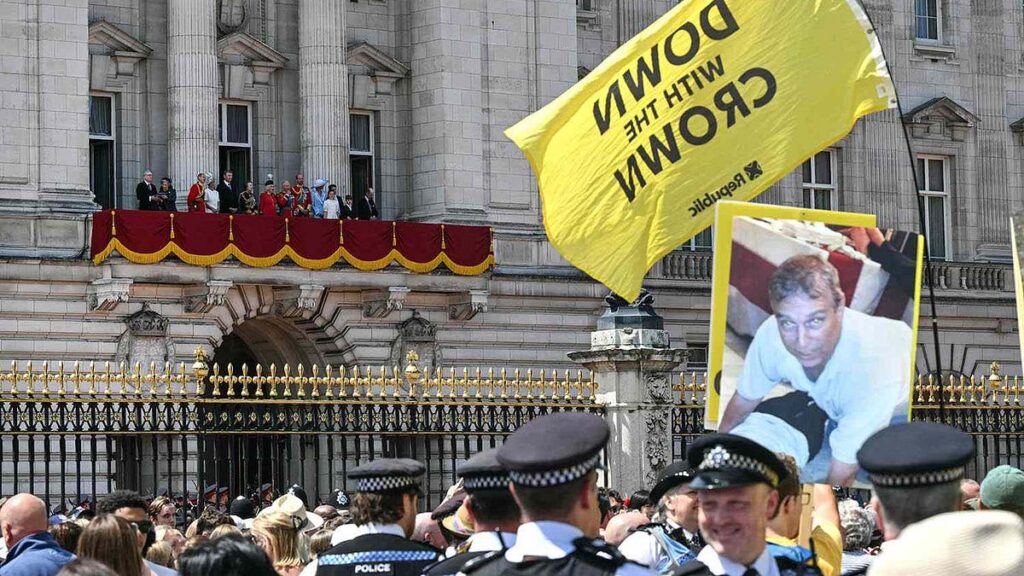
The most striking thing about this year’s Trooping the Colour was how little I have found to say about it.
I simply mean that as an observation, not a complaint. On Saturday, King Charles III rode down London’s Mall in the Ascot Landau, reviewed roughly a thousand guardsmen of the Grenadier, Scots, Irish, and Coldstream Guards, and watched the Grenadiers troop their King’s Colour—the one he had presented to the regiment days earlier at Buckingham Palace.

Prince William, Princess Anne, and Prince Edward rode behind on horseback. Queen Camilla wore the red Grenadier uniform dress of her colonelcy. Catherine, Princess of Wales, followed in an open-air carriage with her three children.

Then, the balcony filled; the anthem played; the flypast came and went. It was, down to nearly every detail, exactly what the event was supposed to be.
That, for many contemporary watchers, is new. For most of the last decade, Trooping has been a barometer of institutional drama. We read it for who was missing, for who jostled for a prime place, for the body language between people who were painted in the press as a tight-knit crew.
This year, there was none of that. And the absence of all that noise is, I think, the real angle here.
Thank you for reading this special edition of The Fascinator! This one is free; paid subscribers get these reads and spicier Friday editions (including last week’s analysis of non-working royals and rent-free accommodation) delivered straight to their inboxes.
To understand why Trooping the Colour 2026 felt so subdued, it helps to crunch the numbers.
Fourteen members of the royal family appeared on the balcony this year. Back in 2018 (the year that Meghan, Duchess of Sussex, made her Trooping debut) numerous outlets ran “who’s who” explainers, helpfully cataloging over forty.

The contraction in eight years is the visible result of three separate institutional departures, each of which once generated its own news cycle. It is also, we are told, intentional.
Harry and Meghan exited the monarchy in 2020 (and took half the tabloid economy with them). Andrew, stripped of his military roles, has not stood on that balcony since 2019. But with him now contending with an arrest and a live police inquiry, it would just feel silly to play the “will he or won’t he?” game with regard to his place in the lineup.
And if the late Queen began sketching a slimmed-down monarchy before her death in 2022, King Charles has pursued it with more prominent conviction. In 2026, his whittling has done precisely what it was designed to do: produce a smaller, tighter, less combustible royal family.

This is the monarchy Charles said he wanted.
For a few Troopings now, we’ve seen the visual evidence that he’s got it. Now that the media ecosystem seems to have caught its breath and the monarchical pecking order has been firmly established, things finally feel settled. (We are still, however, earnestly trying for clicks with “Who’s who?” articles. . . to help identify fourteen people).
Here is the question I keep turning over, and I promise it is not a cynical one, though I recognize that it can be made to sound that way. For this monarchy, in this era, is “settled” enough?
A monarchy with no drama is also a monarchy with fewer reasons to tune in. The engagement of the last fifteen years (the wall-to-wall coverage, the body language experts, the documentaries, the taking of sides, the think-pieces, the genuine constitutional debates) was substantially powered by conflict. Remove the conflict, and you are left with pomp pageantry. . . which is beautiful and historically rich and, still, for a great many people, not quite enough to clear the calendar for.
I would gently point out that the people who show up to an event like Trooping, most determined to engage with the monarchy, are either die-hard fans or protesters.

The anti-monarchy organization Republic timed its demonstration to the day’s biggest moment, unfurled umbrellas that spelled out “Stop The Reign,” and chanted “Not my King” and “Not my Queen” as the carriages passed. You can find that distasteful—as many in the crowd did, answering with “God Save the King” and applause for the Princess of Wales and her children. But you cannot call it indifferent. The protesters care enormously about the monarchy. They have built an organization around caring.
The thing that should actually worry the Palace is not the people holding the signs and shouting. It is the people who have stopped watching altogether. Those who once tuned in for the soap opera and now find the cast too small, the children too grown, the dynamics too resolved to bother with.
The day’s fashion told a version of the same story.
Kate wore a baby-blue Catherine Walker coat dress with sharp white piping, severe shoulders, a dramatic Philip Treacy hat built around an oversized bow, the Irish Guards brooch of her honorary colonelcy, and Cassandra Goad earrings she first wore to Prince Louis’s christening. The widely circulated reading was another Diana tribute; the silhouette echoed a pale-blue Catherine Walker coat dress Diana wore in 1987.

This is decidedly not the Kate of 2012, all hazy borders in a powder-blue dress and fascinator, or even the Kate of 2017, whose bubblegum pink was, at the time, the boldest color she had ever risked at Trooping:

I think Catherine’s sartorial shift is, on balance, a good thing. There was always something slightly off about dressing a royal bride in her early thirties to match the registers of women three and five decades her senior. What Kate has built instead is a visual identity that no one else in the current, very short lineup occupies. It says, more or less, I wasn’t born into this role, but I take it seriously.
It reads differently from Camilla’s approach, which on a day like Saturday is regimental in the most literal sense: a near-accurate uniform-inspired dress, the cap badge, the beret with its outlandish plume. Her Granadier Guards brooch is a nod to the late Queen, who was appointed Colonel of the same regiment on her 16th birthday in 1942. But it is also a reminder that this institution not only appoints those who have never served in the armed forces to honorary military commands, but has also given such postings to children.

With their sartorial choices this year, both Camilla and Catherine are signaling belonging to an institution that is, at root, military and ceremonial. They simply now approach it from opposite ends of the spectrum: one through literal costume and one through interpretation.
We’re constantly told that Kate is more comfortable in her own skin after her cancer treatment, and that she’s carving out her own place in the institution anew. In her wardrobe, this has manifested as structured, deliberate, almost armored silhouettes.
Her coats and pantsuits no longer invite sympathy or self-insert princess fantasies. Instead, they anchor the royal body inside an unyielding frame. I’m not sure that’s the direction that the monarchy of old would have ever chosen for Kate.

The extreme irony here is that the official narrative tells us that Kate is freer, softer, more herself after treatment. But her wardrobe moves the opposite way. Comfort typically manifests as a visual loosening; Catherine’s answer has been to fortify.
The harder question here, which I’m sure someone will tell me is anti-girlboss, is whether seriousness is the lesson the monarchy should be drawing at all. People like the princessy touches. The fairy-tale register is, for a great many of the people who still care, the entire appeal. A crown that responds to modern criticism by becoming more austere, more businesslike, may be solving for the wrong audience. I don’t know that we can win over any new hearts and minds in 2026, ya know?
You could see the austerity again tipping too far in one direction on the balcony itself, where the ninety-year-old Prince Edward, Duke of Kent, stood somewhat apart from the rest of the family, at various points taking photos of the crowd or looking down at his phone rather than engaging.

Now, the Duke did come out to the balcony through a side door, and the family simply didn’t fill in the space around him. It is the kind of thing that means nothing in the moment and ends up dominating the day’s press coverage. Sort of like reaching out to children of color through a chain-link fence or riding in an open-topped Land Rover in full ceremonial day dress during a Commonwealth Tour.
But this lonely figure points to a larger pattern: the monarchy is beginning to look and feel isolated for the people inside it. It is smaller, more exclusive, and not especially warm.
On the same day as Trooping, the King and his immediate relatives were absent from the funeral of Lady Pamela Hicks, the last living link to a particular vanished world of the royal household:
The family was not officially unrepresented: Lady Helen Taylor, daughter of the late Queen’s cousin, the Duke of Kent, stood in for the Edinburghs and her father. And the King was represented by the Duke of Abercorn, a first cousin of Diana’s father.
The image of the monarchy as a family—relatable, domestic, lovable—is not ancient. It is largely a Victorian invention, deliberately built by Victoria and Albert around their own crowded nursery to show the public that the dissolute ways of the Georgian court were over.
 A still from the infamous documentary ‘Royal Family,’ which aired just once: on the BBC on June 21, 1969.
That brand has been reinforced throughout the twentieth century by the Christmas broadcasts, familial interviews, and peeks behind the curtain at archival footage. And if you disregard, as many monarchists try to do, the appeal of royals as “celebrities” or glamorous tabloid fodder, this family-oriented construction is the main source of the affection the institution has traded on for a hundred and fifty years.
A monarchy that slims itself down to just fourteen people standing kinda close to one another on a balcony may be more sustainable and more scandal-resistant (both real benefits!), but it also risks dismantling the very thing that made ordinary people feel they had a stake in the whole affair.
I think Charles got the Trooping he wanted, and I think that is genuinely an achievement: a calm, dignified, well-run day, free of the feuds and absences that turned the last decade of these parades into something closer to a serialized drama than a stately tradition. After years of crisis, calm is not nothing.

But a settled monarchy now faces a problem it has not had to think about in a long time. For fifteen years, the institution survived by being impossible to ignore. The work that lies ahead is to make stability sexy compelling, and to give people a reason to keep watching a family that has, by design, made itself harder to gossip about.
The protesters have already decided the monarchy is worth their Saturday. Will everyone else?
That, not Republic, is the biggest looming threat. The crown can survive being argued about. I am less sure it can survive being unwatched.