

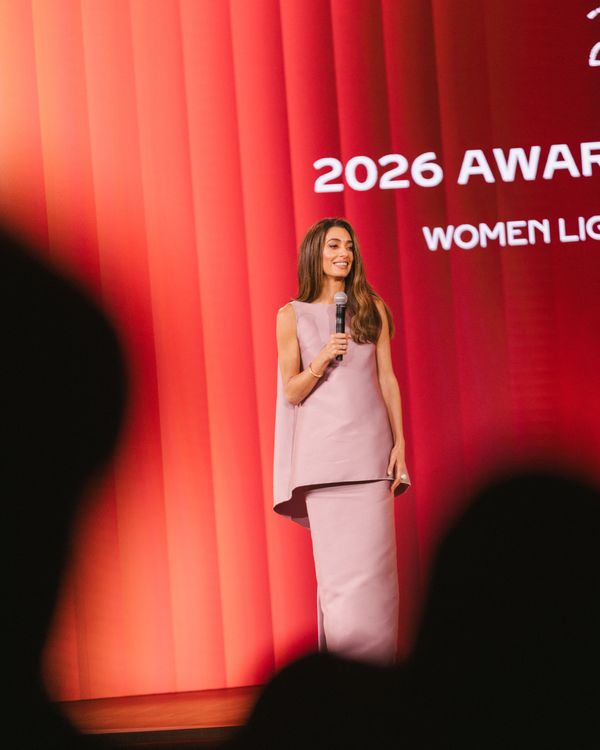
Photo: © Victor Picon and © Cartier
“We’re here to celebrate this year’s 30 Cartier Women’s Initiative fellows,” said Amal Clooney onstage in Bangkok, as the brand brought together “a formidable group of women entrepreneurs driving change.” Now in its 20th year, the event’s honorees included Keely Cat-Wells, whose U.S.-based company, Making Space, trains and hires disabled individuals; Mylène Fifamè, whose company, Irawo, supports Africa’s workforce by trying to close skill gaps; and Monika Shukla, whose company, Humble Bee, empowers rural women in India through beekeeping. After the ceremony wrapped, Clooney talked about their work, what inspires her, and how to find the antidote to hopelessness.
Which Cartier Women’s Initiative fellows would you highlight, and why?
It’s hard to choose — every fellow I’ve met in the last few years is a force in her own right and has taught me something. I remember the founder behind the “Uber ambulance,” Caitlin Dolkart, who was concerned that 95 percent of Africa lives without an effective emergency service and was able to cut emergency-response times across Kenya from hours down to just 16 minutes. I have enjoyed following the progress of Mariam Torosyan, who built Safe YOU, which uses technology to help survivors of violence gather evidence and reach support. I have loved hearing from fellows from small countries like Benin and Nepal, to understand their journey. And it’s been fascinating to see how many of the fellows this year are putting AI to noble use: screening retinas to catch disease before it causes blindness, building diagnostic tests designed for women, and giving parents trustworthy pediatric guidance around the clock.
Why was it important for you to get involved with the Cartier Women’s Initiative?
I believe we need women’s talent to solve every challenge we face — from building responsible AI to countering violence and disease to advancing opportunities for women and girls. It’s shocking that even in places like the U.K., Japan, Korea, and the U.S., women make up less than 10 percent of brain surgeons. Wouldn’t you want the best talent pool to be available for your brain surgery? The U.S., Spain, and the Netherlands have never had a woman lead their country. And reports suggest that women’s full economic participation would add $12 trillion to the global economy.
Yet, at the current rate, gender equality is still more than a hundred years away. And only about 2 percent of charitable giving in the United States goes to organizations focused on advancing equal opportunities for women and girls. So any initiative that helps to unlock talent and unleash women’s ability to participate in the workforce is one that I
support. And this one is particularly impressive. They have now spent more than $14 million funding women entrepreneurs, and their program is holistic — from funding to mentorship, training at INSEAD, and great networking opportunities. And each year, I am so impressed with the impact these women are already having in their communities.
You’ve said you cannot prevent evil, but you can combat apathy. What would you say to a woman who feels hopeless?
It’s interesting. I am a visiting professor at Oxford. I was there last week with my students, and this week I’ve been in Thailand with these young entrepreneurs. I do feel there is a sense of pessimism and hopelessness for many. I can feel the weight that they are carrying on their shoulders when they describe the conditions they face in their countries. I can feel their sense of hopelessness from simply reading the news. I remind them that history doesn’t move in a straight line; that things will change. That we are all privileged to be able to play a part in bending the arc
toward justice. And that they are not alone — they are part of a community of people who care, and who are trying to make a difference.
Beyond the grant money, what can the Initiative really do for a fellow?
A lot of the fellows have talked about access — that the fellowship gives them access not only to capital and new skills but to people and conversations that they would not otherwise have. In my own work, the secret of scaling impact has been through powerful collaborations — with partners like Melinda French Gates and Michelle Obama, with Microsoft’s AI for Good Lab, and with law firms giving tens of thousands of pro bono hours. So I am excited for these young women, some of whom are coming from small countries, that their exposure and networks can grow. When they surveyed the fellows in recent years at the completion of their fellowship, 97 percent reported increased self-confidence, and 100 percent felt a sense of belonging to a global community. Similarly, at the Clooney Foundation for Justice, many of our legal fellows say that the fellowship has boosted their self-confidence and made them feel like they are part of a community so that “anything is possible.” And that is my favorite thing to hear.
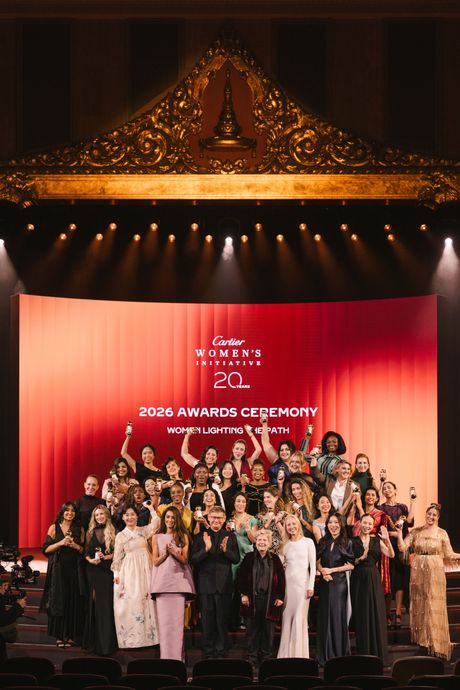

From left: Photo: © Victor Picon and © CartierPhoto: © Victor Picon and © Cartier
From top: Photo: © Victor Picon and © CartierPhoto: © Victor Picon and © Cartier
As a professor at Oxford, what advice do you give your students entering the law?
My advice is not to have a ten-year plan, but to follow the work they are most passionate about. And remember that the only real failure is not trying: If you go for something and don’t get it, you’ve lost nothing. But if you never try, you’ll spend your life wondering what could have been, and that’s corrosive. I want my students to be bold and to move from a frame of mind where they think, Why would they pick me? to Why not me? And just go for it.
Stay in touch.
The latest in style, self, culture, and power in your inbox.
Vox Media, LLC Terms and Privacy Notice