
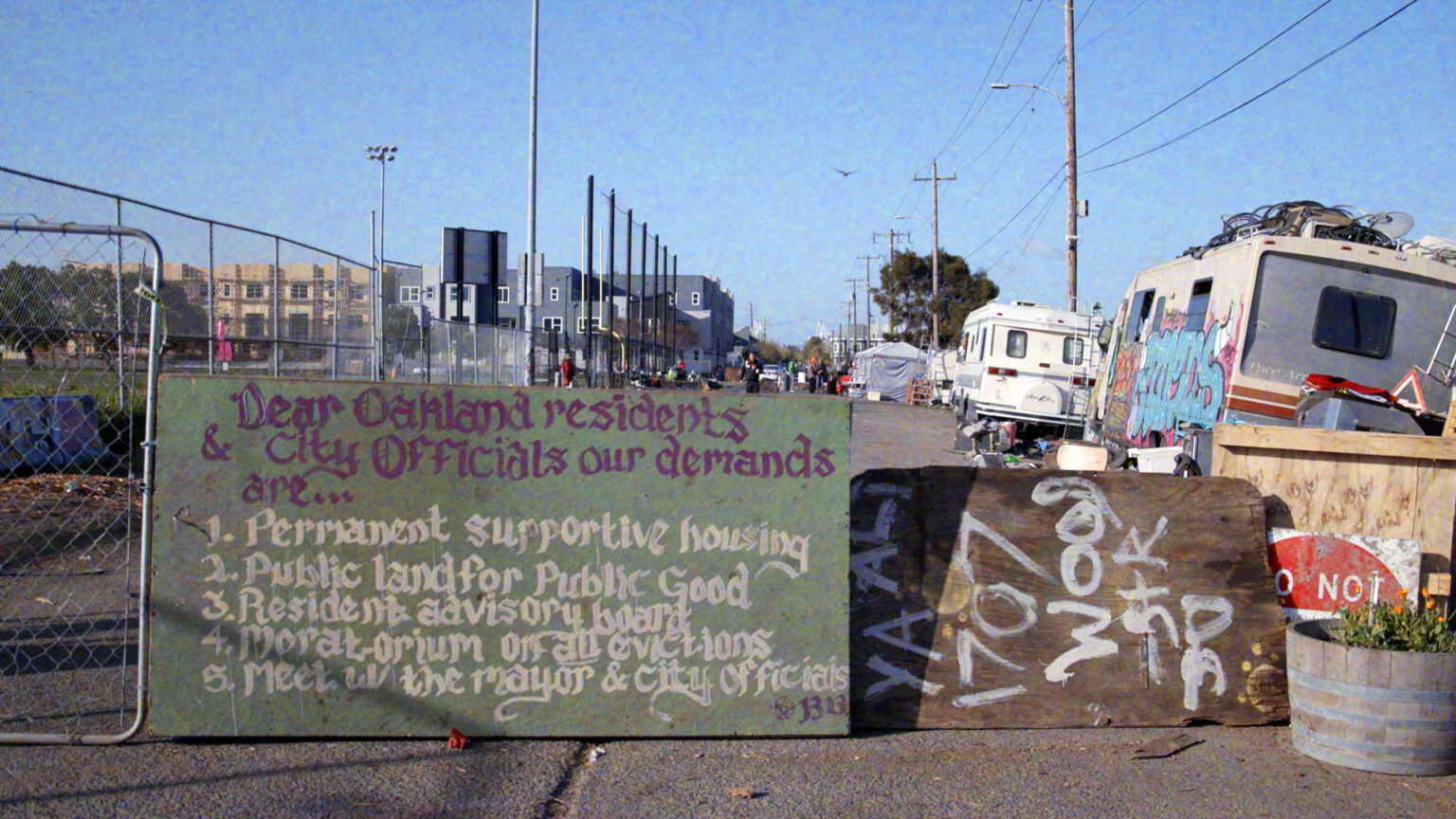
At its peak a few years ago, some 200 or 300 people lived along Wood Street, at the western edge of Oakland. They slept in RVs, trailers, and sheds they built by hand.
These days, that stretch of the city is largely barren. A six-story apartment building for low-income renters rose on a small piece of it. Part of the street is now a parking lot used by fans attending baseball games at the Oakland Ballers’ field across the street.
Where did all the people go? In a series of encampment sweeps that culminated in a massive April 2023 operation, the city and state moved the hundreds of people off the land. Some residents accepted offers to relocate into a temporary tiny-house homeless shelter nearby. Some of them still live in scattered RVs nearby.
The sprawling homeless camp’s closure, and the increasingly tense months leading up to it, are captured in “Wood Street,” the debut feature documentary from Oakland filmmaker Caron Creighton. It screens in Oakland for the first time on July 14 at the New Parkway Theater.
The turbulent story is told largely through John Janosko and LaMonté Ford, two longtime Wood Street residents-cum-community-organizers. Throughout the film, we see them facilitate meetings among their incensed and tight-knit community at the encampment, confront city leaders and pissed-off housed neighbors, navigate interpersonal relationships as the eviction looms, and deal with addiction.
It’s an immediate and visceral film. We see Wood Street through its homeless residents’ lenses — often literally, through Janosko’s own Instagram videos. He’s posted some 8,000 videos and photos of his Wood Street world.
“We were documenting how we were surviving, but we turned our survival, in our heads, into this reality TV show,” said Janosko, who grew up in Oakland and was homeless for about 12 years. Some of those “episodes” are woven strategically throughout Creighton’s documentary.
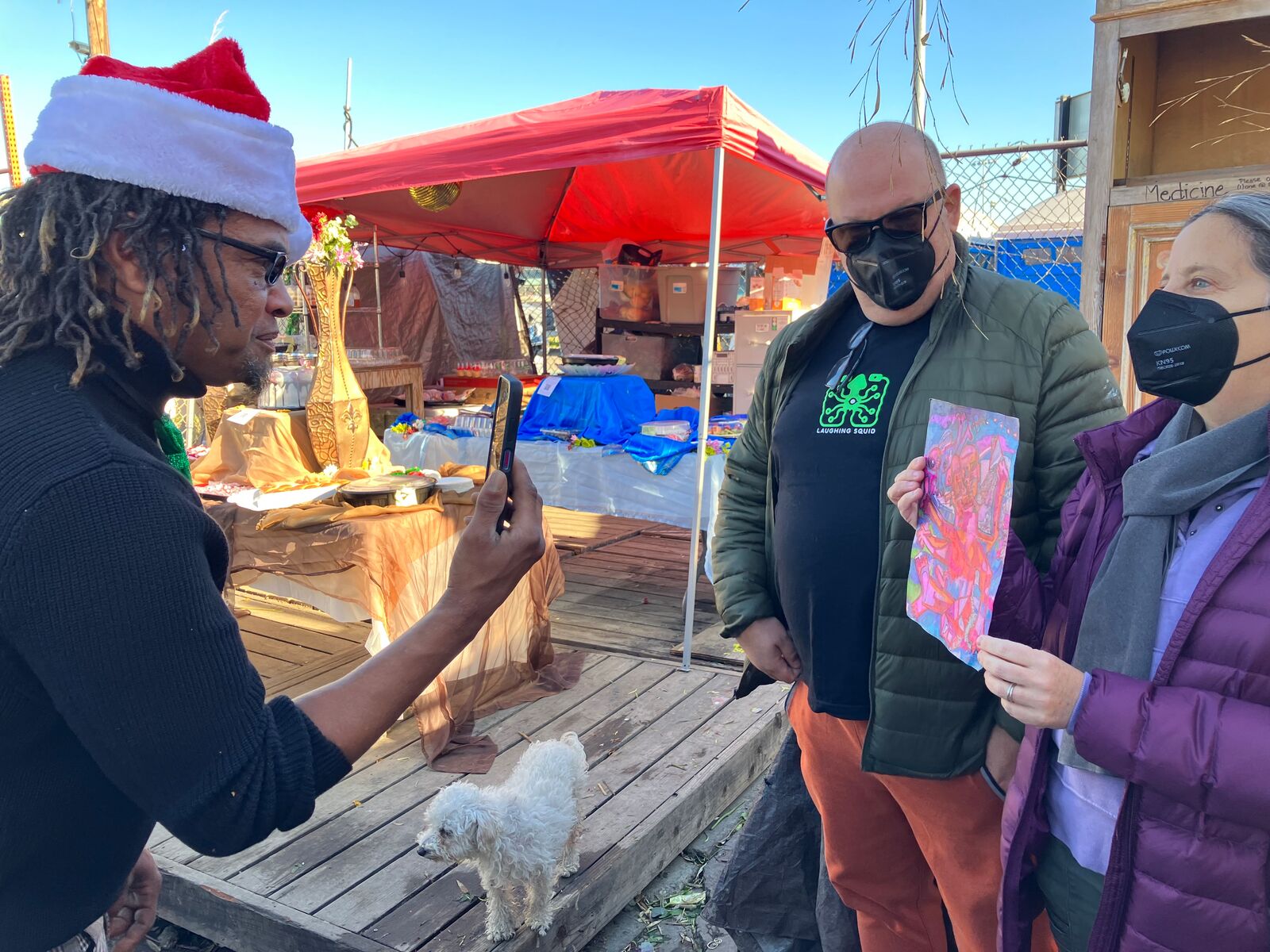 John Janosko, a central subject in “Wood Street,” filming attendees at the community’s Christmas party and art sale in December 2022. Credit: Natalie Orenstein/The Oaklandside
In filmmaking and journalism, “there’s a lot of this idea of ‘sharing both sides,’” said Creighton, a former producer for the San Francisco Chronicle. “But I think one side is often louder and more well-resourced than the other…So it felt important to tell the story differently than had been done in a lot of other homelessness films and reporting, which is really just showing the Wood Street community’s perspective.”
The immediacy, propelled by a drum-heavy score by Tyler Blomstrom Moore, is also intentional.
“I really wanted the people to feel the tension and anxiety that the Wood Street community felt as this process was happening,” Creighton said. She chose not to include any backstory for the subjects, both to avoid slowing down the natural momentum of the film, and because she believes “people don’t need to justify why they’ve become homeless.”
“Wood Street” depicts a group of people who’ve developed a deep-seated skepticism and sense of distrust after experiencing a torrent of broken promises and mistreatment by outsiders and authority figures.
But Janosko said it felt natural to let Creighton into their world, allowing her to capture everything from the beautiful to the messy, including sensitive and stigmatized topics like drug use and mental health crises.
“I don’t remember it taking too much for me personally to warm up, because I automatically realized that with her being there, this is a way to amplify our voices. This is a way to show what we’ve been talking about,” Janosko said.
Wood Street residents developed an elaborate system of supporting and feeding one another and honed a philosophy of collective self-determination. Some had detailed plans for building a self-sustaining campus on the property, complete with jobs and job training for residents. They hosted events, like the annual Christmas party shown briefly in the documentary.
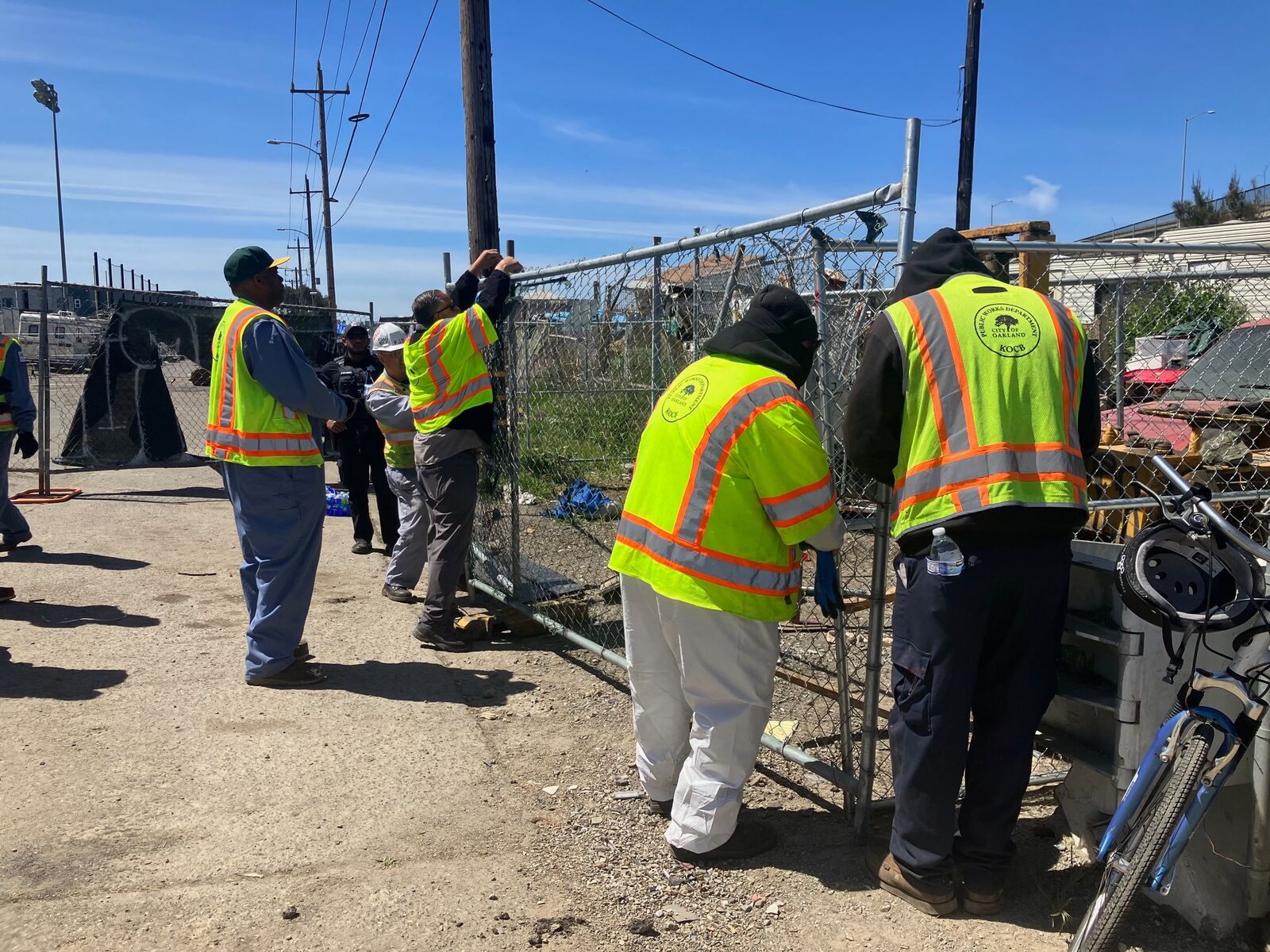 City work crews during the 2023 closure of the Wood Street encampment. Credit: Natalie Orenstein/The Oaklandside
“This land has held me, kept me, comforted me, kept me out of jail, kept me alive,” says Ford in the film.
To the city, county, and private property owners, it was a perpetual safety hazard. The Oakland Fire Department responded to hundreds of blazes on Wood Street over the years, including one that killed a man living in an RV.
In one difficult scene in the documentary, at a West Oakland community meeting, Ford tries to communicate that he and his unhoused neighbors have put out plenty of fires themselves. “I got off the beaten track, I did, but I’m trying,” he says.
A housed woman comes toward him, pointing a finger: “One of your buddies stole something,” she says.
Creighton decided to begin filming regularly on Wood Street after she reported on a virtual court hearing there in the summer of 2022. The unhoused community was seeking a restraining order against the California Department of Transportation, which wanted to clear out a portion of Wood Street at the time.
Creighton recalled hearing the judge’s voice drone out of laptop speakers as cars whizzed by on the highway. “It was this encampment of people taking the state to court,” she said. “I just thought it was so powerful, and it was something that I hadn’t personally seen before. I just knew there was a deeper story there.”
A central friction in the film develops between Janosko, who wants his friends to move together into the tiny-house shelter the city establishes during the sweep, and other residents, who want to try and stay put.
The interpersonal tensions culminate in a fight between the two men at the center of the film, Janosko and Ford, who are as close as brothers, according to the former.
Unexpectedly, this scene is one of Janosko’s favorites.
“It showed the boiling point of where we were at, and how triggered and emotional and angry we were at the situation overall,” he said.
While the film mostly treats the city of Oakland as an abstract entity hurdling toward Wood Street with bulldozers, politics is a key theme.
The Wood Street residents dress up and drive a bus to Mayor Sheng Thao’s inauguration in 2023.
They watch from the crowded room as Thao, who was once homeless herself, says she’ll tackle the city’s most persistent problems “the Oakland way — through unity.”
“Yeah!” shout the Wood Streeters, the optimism palpable on their smiling faces. Janosko debriefs on Instagram after, saying he’s hopeful they’ll be able to start “negotiations” with the administration over their future on the land soon. He and his friends had published a voter guide for homeless people, helped register voters, and had driven several to the polls to get out the vote for Thao.
But soon after the inauguration, the film shows Ford standing outside of City Hall in a suit jacket, calling the mayor’s office. He gets her assistant and isn’t let in. They never got that meeting with Thao, Janosko said.
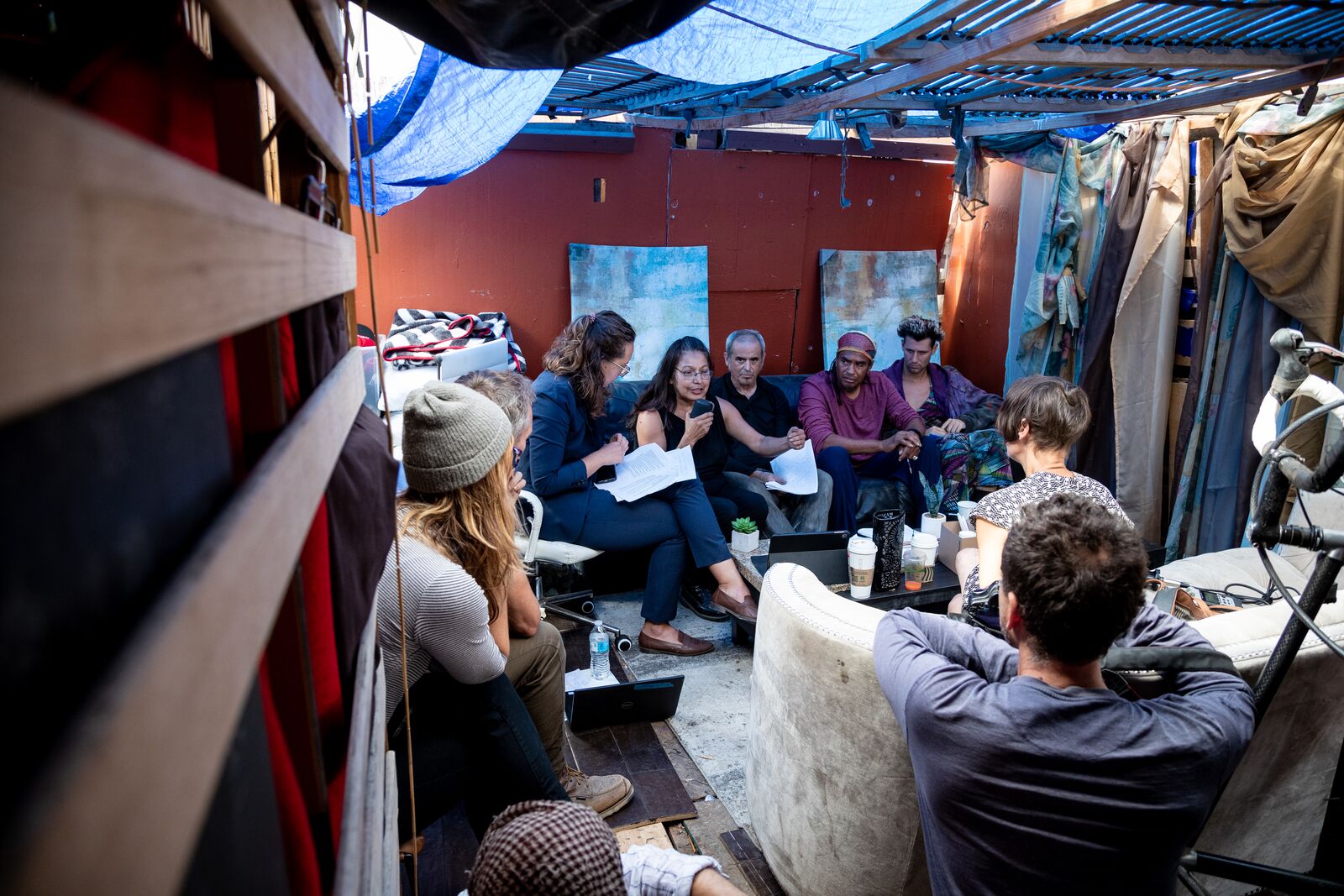 Wood Street residents and their lawyers speak at a virtual court hearing in 2022 — the event that inspired Creighton to film a documentary about the community. Credit: Amir Aziz/The Oaklandside
The statistics say Oakland is in a better position with homelessness than it was even when the film was shot. For the first time in recent memory, Oakland’s unhoused population decreased, by 20%, according to the latest biennial count. Mayor Barbara Lee opened a new office dedicated to homelessness. The city has built a lot more affordable housing, including projects reserved for people who are homeless.
(The completed affordable housing project on Wood Street, though, is for people making up to 80% of the area median income — $95,050 for an individual or $135,750 for a family of four.)
Janosko isn’t impressed.
“We’re surrounded by space everywhere that’s not being used,” he said. “I don’t have too much hope in politicians or the system or the way they do things.”
Janosko is now living in his own apartment, which he secured with assistance from the Homeless Action Center, he said. Wood Street Commons is now a nonprofit organization that advocates for the broader East Bay homeless community.
The film screened first at the Big Sky Documentary Film Festival in Missoula, Montana. Creighton was startled by how much people there related to such an Oakland film. After screenings, many viewers have shared moving personal stories brought to the surface by what they just watched.
The Bay Area film industry and community supported Creighton throughout the filming of her first-ever feature documentary. She was an SFFilm resident and a Bay Area Video Coalition fellow. She financed the project through grants, crowdfunding, and friends’ camerawork.
She’s planning to screen “Wood Street” in more locations, but one in particular tops her wishlist: the Ballers stadium at Raimondi Park across from Wood, or the team’s parking lot where many of the film subjects once lived.
“I think that’d be really powerful,” Creighton said, “to bring it back to the space where everything happened.”
Related stories

As Oakland closes its largest homeless camp, some residents resist, others move on
April 24, 2023April 24, 2023, 3:45 p.m.
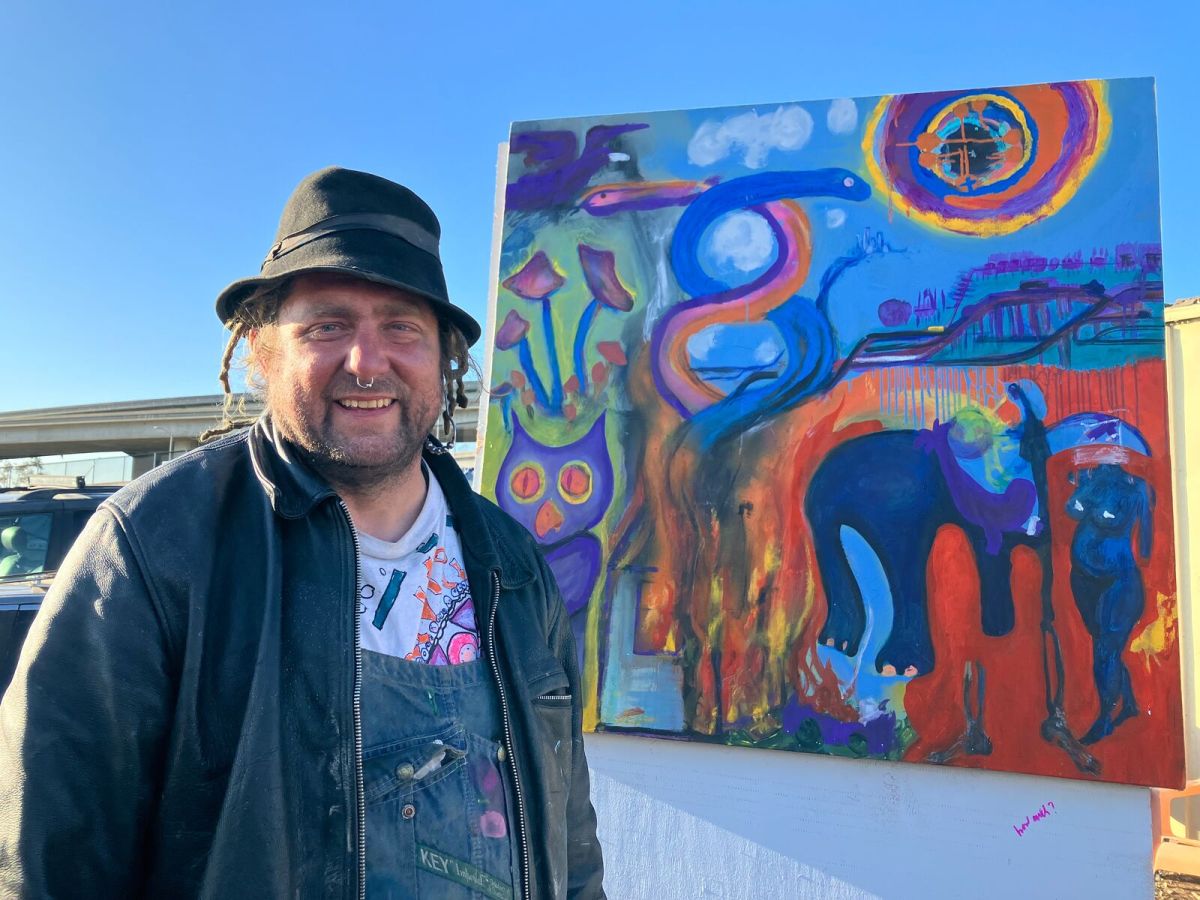
A lavish Christmas party caps a tumultuous year on Wood Street
December 19, 2022Dec. 19, 2022, 2:55 p.m.

Homelessness drops 20% in Oakland, marking the first decline in years
May 19, 2026May 19, 2026, 2:27 p.m.
“*” indicates required fields