
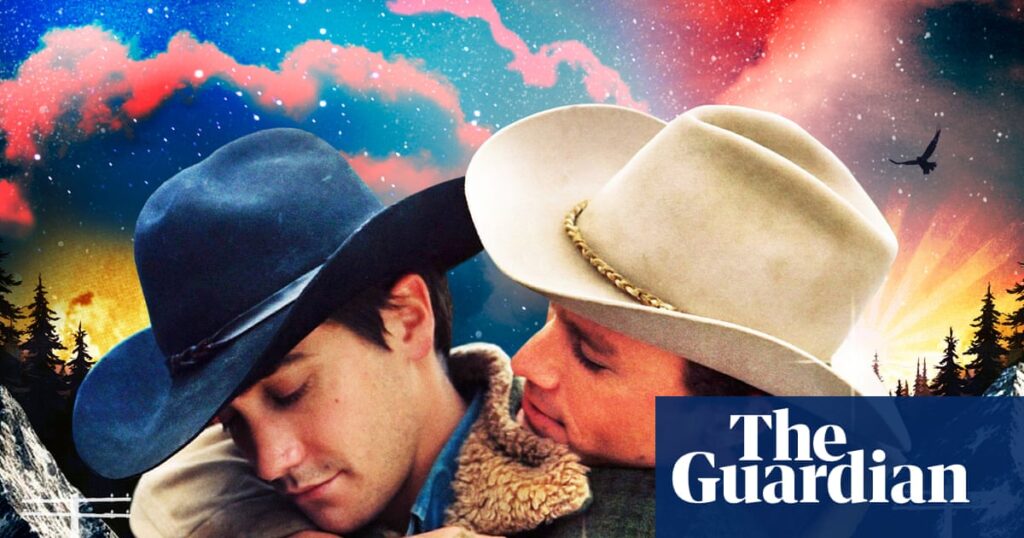
I was 14 years old the first time I saw two men kiss on screen. It was 2006, and my mum had rented Brokeback Mountain from our local Blockbuster. She said it was a “special” movie night for “just the two of us”.
For the next 134 minutes, I watched two sheep herders, Ennis Del Mar (Heath Ledger) and Jack Twist (Jake Gyllenhaal), fall in love in the beautiful Wyoming countryside, only for that love to be suffocated by rigid expectations of masculinity and self-contempt. The film culminates in Jack’s untimely death, and alludes to the possibility that he was the victim of a vicious homophobic hate crime.
When this desperately sad film finally finished, my mum turned to me and matter-of-factly asked: “Is there anything you want to say?” My whole body burned with shame as I shook my head and ran out of the room.
This was my mum’s well-intentioned but misguided attempt to coax me out of the closet. She was right: I am gay. When I eventually came out to my family, it was hardly a surprise. I was the boy who cried for three days when Geri left the Spice Girls and had a poster of Legolas in my room. What I tried so hard to suppress was really quite obvious. But it would be another six years before I said the words aloud to myself and others.
double quotation markIt was years until I returned to Brokeback Mountain. I wrote it off as a film I didn’t like to avoid my painful memories
In fact, watching Brokeback Mountain had the opposite effect to what my mum had intended. In it, Jack says to Ennis: “I wish I knew how to quit you.” The “you” for me at that time meant my attraction to men. I hated who I was so much that all I took from the film was that being gay meant one of two things: living a miserable life or death. I shrank further back into the closet.
Besides, a year earlier, Canada had legalised same-sex marriage, and the rhetoric around the decision had been toxic. At school, most of my peers were unsettlingly keen to make the case that it was “unnatural” and “wrong” for two men to get married. After that, I put a deadbolt and extra lock on my closet door. It took me a long time to shake my belief that I could not live and be loved as an out gay man.
I eventually sought out LGBTQ+ stories in TV, film and literature to expand my understanding of what life could be like. By the 2010s, the hard work of activists meant that it was increasingly common to see queer stories and characters in the mainstream. The TV series Glee showed me that it was possible to love out loud. The Harvey Milk biopic taught me the political value of visibility. Janet Mock’s memoir Redefining Realness, which tells her story growing up as a transgender woman in Hawaii, helped me understand what it means to be part of a community and to fight for others.
It would be years before I returned to Brokeback Mountain. I wrote it off as a film I just didn’t like, a flimsy deflection to avoid the painful memories of the person I was back then. That was until a friend brought me to a special Pride screening in 2018.
My second trip to Brokeback felt like a long overdue release. The opening notes of Gustavo Santaolalla’s haunting score filled my eyes with tears that would not stop flowing for the duration of the film. No longer a scared, shamed young boy, it almost felt as if I were watching for the first time. I could appreciate the film’s aching restraint, and the depth of denialism Ennis goes through to survive in small-town USA. I saw myself in Jack, the romantic dreamer, who wants a love that exists in more than just stolen moments.
skip past newsletter promotion
Sign up to Inside Saturday
The only way to get a look behind the scenes of the Saturday magazine. Sign up to get the inside story from our top writers as well as all the must-read articles and columns, delivered to your inbox every weekend.
after newsletter promotion
Brokeback Mountain is now one of my favourite films. I watch it at least once a year. I cried at the stage adaptation in London three years ago.
My mum would explain to me years later that she was willing to try anything to save her struggling son. Not every mum would do that for their queer child. So in a way, I’m grateful that she put on Brokeback Mountain all those years ago because it was her way of saying: “I love you for who you are.” I just couldn’t hear it at the time – but I do now.
Share your cultural awakenings
You can tell us how a cultural moment has prompted you to make a major life change by filling in the form below or emailing us on cultural.awakening@theguardian.com.
Your responses, which can be anonymous, are secure as the form is encrypted and only the Guardian has access to your contributions. We will only use the data you provide us for the purpose of the feature and we will delete any personal data when we no longer require it for this purpose. For alternative ways to get in touch securely please see our tips guide.Show more