
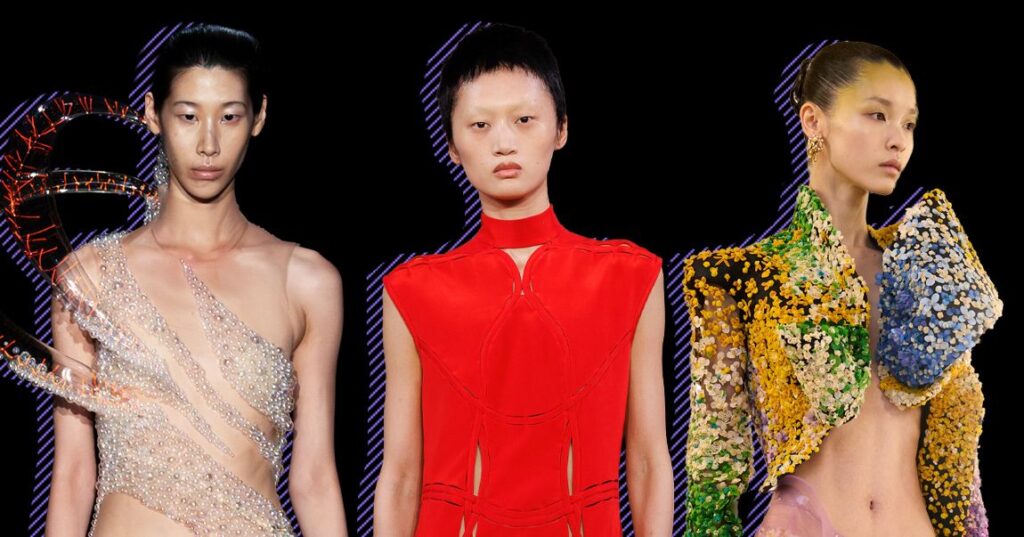
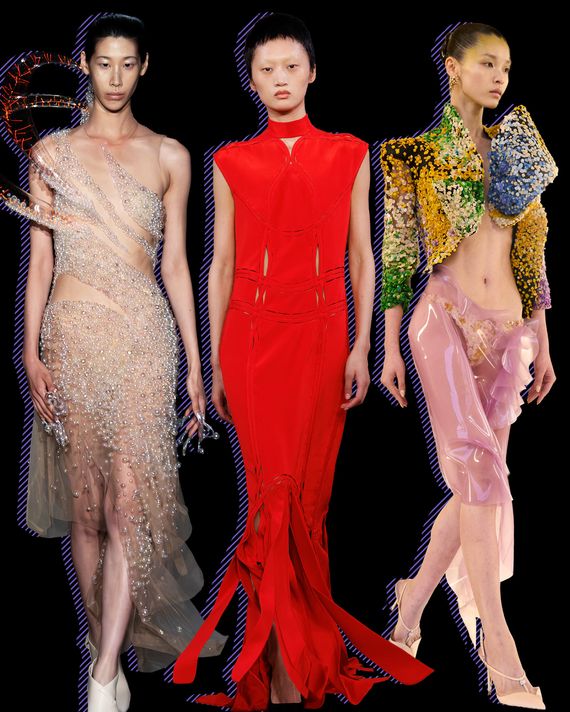
Photo-Illustration: by The Cut; Photos: Courtesy of Iris Van Herpen, Standing Ground, Schiaparelli
Listen to fashion critic-at-large Cathy Horyn read her review.
Daniel Roseberry’s corseted bodies for Schiaparelli have influenced public tastes about feminine fashion, but is the look modern or just something fun to gawk at on Instagram? And can the look ever be both? That was a question lingering over the fall haute couture shows, now underway in Paris.
Roseberry opened his show on a mirrored runway with daylight streaming in through the windows of the Petit Palais, an art museum, and I was glad to see him out of the annoying darkness that sometimes captivates him. His last two collections, for couture and ready-to-wear, were presented in semi-darkness, with special lighting, and it always makes me think I’m in a casino. Nothing is quite real. Roseberry is also using a lighter hand, which is even more welcome. His January couture collection, you may remember (or not), featured a jacket with animal horns poking out from the breasts and another costume with a scorpion tail at the back. Like most gimmicks, the animal parts quickly become a bore.
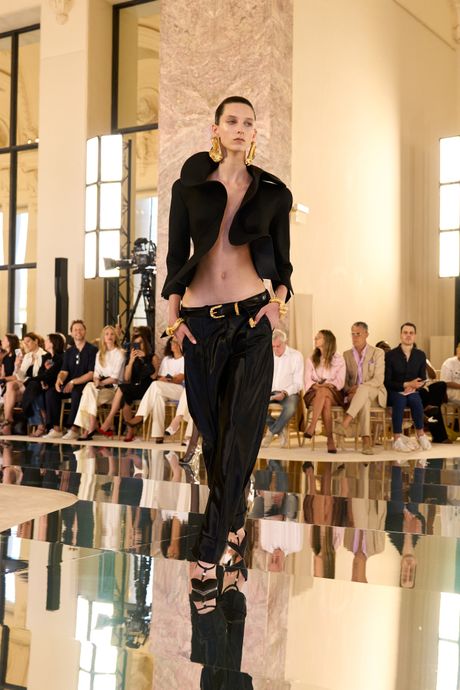
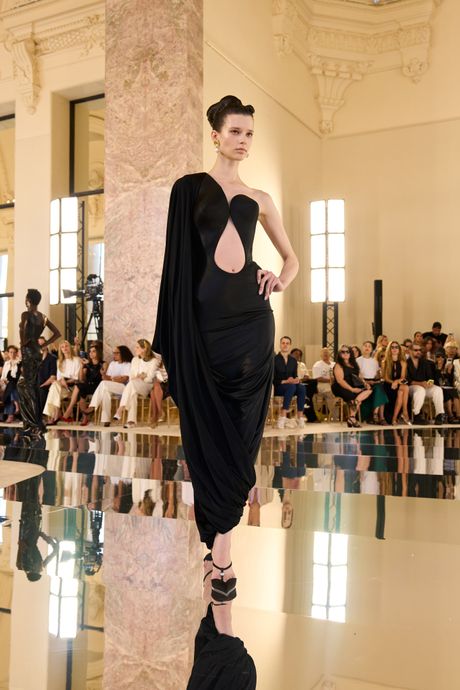
Roseberry’s first looks indicated a new direction. He described a lean black dress with a plunging, squared-off neckline as an “Azzedine kind of thing” — meaning the strict French form of the late Azzedine Alaïa, a look that was silhouette-driven and that is stamped on every fashion lover’s brain. Just as interesting was a sculptural black jacket that looked as light and delicate as a leaf on the body, and a pair of low-rise pants in a bias-cut cotton-and-linen blend. Roseberry said he used his own jeans as the model for the trousers. They don’t quite qualify as “everyday,” the way that look has worked so well for Matthieu Blazy at Chanel, but it’s great to see Roseberry relax his grip on ultrafancy clothes.
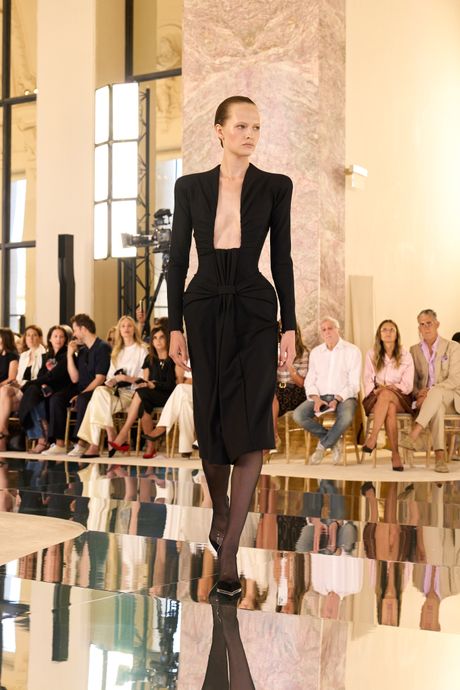
Schiaparelli From left: Photo: Filippo Fior / Gorunway.com / Courtesy of SchiaparelliPhoto: Filippo Fior / Gorunway.com / Courtesy of Schiaparelli
Schiaparelli From top: Photo: Filippo Fior / Gorunway.com / Courtesy of SchiaparelliPhoto: Filippo Fior / Gorunway.com / Courtesy of Schiaparelli
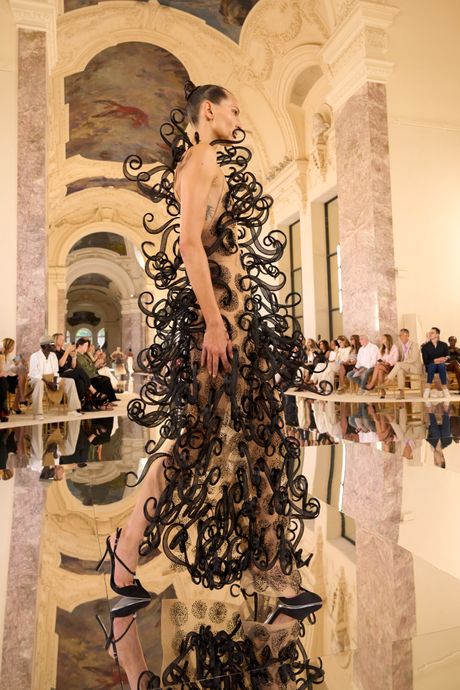
Two other styles that I adored in this collection, because they marked a shift, included a long sheer dress in a flesh-tone fabric covered with quivering black tentacles. Roseberry joked that they were the ends of the artist Salvador Dalí’s mustache, and that’s a fine Surrealist joke. The other look was a superbly draped black jersey dress with a molded, deeply cut out bodice that just barely echoed the minimalist glamour of Halston. Roseberry knows his stuff, but he’s not derivative. From the back, you could see the corset lacing. To me, the dress is a great example of how that style can be both new and modern and pure entertainment.
Schiaparelli From left: Photo: Isidore Montag / Gorunway / Courtesy of SchiaparelliPhoto: Filippo Fior / Gorunway.com / Courtesy of Schiaparelli
Schiaparelli From top: Photo: Isidore Montag / Gorunway / Courtesy of SchiaparelliPhoto: Filippo Fior / Gorunway.com / Courtesy of Schiaparelli
Roseberry seems conscious of his social-media audience. He told me, “When you’re designing for the people in the industry, it becomes very claustrophobic. We are the strongest when we’re designing for students and other people, when we’re vibrating on that level.” That approach carries its own obligations. Many of his molded bustier shapes didn’t produce a sense of wonder; you don’t feel anything looking at them.
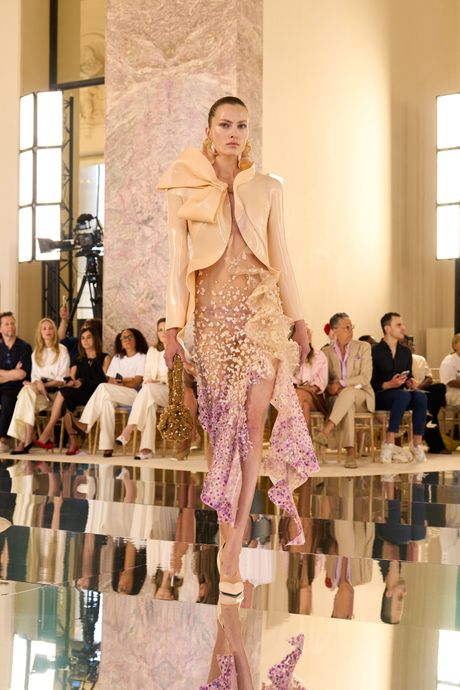
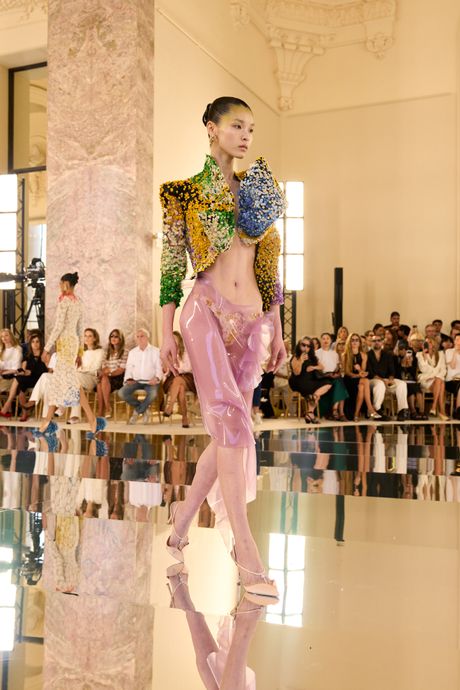
But when Roseberry strips things back a bit and uses a lighter hand, he starts to get some novelty, in particular with a delicate nude-beige jacket made from poured silicone — and treated like silk — and shown with a wispy dress in tulle embroidered with tiny hand-painted flowers, mostly in lavender. Roseberry used flocks of real flowers — specially dried to retain a softness — on clothes, shoes, and bags. Sometimes they were embroidered with velvet ribbon. It was extremely effective, both for the color and the freshness of the embellishment.
Schiaparelli From left: Photo: Filippo Fior / Gorunway.com / Courtesy of SchiaparelliPhoto: Filippo Fior / Gorunway.com / Courtesy of Schiaparelli
Schiaparelli From top: Photo: Filippo Fior / Gorunway.com / Courtesy of SchiaparelliPhoto: Filippo Fior / Gorunway.com / Courtesy of Schiaparelli
As for the silicone, which he used for a white fitted dress that was almost entirely fringed, it came from a workshop that produces photo-realistic infants for the movies. How did the movie-baby-makers like working with a world-class couture house? “They were so into it,” Roseberry said. “And they were all, like, under 35.” Apparently, visitors to the workshop enter through a pair of giant, outstretched legs, with an expandable vagina in the center. This stuff isn’t deep.
Michael Stewart is an independent designer based in London with a label called Standing Ground that has become a kind of cult favorite, partly for his signature technique of entrapping hundreds of tiny beads in channels on dresses and coats. It’s an anti-approach to rich adornment. A recent recipient of an LVMH Prize, Stewart has long wanted to show at Paris couture, and he finally did on Monday at the Irish Embassy. The other day he said, recalling the effort to put on a show, “You know what? If I don’t do this, it’s just going to disintegrate to nothing. So I’ve been able to sort of lily-pad across the Channel.” He added that, to his many custom clients, being part of couture is important. “It’s like the stamp of approval.” He’s absolutely right about that.
He showed many of his bead-entrapped styles, notably a long coat in the palest dove gray with a clerical collar. They were all beautifully done, but I was more into the softer things, like a deep-brown dress in draped georgette, a red dress with tiny vented openings, and the closing look, a handmade lace dress with a long, trailing skirt, quite romantic. (It was the work of lacemakers in Carrickmacross, Ireland, and it arrived about two days before the show.)
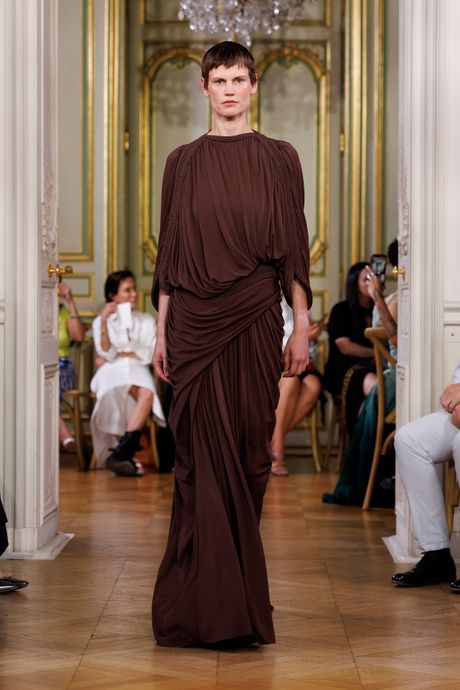
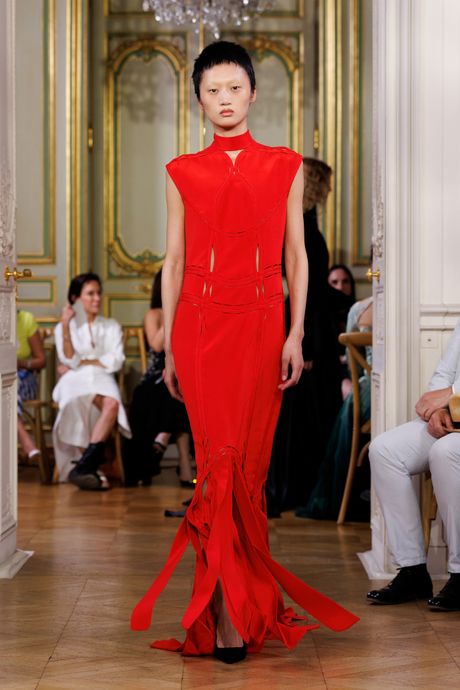
Standing Ground From left: Photo: Ik Aldama/Courtesy of Standing GroundPhoto: Ik Aldama/Courtesy of Standing Ground
Standing Ground From top: Photo: Ik Aldama/Courtesy of Standing GroundPhoto: Ik Aldama/Courtesy of Standing Ground
New from Stewart were corseted bodies, and he was helped by Mr. Pearl, a well-known corset-maker. They were well done, but, honestly, I missed the lightness and street edge of Stewart’s previous show in London. Just because a collection is “couture” doesn’t mean it has to be stiff and imposingly elegant.
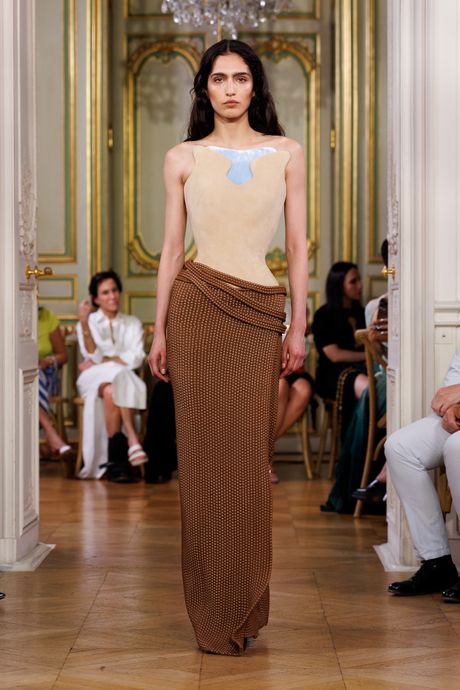
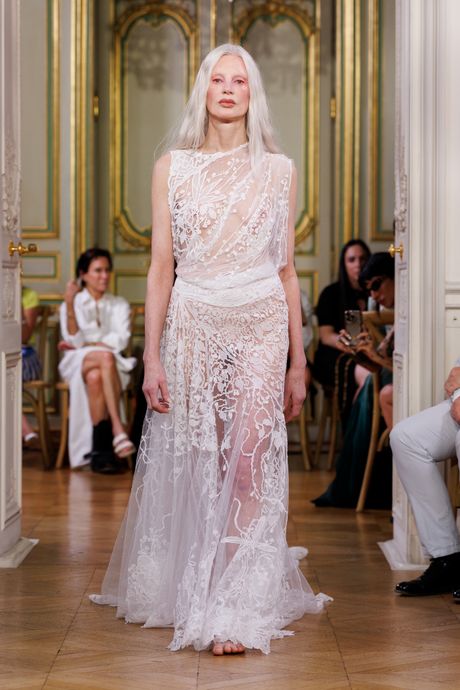
Standing Ground From left: Photo: Ik Aldama/Courtesy of Standing GroundPhoto: Ik Aldama/Courtesy of Standing Ground
Standing Ground From top: Photo: Ik Aldama/Courtesy of Standing GroundPhoto: Ik Aldama/Courtesy of Standing Ground
Iris van Herpen called her collection Sonic Starquakes, and for it she wanted to harness the energy of plasma and lightning. Sound preposterous? Not really, if you’re van Herpen. She worked with scientists to create those effects in clothes, including one sliver of a dress embroidered with thousands of tiny glass balls (avoid sitting) and tubes circling the collarbone that glowed with plasma. She also had some amazingly innovative fabrics, including a Japanese polyester that weighs about five grams per meter. Basically, it just flows through your hands.
But while her investigations were new, I didn’t feel the same about her shapes. They felt a bit stale, and that’s not a planet you want to remain on.
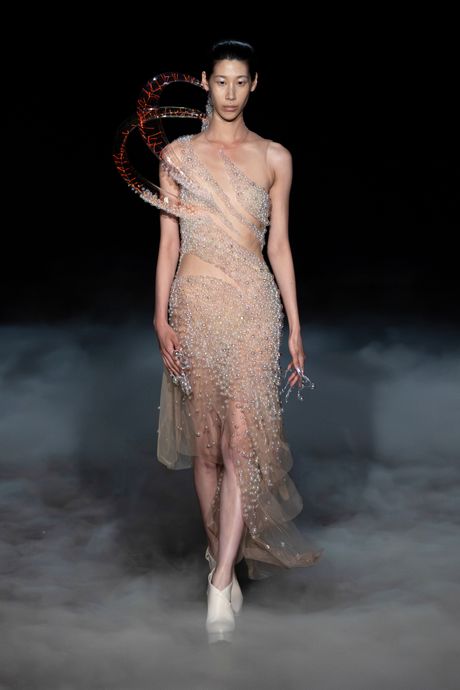
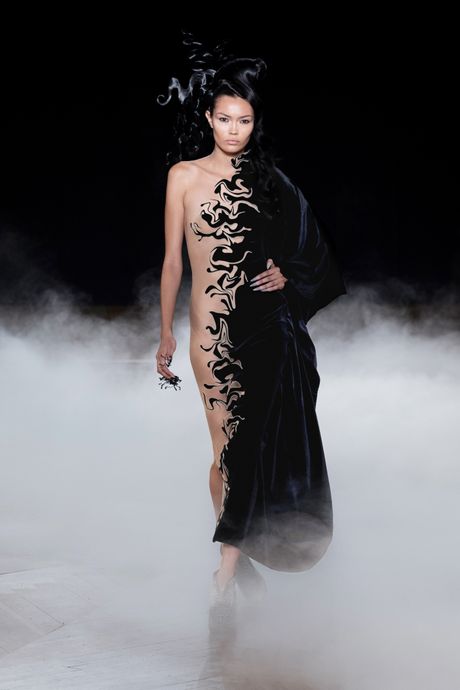
Iris van Herpen From left: Photo: IK ALDAMA/Courtesy of Iris Van HerpenPhoto: IK ALDAMA/Courtesy of Iris Van Herpen
Iris van Herpen From top: Photo: IK ALDAMA/Courtesy of Iris Van HerpenPhoto: IK ALDAMA/Courtesy of Iris Van Herpen
See All