
Photo-Illustration: Vulture; Photos: Disney, Everett Collection
Once upon a time, Disney’s live-action Moana movie seemed like the surest of box-office bets. Exerting an appeal as broad and wide as the tattooed torso of Maui — the vainglorious demigod character voiced by the Rock — the original animated version of the Polynesian princess adventure took in $643 million a decade ago and teed up a billion-dollar worldwide haul for 2024’s Moana 2. Hence, the Mouse House’s assuredness in green-lighting a $250 million production budget (plus an additional $150 million-ish marketing spend) for a beat-for-beat adaptation of the original with Dwayne Johnson now appearing in the flesh in a flowing wig and 40-pound prosthetic bodysuit.
But over its three opening days in theaters, the update wiped out. Grossing a mere $43 million in 3,875 North American theaters, director Thomas Kail’s Moana undershot even the most pessimistic prerelease “tracking” estimates (which were in the $60 million to $65 million range last week) — estimates that had themselves been downgraded from predictions of up to $130 million a month ago.
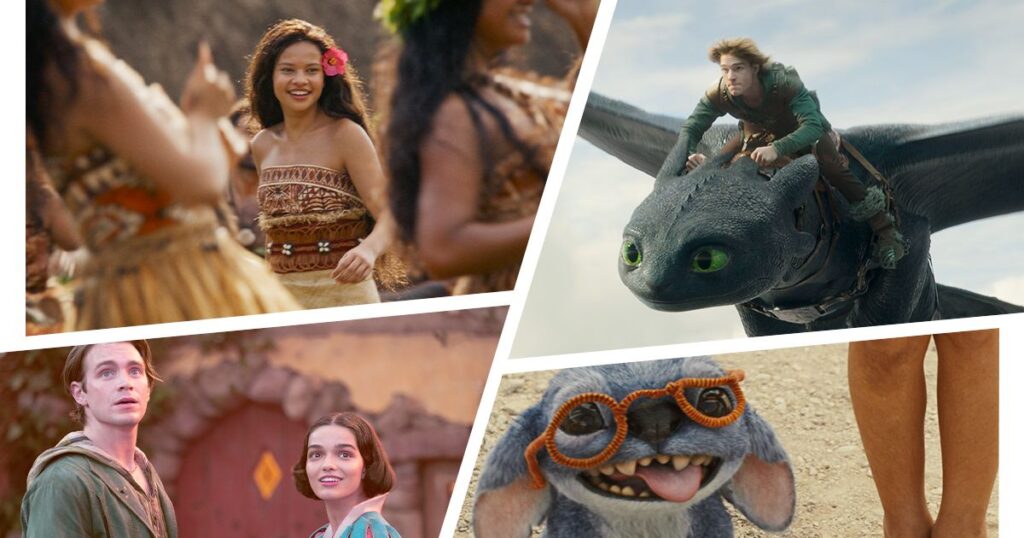
Even while the movie sits at an ignominious 31 percent on the Tomatometer, as Vulture’s Alison Willmore points out in her review, “Moana isn’t the worst of the live-action Disney remakes, or the ugliest, but it’s the fastest in terms of the amount of time that has elapsed since the original, which is its own extra-depressing stat.” Arriving almost exactly one year after Disney’s “ruthlessly faithful” live-action Lilo & Stitch remake harvested over $1 billion in torn tickets, such cash-grab do-overs have become a fact of life in IP-crazy Hollywood. But in light of Disney’s other megabudget 2025 live-action reimagining — the Rachel Zegler–starring Snow White, which carried a $450 million production budget and resulted in a $170 million net loss for Disney — it’s worth reiterating: These things don’t always work out.
With Disney serving as popular culture’s foremost purveyor of such retreads, the formula for what makes a live-action remake hit or miss with audiences could hardly seem less formulaic. To wit, in 2019, director Tim Burton’s megabudget Dumbo redo arrived as an elephant-size belly flop, while just two months later, Aladdin (which features a top-knotted Will Smith in place of Robin Williams’s fast-talking genie character) grossed $1.05 billion worldwide.
“I think the surprise is, Moana didn’t pass the what-else-have-you-got-for-me test,” says Scott Mendelson, Puck News’ box-office analyst who writes the industry newsletter The Outside Scoop. “Dwayne Johnson: he’s Maui in live-action. Is that different than Maui in animation? No. So what else have you got for me?”
“When they started doing this type of movie about 15 years ago — Alice in Wonderland, Oz the Great and Powerful, Maleficent, take your pick — these films were interesting and at least worthy of attention,” he continues. “You had generational nostalgia. But by 2016, people like me are ripping their hair out in panic. Realizing that, ‘Oh my God, studio programmers are just bopping these things in one after another!’ What we see is fewer and fewer event movies.”
Despite surfing to the top box-office spot over its debut, Moana only narrowly out-paddled becoming the lowest-grossing live-action remake of all time. That distinction of dishonor is still held by Snow White ($42 million). But Moana managed to undershoot expectations without the Zegler “Fuck Donald Trump” fracas on social media, which dominated that film’s prerelease awareness. Overseas, the Polynesian princess tale also beached on the rocky shoals of flopdom, grossing just $52 million for a $95 million global “cume.”
Easy enough to forget, then, that for every Speed Racer — the Wachowski siblings’ 2008 anime adaptation that cost $120 million, grossed a disappointing $93 million and seemingly cured Warner Bros. of its live-action remake ambitions — there is a Jungle Book ($967 million on a $175 million production budget). For every Little Mermaid (starring Halle Bailey and a bunch of poorly rendered CG sea creatures — it hovered around break-even despite grossing $569 million), Hollywood pumps out at least one Maleficent. (Critics largely hated the 2014 Sleeping Beauty spinoff, but peak Brangelina-era Angelina Jolie’s star turn in conjunction with the movie’s newly sympathetic take on an evil queen resulted in a $758 million bite of the box-office apple.) “Why did Snow White bomb and Lilo & Stitch work?” says Mendelson. “I will argue it’s because people of movie-buying age actually gave a damn about the original Lilo & Stich.”
And with respect to Maleficent, one of the only through lines of profitability for Disney’s live-action remakes is that those based on titles released during Jeffrey Katzenberg’s 1984 to 1994 tenure as studio chairman — Beauty and the Beast, Aladdin, and The Lion King chief among them — tend to make way more money than retreads of classic Disney cartoons (Disney+’s 2019 streaming-only Lady and the Tramp, Dumbo, and Kenneth Branagh’s Cinderella).
As seemingly scattershot as the box-office yields for these films can be, don’t expect live-action remakes of classic animation to turn into a pumpkin anytime soon. A photo-real remake of 2010’s Tangled is scheduled to make theatrical landfall in 2028 and already has fans of the original animated Rapunzel tale’s knickers in a twist. (At issue: Leaked set photos indicate the color of certain banners within the film’s island kingdom of Corona that were purple and gold in the original have been — gasp! — updated to blue and yellow.) Perhaps inevitably, Lilo & Stitch 2 is also in the offing for 2028. And while live-action adaptations of Bambi, The Aristocats (reportedly to be directed by Questlove), and a computer-animated, photorealistic take on Robin Hood were quietly canceled, Disney is moving ahead with filmed reboots of The Hunchback of Notre Dame and Aladdin 2.
The real stakes of success for the live-action-version-of-classic-animation industrial complex were thrown into stark relief in May 2025 with the grand opening of the How to Train Your Dragon — Island of Berk theme-park ride in Universal Orlando’s Epic Universe park. As an animated franchise, How to Train Your Dragon has shown admirable profitability and cultural staying power. Its three installments grossed a cumulative $1.63 billion between 2010 and 2019 for three different studios (respectively, Paramount, 20th Century Fox, and Universal, though DreamWorks produced all of the movies).
Universal held on to the IP rights after hitting profitability with How to Train Your Dragon: The Hidden World and hired original HTTYD co-writer and director Dean DeBlois to concoct a nearly shot-for-shot live-action remake of the first film, blending live action and computer-generated imagery. But in an outward show of IP confidence with almost no Hollywood precedent, Universal’s corporate overseers decided to allocate theme-park real estate for How to Train Your Dragon in Epic Universe. It would coexist alongside attractions based on other certified blockbusters: Super Nintendo World (homeland of Super Mario Bros.) and the Wizarding World of Harry Potter — Ministry of Magic. HTTYD experiences including Hiccup’s Wing Gliders, Fyre Drill, and Viking Training Camp would be open to the public in May 2025, just weeks ahead of the release of the live-action How to Train Your Dragon. And if DeBlois’s new movie flopped, the rides would stand as multimillion-dollar monuments to corporate hubris and Hollywood greed.
Instead, the live-action How to Train Your Dragon pulled in $636.5 million worldwide. “You had the director of the cartoons, so you could sort of sell this as auteur-driven,” Mendelson says. “The guy who created the franchise, for all intents and purposes, is now helming the live-action version, which gives it a certain pedigree. It got pretty good reviews. It passed the what-else-have-you-got-for-me test.”
Sign up for the Vulture Daily
An entertainment newsletter for the pop-culture obsessed.
Vox Media, LLC Terms and Privacy Notice
Related