
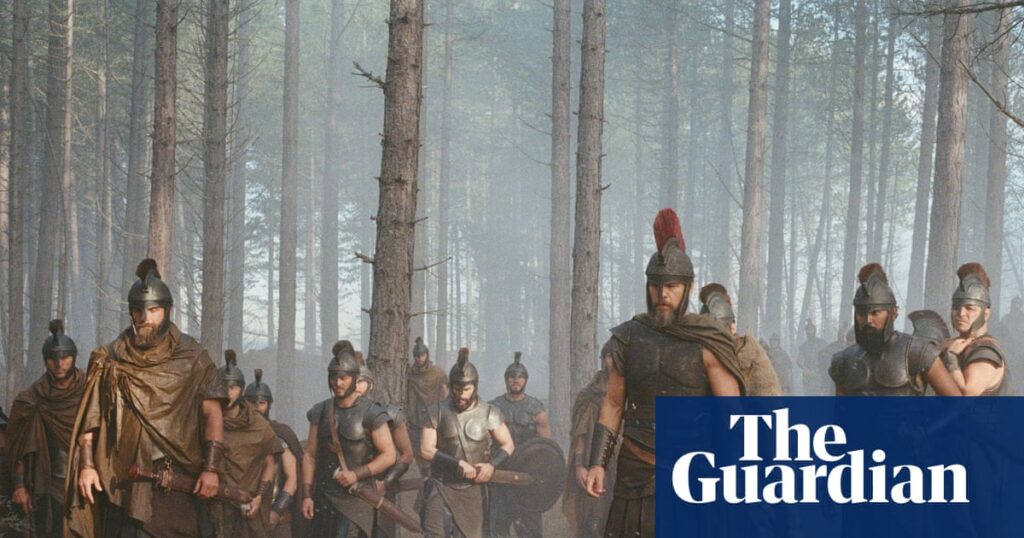
Christopher Nolan’s $250m Imax blockbuster version of Homer’s epic poem the Odyssey looks set to be among the director’s best-received of his career, and could be a frontrunner for next year’s best picture Oscar.
The Guardian’s Peter Bradshaw was among the vast majority of critics who awarded it five stars, calling it a film “with thrilling ambition, boldness, seriousness, generosity and flair. There are some broad-brush moments in the dialogue, yes, but even these are applied with a muscular flourish.”
In the Independent, Clarisse Loughrey said the film was “Nolan’s best work to date” and “deserves to be the film that defines him”, while the Telegraph’s Robbie Collin called it “a strange, fearsome and trailblazing machine of a movie – by some distance, the best of the year so far”.
The Times’s Kevin Maher called the film “a masterpiece in every way”. He added: “There is a palpable yearning for primal storytelling and a need for art that can inform and instruct as well as entertain. Nolan has done it. This is the artwork.”
Meanwhile, New York Times critic Manohla Dargis said she could discern Nolan’s passion for cinema “in every frame of his monumental adaptation”, calling it “one of the most Nolan of Nolan spectacles in its thematic concerns, formal playfulness, kinetic thrills and unabashed showmanship”.
‘One of the most Nolan of Nolan spectacles’ … The Odyssey. Photograph: Melinda Sue Gordon/Universal Pictures
“Nolan asks us to dream bigger,” she added. “His Odyssey is a classic in every sense, a transporting affirmation of the art and a work of pure cinema.”
Guy Lodge, chief critic of US industry magazine Variety was almost entirely enthusiastic, writing that, as “a genuinely grand, gutsy vision, The Odyssey thrills generously for the bulk of its near three-hour running time: every few minutes, it seems, it throws at its audience another mighty set piece that, in almost any other summer studio spectacle, would be a climactic standout.
“The Odyssey is a veritable banquet, then, of such loud, grandiose, movie-movie pleasures, so brashly, confidently lavish that it can afford to throw away a significant portion of its all-star cast on lily-gilding cameos.”
He continued: “There’s so much to feel here at a sensory level that the film gets away with its slightly aloof, soul-skirting chill; we leave it feeling that we’ve been to hell and back, and exhilaratingly so.”
double quotation markNolan asks us to dream bigger … his Odyssey is a classic in every senseManohla Dargis, New York Times
Lodge’s faint note of criticism was echoed by his opposite number at the Hollywood Reporter, David Rooney, who suggested the scenes involving Matt Damon’s Odysseus and Charlize Theron’s Calypso conversing on a beach were “dull interludes” that “stop the narrative dead in its tracks, recalling Sean Penn’s purgatorial wanderings in Malick’s The Tree of Life”.
Rooney also called the film “structurally clumsy”, questioned the casting of Tom Holland as Damon’s son, and said he “winced at anachronistic language like Penelope telling her rowdy suitors, ‘I’ve listened to you party’, or Telemachus referring to his father as ‘dad’”.
Such anachronistic language did not trouble classicist Mary Beard, however, who called it a “brisk, pacy and contemporary film, with no dreadful cod-epic language” and praised Nolan for providing what she felt would be for many people “a great introduction to Homer”.
Anachronistic? … Anne Hathaway as Penelope and Tom Holland as Telemachus in The Odyssey. Photograph: Melinda Sue Gordon/Universal Pictures
Writing in the Times, Beard did take issue with the “one-dimensional, single-minded, even [more] stolid” characterisation of the leading man, with little of the “tricksiness” and propensity for humour or yarn-spinning of Homer’s hero.
Beard also expressed disappointment that at least two key female characters had been cut, and the agency of others removed, saying: “This is an Odyssey without the sex.”
Writing in the Guardian, the classicist Emily Hauser was likewise dismayed by some of Nolan’s omissions and alterations, suggesting that the director’s decision to centre a modern-day hero left little airtime for either women or nuance.
“Nolan inexcusably turns Penelope into the executor of her enslaved woman, Melantho, and has Penelope actually push her into the slaughter,” writes Hauser, adding that “what this Odyssey offers us, by way of a hero and the grandiloquent experience of epic cinema, is a man who seeks redemption and solidarity among men, recognition from women, and absolution for a civilisation’s fall. Make of that, in the current climate, what you will.”