
Photo-Illustration: Vuture; Photos: Everett Collection (Warner Bros., Paramount, Universal)
Warning: Light spoilers ahead for The Odyssey.
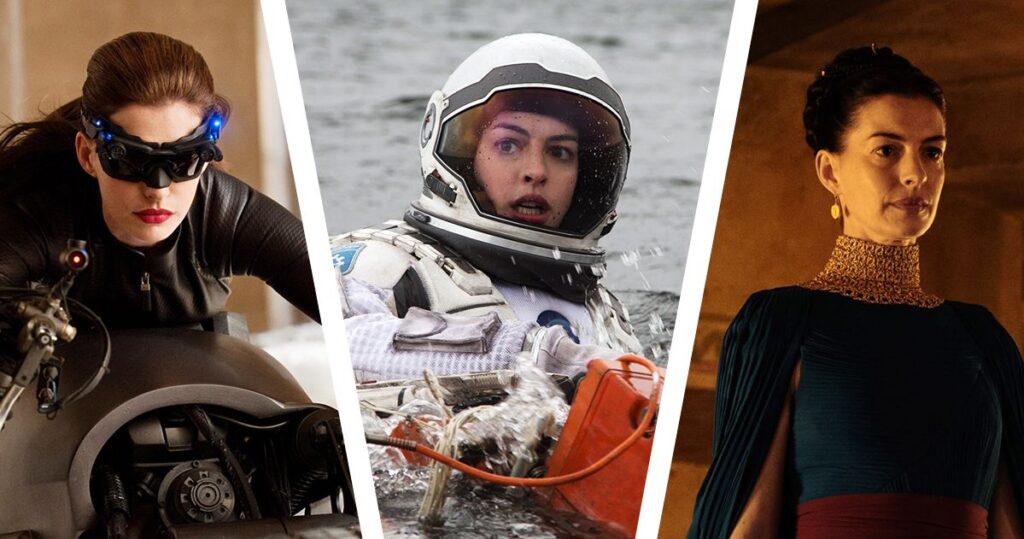
The ending of Christopher Nolan’s The Dark Knight Rises lives rent-free, as they say, in the back of my mind — one of the director’s finest “where are they now”–type of montages that so often conclude his films. With Batman presumed dead, Wayne Manor becomes an orphanage; noble cop John Blake (Joseph Gordon-Levitt), whose real name is Robin, inherits the Batcave; and Alfred (Michael Caine) goes off to Florence to enjoy a nice Fernet Branca at an outdoor café. Alfred looks up from his digestif to see the very much not dead Bruce Wayne (Christian Bale) sitting across the table from Selina Kyle (Anne Hathaway). Hathaway’s side profile, looking around and smiling at strangers, is the film’s ultimate symbol of peace: No longer having to be Batman means that you can hang out with her forever.
The Dark Knight Rises was Nolan’s first collaboration with Hathaway, who went on to appear in Interstellar and now stars in The Odyssey as Penelope, one of her finest roles to date, and if there’s anything that unites her three performances across these quite different films, it’s that each of them ends with its male hero forsaking a civilization in favor of traveling with her to the ends of the universe. Sometimes, the end of that universe is literally just going to Florence, Italy, but in Interstellar, Matthew McConaughey’s Coop goes back out into the galaxies in order to help Hathaway’s Amelia Brand populate a desolate new planet upon which humankind may one day survive. In The Odyssey, Matt Damon’s Odysseus and his wife, Penelope, leave Ithaca in the hands of their capable son Telemachus (Tom Holland) in order to sail off into the distance once again, where Odysseus plans to return to Hades in order to reckon with the violence he’s wrought in an attempt to come home. In all three films, she is a tether to a world that can be good at some point, if only she’s granted the grace to help or lead or rule.
In The Odyssey, Odysseus and Penelope’s abandonment of Ithaca represents a rejection of duty and obligation in a bureaucratic sense; they turn inward to prioritize their relationship to each other and to those they’ve wronged. It is, as the director called it, something of a middle-age love story in this way. As much as any of these three Nolan films have happy endings (bittersweet as they are), they do because of Hathaway’s stronghold on a sense of goodness. Even when she’s playing a burglar.
Sign up for the Vulture Daily
An entertainment newsletter for the pop-culture obsessed.
Vox Media, LLC Terms and Privacy Notice
Related